

LLM Citation Optimization: How to Get Cited by AI Systems
- October 10, 2024
- LLM Citation Optimization, AI and Search
AI Summary
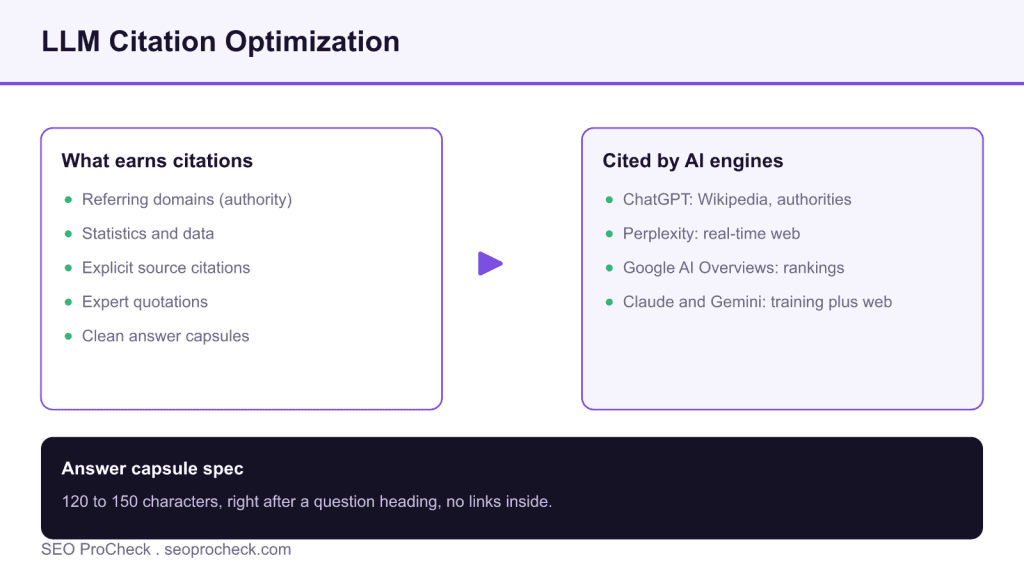
To get cited by AI systems, combine traditional authority (referring domains, brand recognition) with citation friendly structure: sourced statistics, expert quotes, and clean answer capsules of 120 to 150 characters placed after question headings. Different engines weight these signals differently, so a page that combines authority with clear structure gets cited most widely.
- Referring domain count is the strongest predictor of citation frequency (SE Ranking, 129,000 domains).
- Answer capsules of 120 to 150 characters after question headings appear in 72% of cited content.
- Statistics, explicit source citations, and expert quotes all raise citation likelihood.
- ChatGPT favors authorities and the Bing index, Perplexity favors fresh web content, AI Overviews tracks rankings.

Being cited by Large Language Models (LLMs) like ChatGPT, Claude, and Gemini has become a new form of organic visibility. When these systems reference your content as a source, you gain both credibility and potential traffic. This guide covers practical approaches to increasing your citation frequency.
Understanding How LLMs Select Sources
LLMs don't search the web in real-time for most queries (except when using tools like web search). They draw on training data that includes web content indexed before their cutoff dates. For systems with web search capabilities, they query search engines and synthesize results, choosing which sources to cite based on authority, relevance, and content quality.
Research from SE Ranking analyzing 129,000 domains found that referring domain count was the strongest predictor of citation frequency. Sites with over 32,000 referring domains saw citations nearly double. This suggests that traditional authority building through link acquisition translates to LLM visibility.
Content Characteristics That Earn Citations
The Princeton GEO study identified specific content characteristics that increase citation likelihood. Adding statistics and quantitative data improved visibility by 30-40%. Including explicit source citations within your content boosted citation rates. Content with quotations from experts outperformed content without.
Structure matters significantly. Research shows "answer capsules" of 120-150 characters placed after question-based headings appear in 72% of cited content. These concise, direct answers are easily extractable by AI systems. Interestingly, answer capsules containing links performed worse than those without; keep your citable passages clean.
Authority Signals for LLMs
Traditional E-E-A-T signals translate to LLM citation. Author expertise, site reputation, and topical authority all influence citation selection. Sites consistently publishing quality content on specific topics build the kind of authority that AI systems recognize.
Brand recognition matters. Research shows branded search volume correlates with non-branded visibility in both traditional and AI search. Building genuine brand awareness through PR, industry participation, and consistent quality creates citation opportunities.
Platform-Specific Considerations
Different AI platforms show different citation preferences. ChatGPT favors Wikipedia and established authoritative sources heavily. Perplexity draws from real-time web content and shows more diversity in citations. Google AI Overviews correlates more closely with traditional search rankings. Optimizing for each platform may require slightly different approaches.
Practical Implementation
Audit existing content for citation potential. Does it contain specific statistics with sources? Are there clear, extractable answer passages? Is expertise demonstrated through author credentials and content depth? Update high-potential content to include citation-worthy elements.
Create new content designed for citation. Target questions your audience asks. Provide direct, factual answers. Include original data or synthesize existing research with proper attribution. Structure content with clear sections that AI can extract as standalone citations.
Monitor your citation presence across AI platforms. Search for topics where you should be cited and note whether you appear. Track competitors' citations to identify content gaps. This ongoing monitoring reveals optimization opportunities and measures progress.
The Answer Capsule, Written Out
The single most actionable finding above is the answer capsule: a direct answer of roughly 120 to 150 characters placed immediately after a question-based heading, with no links inside it. AI systems extract these clean passages verbatim. The pattern is simple to apply. Use the exact question a user would type as an H2 or H3, then answer it in one or two tight sentences before you elaborate.
For example, under a heading like "How long should an answer capsule be?" a citable passage reads: "An answer capsule is a direct 120 to 150 character reply placed right after a question heading, with no links, so AI systems can extract it cleanly." That single sentence is self contained, factual, and quotable, which is exactly what a generative engine looks for when assembling an answer.
Platform Preferences at a Glance
Because each engine sources citations differently, a page that gets cited everywhere tends to combine classic authority with clean structure. Use this table to tune emphasis per platform.
| Platform | Citation tendency | Practical takeaway |
|---|---|---|
| ChatGPT and SearchGPT | Favors Wikipedia and established authorities, uses the Bing index | Build recognized authority and confirm Bing indexing |
| Perplexity | Real-time web with more source diversity | Publish fresh, well structured, clearly attributed pages |
| Google AI Overviews | Tracks traditional rankings closely | Keep strong classic SEO fundamentals in place |
| Claude and Gemini | Lean on training data plus optional web tools | Earn durable authority signals that persist across model updates |
A Citation Readiness Checklist
Before publishing, run each key page through the checks below. Every "no" is a concrete edit that raises citation odds without adding fluff.
| Element | Question to ask | Fix if missing |
|---|---|---|
| Statistics | Does the passage cite specific numbers with a named source? | Add sourced, dated data points |
| Answer capsule | Is there a 120 to 150 character answer after each question heading? | Write one clean, link free sentence |
| Attribution | Are claims tied to named, linkable sources? | Add explicit citations in the body |
| Expertise | Are the author and credentials visible? | Add an author bio and E-E-A-T signals |
| Authority | Does the domain earn referring domains over time? | Invest in digital PR and link acquisition |
Citation optimization sits inside the broader discipline of generative engine optimization, our GEO fundamentals guide explains the strategy end to end, and because ChatGPT draws on the Bing index, the platform specific tactics in our ChatGPT SEO guide pair directly with the checklist above.
Frequently Asked Questions
What is LLM citation optimization?
It is the practice of structuring and building content so that large language models such as ChatGPT, Claude, and Gemini reference it as a source when answering user questions. It combines traditional authority building with citation friendly content structure like clean, extractable answer passages.
What is an answer capsule and how long should it be?
An answer capsule is a direct reply of roughly 120 to 150 characters placed immediately after a question heading, with no links inside. Research found these appear in 72% of cited content, because AI systems can extract them cleanly as a standalone quote.
Do backlinks still matter for getting cited by AI?
Yes. Research from SE Ranking analyzing 129,000 domains found referring domain count was the strongest predictor of citation frequency, with sites over 32,000 referring domains seeing citations nearly double. Traditional authority building translates directly to LLM visibility.
Which content elements increase citation likelihood the most?
The Princeton GEO study found that adding statistics and quantitative data improved visibility by 30 to 40 percent, and that explicit source citations and expert quotations boosted citation rates. Notably, answer capsules containing links performed worse, so keep citable passages clean.
Do different AI platforms cite sources differently?
Yes. ChatGPT favors Wikipedia and established authorities and relies on the Bing index, Perplexity pulls from real-time web content with more diversity, and Google AI Overviews tracks traditional rankings closely. A page that combines authority with clean structure tends to be cited across all of them.
How do I know if AI systems are citing my content?
Search the topics where you should appear across ChatGPT, Perplexity, and Google AI Overviews and note whether your pages are referenced. Track competitor citations to spot content gaps, and treat this monitoring as an ongoing measure of progress.
Take this with you
The assistant links open with a question about this page already written. Nothing is sent until you press enter.
Claude Vincent is a technical SEO consultant focused on crawlability, rendering, and AI-search visibility. He writes the field guides and case studies at SEO ProCheck, with a bias toward the durable, unglamorous work that decides whether search engines and AI answer engines can actually read and cite a site.
About SEO ProCheck
Technical SEO consulting and GEO strategy with 20 years of enterprise experience. Case studies, resources, and tools for search and AI visibility.
Work With Me
Technical SEO audits, GEO strategy, site migrations, and international SEO. Hourly consulting for teams who need hands-on support, not just reports.
Subscribe to our newsletter!
Recent Posts
- Most Top Sites Never Say Who They Are in Structured Data October 14, 2026
- Homepage Titles Are Mostly Too Short, Not Too Long October 8, 2026
- Who Actually Serves an llms.txt? 184 Top Sites Measured September 29, 2026