

Case study: The true value of informational content for e-commerce SEO
- January 16, 2020
- Content
AI Summary
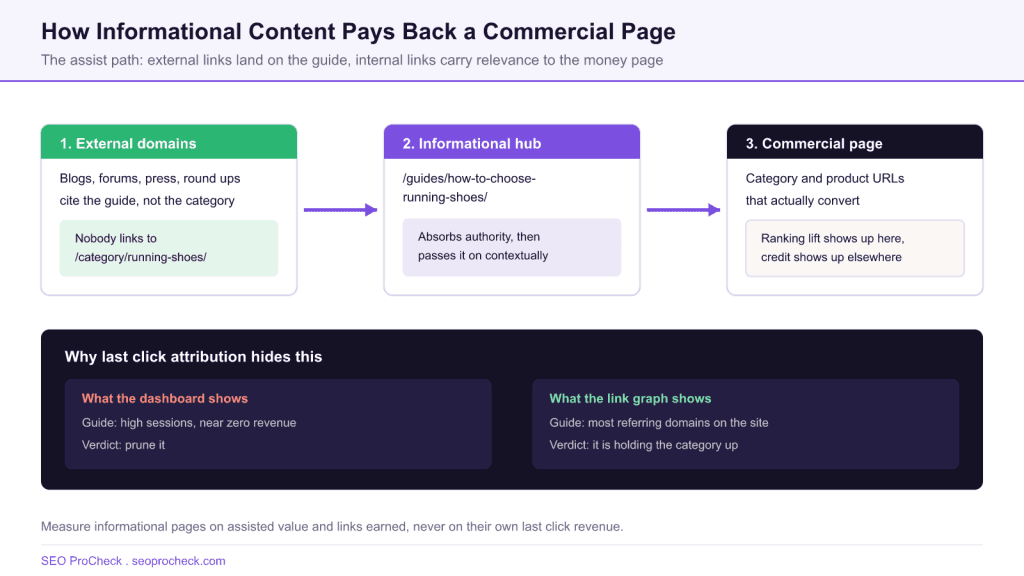
The argument in this case study is that informational content earns the external links commercial pages cannot, and that contextual internal links then pass that relevance through to the category and product URLs that make money. That makes informational content look worthless in last click reporting while it is quietly holding up the rankings of the pages next to it.
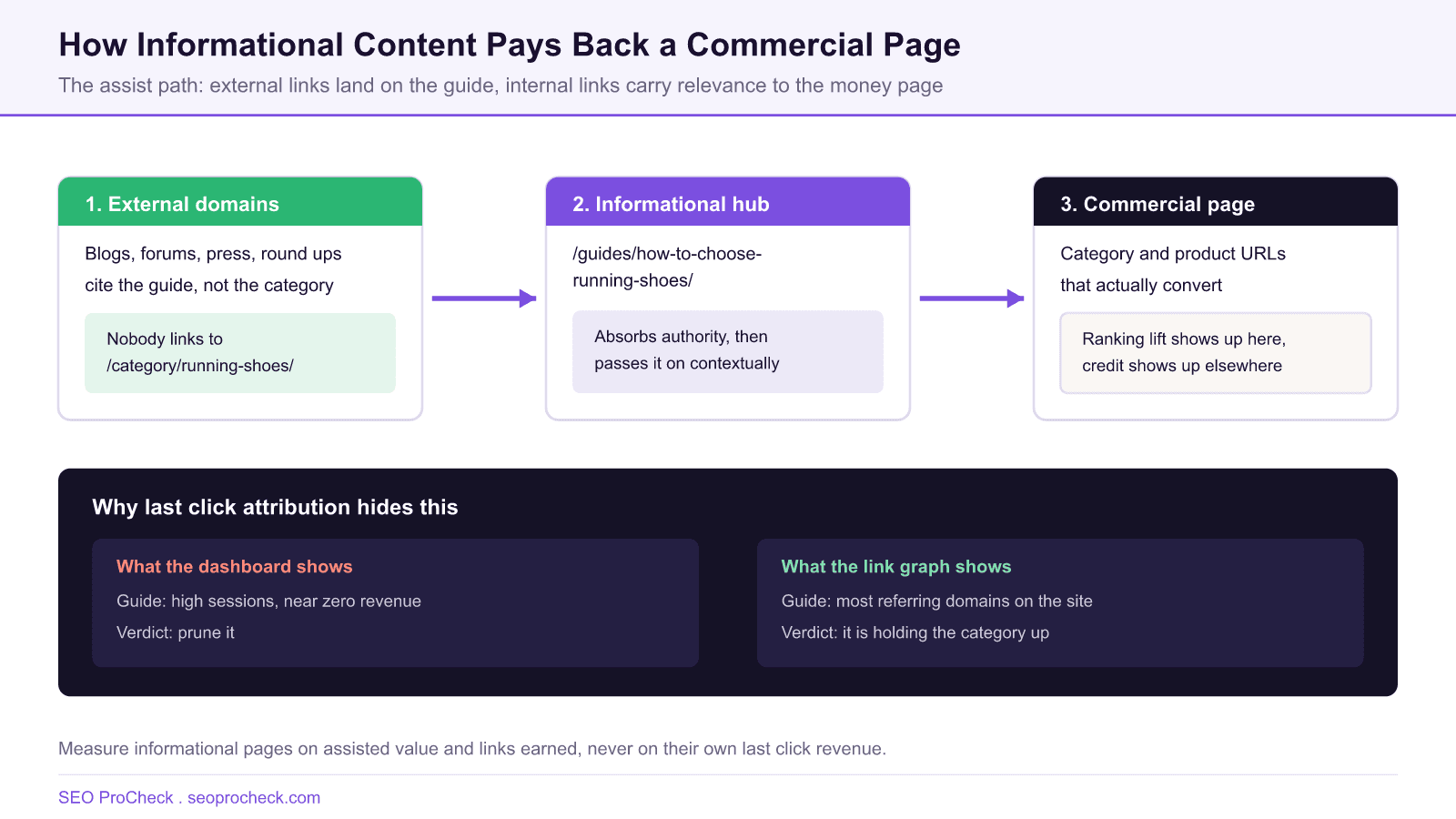
- The mechanism: external domains link to the guide, the guide links contextually to the commercial page.
- Last click attribution systematically undervalues informational URLs, sometimes to near zero.
- The measurable proxies are referring domains per URL group and assisted conversions, not page level revenue.
- Verification note: the original Search Engine Land article is currently returning HTTP 429 and could not be re-read, so no figures from it are restated here.
What the source argues
The case study, published on Search Engine Land, sets out to answer a question ecommerce teams ask constantly: does informational content actually pull its weight, or is it a content marketing habit that survives because nobody measures it? Its thesis is that the value is real but indirect. Informational pages act as link magnets, accumulating relevance from other domains, and contextual internal links then route that relevance to commercial pages that would never attract citations on their own merits.
A verification note before we go further. At the time of writing, the original article returns an HTTP 429 rate limit response to automated requests, so we could not re-read it to confirm the specific traffic and ranking figures it reported. Rather than restate numbers we cannot check, this page covers the mechanism the article describes and the measurement work you need to do on your own site. The source link is preserved in full at the foot of the page.
Why the value disappears from your dashboard
Nobody links to /category/running-shoes/. Journalists, forum posters, newsletter writers and Reddit commenters link to the thing that answered a question. That asymmetry is the whole game. Your category page is where the money is made and your guide is where the authority arrives, and the two are only connected if you connect them deliberately.
Meanwhile, default ecommerce analytics is last click. A customer reads your sizing guide on a phone during a commute, comes back nine days later on a laptop, searches the product name, and buys. Google Analytics 4 in a last click view attributes 100 percent of that order to the product page. The guide shows sessions and no revenue, and if you run a purely revenue weighted content audit it lands on the prune list. Deleting it removes the page carrying most of your earned links.
The measurement you should run instead
Split your URLs into two groups and compare them on link and assist metrics rather than page level revenue. This takes an afternoon and it settles the argument with stakeholders permanently.
| Metric | Where to get it | What a healthy result looks like |
|---|---|---|
| Referring domains per URL group | Ahrefs or Semrush backlinks export, grouped by URL path prefix | Informational URLs hold the clear majority of unique referring domains |
| Internal links out to commercial URLs | Screaming Frog, All Outlinks export, filtered to internal HTML links | Every guide links to at least the categories it names, in body, not just in a footer |
| Assisted conversions | GA4 Advertising, Attribution, Conversion paths, or a data driven model | Informational URLs appear in the early positions of a meaningful share of converting paths |
| First touch sessions | GA4 Explorations with session source and landing page | Guides are the entry point for a large slice of new users |
| Query overlap | Search Console, compare queries for guide versus category | Low overlap. If the guide cannibalises the category, consolidate instead |
A two group comparison for judging informational content. Group by URL path prefix so the split is reproducible each quarter.
Extracting the internal link graph
The claim that a guide passes relevance to a commercial page is only true if the link exists in the rendered HTML body. Verify it rather than assuming it. Crawl the site and export the outlinks, then filter to links whose source path is informational and whose destination path is commercial.
# Screaming Frog: Bulk Export > Links > All Outlinks
# File: all_outlinks.csv

import pandas as pd
df = pd.read_csv('all_outlinks.csv')
df = df[(df['Type'] == 'Hyperlink') & (df['Follow'] == True)]
guides = df['Source'].str.contains('/guides/')
money  = df['Destination'].str.contains('/category/|/product/')
assist = df[guides & money]
print(assist.groupby('Source')['Destination'].nunique().sort_values())
Any guide returning zero at the bottom of that sort is an orphaned asset: it is collecting links and passing none of that value anywhere useful. Fixing it is usually a single paragraph of copy and one anchor tag, and it is the highest return work available on most ecommerce sites.
What good looks like on the page
Three things separate a guide that earns links from one that reads like SEO filler.
It contains something nobody else has. Original measurement, a sizing table built from your own returns data, photographs of the product in use, a comparison nobody bothered to run. Aggregated restatements of the top ten results earn nothing because there is no reason to cite them.
Its internal links are specific. Anchor text that names the category, placed in the sentence that discusses it, pointing at the exact page. A related products carousel injected by the template does not carry the same contextual signal as a link inside a paragraph explaining why that category is the right answer.
It is maintained. Guides decay faster than category pages because they cite prices, models and specifications. A guide with a 2019 model lineup stops earning links the moment a reader notices. Put informational URLs on a refresh cadence and treat the refresh as link maintenance, not content marketing.
The consolidation trap
The opposite failure is worth naming. If the guide and the category compete for the same queries, you have not built an assist path, you have built duplication. Check Search Console for query overlap between the two URLs. Where more than a rough third of the impressions overlap, merge the informational content into the category page rather than maintaining both. Where overlap is low, keep them separate and link them hard.
Both decisions belong inside a repeatable process. The scoring model in how to run a content audit that actually moves traffic handles the keep, merge and improve calls, and the internal linking guide covers anchor and placement mechanics. If your informational pages are also your bid for visibility in AI answers, how to become a cited source in AI answers explains why the same originality that earns links is what earns citations.
FAQ
The mechanism is well established even where individual case studies are hard to verify: guides and comparison content attract external links that commercial category pages almost never earn on their own, and contextual internal links then carry that relevance to the pages that convert. The honest caveat is that isolating the effect requires a holdback group, because informational content usually ships alongside other changes.
Because default ecommerce reporting is last click. A shopper who reads a sizing guide in week one and buys from a Google search for the product name in week three credits the whole order to the product page. Switch to an assisted conversions or data driven attribution view before you judge informational content, and look at links earned separately.
Either works so long as the internal links are real and contextual. What matters more than the folder is that the guide links down to the specific categories and products it discusses, and that the category page links back up to the guide, so the relationship is visible to a crawler rather than only to a human reading a nav menu.
Enough to cover the products actually discussed and no more. In practice that is usually three to eight contextual in body links. Stuffing thirty links into a guide dilutes each one and makes the page read like an affiliate dump, which undermines the credibility that earns the external links in the first place.
Build a two column argument. Column one: referring domains and unique linking root domains pointing at informational URLs versus commercial URLs. Column two: assisted conversions and first touch sessions for the same two groups. Most ecommerce sites find that a small number of guides carry the majority of the site's earned links, which is a fact nobody can argue with.
Not before you check their backlinks and internal link role. A page with no revenue but forty referring domains and outbound internal links into your top categories is infrastructure, not deadweight. Check the link profile and the internal link graph before any page joins a prune list.
Is your informational content earning links or just costing money?
An advanced audit maps the link graph between your guides and your commercial pages, so prune decisions stop being guesses.
Claude Vincent is a technical SEO consultant focused on crawlability, rendering, and AI-search visibility. He writes the field guides and case studies at SEO ProCheck, with a bias toward the durable, unglamorous work that decides whether search engines and AI answer engines can actually read and cite a site.
About SEO ProCheck
Technical SEO consulting and GEO strategy with 20 years of enterprise experience. Case studies, resources, and tools for search and AI visibility.
Work With Me
Technical SEO audits, GEO strategy, site migrations, and international SEO. Hourly consulting for teams who need hands-on support, not just reports.
Subscribe to our newsletter!







Recent Posts
- AI Crawler User Agents: The Current Names, and Which Ones Sites Actually Block September 9, 2026
- Can AI Crawlers Actually Read Your Site? I Measured 400 of the Biggest September 5, 2026
- The Pre-Publish Quality Gate for AI-Assisted Content August 6, 2026