

AI Summary
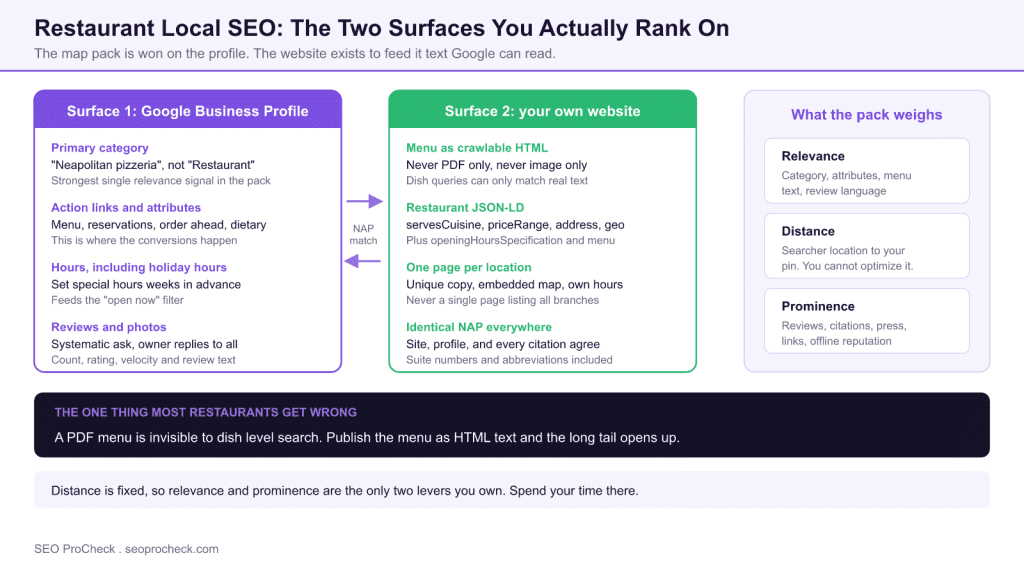
Restaurant SEO is won in the Google local pack and on Maps, which makes the Google Business Profile the primary asset and the website its supporting cast. The profile carries categories, hours, photos, and reviews; the site carries a crawlable HTML menu, Restaurant schema, and one page per location.
- Choose the most specific primary category available: "Ramen restaurant" beats "Restaurant" for the queries that matter.
- Publish the menu as HTML text on your own domain. A PDF menu is invisible to dish-level search.
- Local ranking rests on relevance, distance, and prominence, and only two of those are yours to move.
- Keep NAP identical across the website, the profile, and every citation.

Restaurant SEO is won or lost in the Google local pack and Maps, which means the Google Business Profile is the primary asset (precise categories, a crawlable HTML menu, reservation and order links, photos, and a steady stream of answered reviews), with the website's job being to reinforce it through Restaurant schema, location-specific pages, and content that matches how people actually search: "<cuisine> near me," "<dish> in <neighborhood>," "<occasion> restaurant <city>."
Understanding Local SEO
Local SEO represents a critical component of modern SEO strategy. As search engines continue to evolve and user expectations shift, understanding the nuances of local seo becomes essential for maintaining and improving organic visibility. This guide covers the key concepts, implementation approaches, and strategic considerations that SEO practitioners need to master.
For restaurants specifically, the query landscape is almost entirely local-intent and mobile: discovery happens in the map pack, on Maps directly, and increasingly through dish-level and occasion-level searches. Google ranks local results on three documented factor groups, relevance (do your categories and content match the query), distance (proximity to the searcher), and prominence (reviews, links, overall visibility). You can't move distance, so every tactic below targets relevance or prominence.
The Restaurant Local SEO Checklist
| Area | What to implement | Why it matters |
|---|---|---|
| GBP categories | Primary category as specific as possible ("Neapolitan pizzeria," not "Restaurant"); add secondary categories for every service model that applies (takeout, delivery, bar) | Primary category is the strongest relevance signal in the pack |
| GBP attributes & links | Menu link, reservation link, order-ahead link, dine-in/takeout/delivery attributes, dietary attributes (vegetarian options etc.), price range | Feeds the panel's action buttons: where the actual conversions happen |
| Hours | Exact hours plus special hours for every holiday, set in advance | "Open now" filters; wrong hours are the fastest way to earn 1-star reviews |
| Menu | Full menu as crawlable HTML on your own domain, never PDF-only or image-only; dish names as real text | Dish-level queries can only match text Google can read |
| Photos | Regular uploads of dishes, interior, exterior; categorize them in GBP | Photo engagement correlates with profile actions; Google also surfaces dish photos against menu items |
| Reviews | Systematic ask (QR on receipt, post-visit message where permitted), owner responses to positive and negative alike | Review count, rating, velocity, and keywords in review text all feed prominence and relevance |
| Schema | Restaurant JSON-LD on the homepage/location page: servesCuisine, priceRange, address, geo, openingHoursSpecification, menu (URL), acceptsReservations | Disambiguates the entity and connects site to profile |
| NAP consistency | Identical name, address, phone on site footer, GBP, Yelp, TripAdvisor, delivery platforms, and local directories | Inconsistent citations muddy entity confidence |
| Local pages | One indexable page per location (multi-location) with unique content: that location's menu variations, team, parking, neighborhood copy | Gives each profile a dedicated landing URL and captures "<brand> <neighborhood>" queries |
Restaurant Schema Properties That Earn Their Place
One Restaurant block on the location page, populated properly, does more than three half-filled blocks. The properties worth carrying:
| Property | What it carries | Why it matters |
|---|---|---|
name, address, telephone | The core NAP, matching the profile exactly | Disambiguates the entity and ties site to profile |
geo | Latitude and longitude of the actual entrance | Removes ambiguity for locations with awkward street addressing |
servesCuisine | The cuisine, in the terms diners actually use | Supports cuisine-level queries and matches your primary category |
priceRange | Price band, expressed consistently | Feeds a filter diners use when comparing options |
openingHoursSpecification | Structured hours, including split shifts | Mirrors the profile hours behind the open now filter |
menu | URL of the crawlable HTML menu | Connects the entity to the dish text that wins long-tail queries |
acceptsReservations | Whether booking is possible | Aligns the page with the reservation action on the profile |
Three neighbouring checks are worth running alongside this list. Incomplete or contradictory directory data is the most common drag on prominence, which our note on local citations covers. Restaurants routinely ship a site with no local schema at all, leaving Google to infer the entity from page text alone. And for multi-location groups, the structure rules in local landing pages are what stop five profiles pointing at one undifferentiated homepage.
Key Considerations for Restaurant SEO Local Optimization
When approaching local seo, several factors require careful attention. Technical implementation must align with broader SEO objectives while maintaining site performance and user experience. The balance between optimization and over-optimization requires ongoing monitoring and adjustment based on performance data and algorithm changes. Industry benchmarks and competitor analysis provide context for evaluating your own implementation.
Two restaurant-specific considerations deserve emphasis. First, the aggregator tension: Yelp, TripAdvisor, and delivery platforms will outrank your own site for many queries no matter what you do, so claim and optimize those profiles rather than fighting them, while making sure reservation and direct-order links on your GBP point to your own stack, where margins live. Second, the menu is your keyword inventory: dish-level and cuisine-level queries ("best birria tacos <city>") are captured by having those exact dishes as crawlable text, described in plain language, on a fast mobile page: a designer's PDF menu is invisible to all of it.
Implementation Best Practices
Successful implementation begins with thorough auditing of current state and clear goal definition. Document baseline metrics before making changes to enable accurate impact measurement. Prioritize changes based on potential impact and implementation effort, focusing on high-impact items first. Test changes in staging environments when possible, and monitor closely after deployment to production. Maintain documentation of changes for future reference and troubleshooting.
A sensible rollout order for a single-location restaurant: week one, fix GBP completely (categories, hours, links, attributes, 20+ photos); week two, publish the HTML menu and add Restaurant schema (validate at Google's Rich Results Test and schema.org validator); week three, citation cleanup across the major platforms; ongoing, the review engine and a monthly photo/post cadence. That sequence front-loads the highest-leverage items and costs almost nothing but time.
Common Mistakes to Avoid
Several patterns consistently cause problems in local seo implementations. Rushing implementation without proper planning leads to errors that can be costly to fix. Ignoring the interplay between different SEO factors creates conflicts that undermine results. Failing to monitor and iterate based on performance data means missing optimization opportunities. Over-optimization signals can trigger algorithmic penalties that take months to recover from.
Restaurant-specific traps: keyword-stuffing the GBP business name ("Tony's Pizza Best Pizza Downtown"), a guidelines violation that risks suspension and is the first thing competitors report; letting the menu on delivery apps drift out of sync with the real menu; ignoring the Q&A tab on the profile, where wrong answers from the public sit unchallenged; buying or incentivizing reviews with discounts, which violates Google policy; and blocking the menu behind JavaScript that renders nothing without interaction.
Measuring Success
Effective measurement requires defining appropriate KPIs aligned with business objectives. Track both leading indicators (rankings, impressions, technical metrics) and lagging indicators (traffic, conversions, revenue) to build a complete picture. Establish reasonable timeframes for evaluation, as SEO changes often take weeks or months to fully manifest in results. Compare performance against historical baselines and competitor benchmarks to contextualize results.
The measurement stack for a restaurant: GBP's own Performance report (calls, direction requests, website clicks, menu views, and the queries that surfaced the profile: this is where most of the funnel is visible); Search Console for the website's share (Performance → Search results, filtered to queries containing the city or neighborhood); and GA4 key events for reservation clicks and online orders (mark the reservation-link click as a key event under Admin → Events). Rank tracking for restaurants should be geo-grid based: pack position varies block by block, so a single tracked position from one location is close to meaningless.
Strategic Recommendations
Approach local seo as an ongoing program rather than a one-time project. Build processes for regular auditing, monitoring, and optimization. Stay current with industry developments and algorithm changes that may affect your strategy. Invest in education for team members to build internal capabilities. Consider how local seo fits within your broader digital marketing and business strategy for maximum impact.
The compounding assets for a restaurant are reviews and local links: food bloggers, neighborhood guides, "best of" lists, event sponsorships, supplier pages. A steady trickle of both builds the prominence that no on-page tweak can substitute for, and unlike ads, it doesn't stop working when you stop paying.
Frequently Asked Questions
How do restaurants rank higher in the Google map pack?
Nail the three factor groups Google documents: relevance (a specific primary GBP category, complete attributes, a crawlable menu matching real queries), proximity (not controllable), and prominence (review count and rating, review velocity, local links and mentions). In competitive markets, the differentiators are usually review volume and category precision, because everyone nearby has the basics.
What is the best Google Business Profile category for a restaurant?
The most specific one that describes what you are: "Ramen restaurant" beats "Japanese restaurant" beats "Restaurant" for the queries that matter. Add secondary categories for other true service models (e.g., "Takeout restaurant," "Cocktail bar"), but never pick aspirational categories that don't match reality; mismatched categories suppress rather than expand visibility.
Should a restaurant menu be a PDF or a web page?
A web page, always. HTML menus are readable by search engines (capturing dish-level searches), load fast on phones, work with screen readers, and can carry schema. If the brand insists on a designed PDF, publish the HTML version as the canonical menu page and offer the PDF as a secondary download link.
Do Google reviews affect restaurant SEO?
Yes, Google's own guidance lists review count and score among the prominence factors for local ranking, and review text feeds relevance (dishes and terms customers mention can surface the profile for those queries). Respond to reviews consistently: it's visible to prospective diners and signals an actively managed business. Never buy reviews or trade discounts for them; that violates Google policy.
What schema markup should a restaurant use?
A single Restaurant JSON-LD block on the homepage or location page carrying name, address, geo, telephone, servesCuisine, priceRange, openingHoursSpecification, menu (pointing at the HTML menu URL), and acceptsReservations. Validate with Google's Rich Results Test. Keep it consistent with the GBP data: the schema's job is confirming the same entity, not competing with it.
How should multi-location restaurants structure their website?
One indexable landing page per location: unique URL, unique content (that location's hours, menu differences, parking, neighborhood context), its own Restaurant schema, and set as the website link on that location's GBP. A single homepage shared by five profiles forces Google to guess, and thin cloned location pages with only the address swapped perform barely better.
Claude Vincent is a technical SEO consultant focused on crawlability, rendering, and AI-search visibility. He writes the field guides and case studies at SEO ProCheck, with a bias toward the durable, unglamorous work that decides whether search engines and AI answer engines can actually read and cite a site.
About SEO ProCheck
Technical SEO consulting and GEO strategy with 20 years of enterprise experience. Case studies, resources, and tools for search and AI visibility.
Work With Me
Technical SEO audits, GEO strategy, site migrations, and international SEO. Hourly consulting for teams who need hands-on support, not just reports.
Subscribe to our newsletter!







Recent Posts
- Can AI Crawlers Actually Read Your Site? I Measured 400 of the Biggest September 5, 2026
- The Pre-Publish Quality Gate for AI-Assisted Content August 6, 2026
- AGENTS.md vs llms.txt vs llms-full.txt: Which Agent File Does What July 18, 2026