Element Code: CO-017
What "adapting SEO for LLMs" really means
Answer engines like ChatGPT, Perplexity, Google AI Overviews, and Gemini do not rank ten blue links. They read source material and generate a synthesized answer, often citing a handful of pages. Your goal shifts from "rank number one" to "be the passage the model quotes and attributes." That is the whole adaptation. The tactics are less exotic than the hype suggests, and most of them are things good SEOs already do.
The unhelpful version of this advice is "write for AI." Models do not have taste. They pull the clearest, most extractable, most corroborated statement of a fact. So the real work is making your best claims easy to lift out of context without losing meaning, and making your brand recognizable enough that the model treats you as a source worth naming.
Why this matters now
A growing share of informational queries get answered without a click, because the answer appears right in the interface. If your page is the uncredited raw material behind that answer, you lose the visit and the attribution. If your page is the cited source, you keep brand visibility and often a referral link. The difference between those two outcomes is largely how extractable and trustworthy your content is.
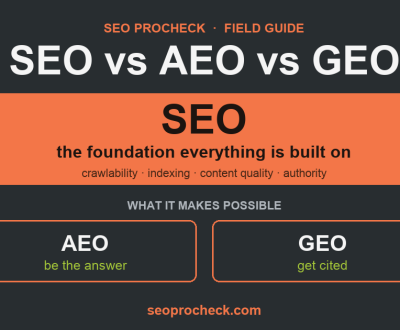
Do not read this as "SEO is dead." Every major answer engine still relies on crawling, indexing, and quality signals that classic SEO produces. A page that Google cannot crawl or index will not surface in an AI answer either. GEO sits on top of technical SEO, it does not replace it.
From classic SEO to LLM adaptation
How to detect where you stand
Start by asking the answer engines directly. Run your target questions in ChatGPT with browsing, in Perplexity, and check Google AI Overviews for the same queries. Note whether your brand appears, whether you are cited, and which competitors get named. Perplexity is especially useful because it shows its sources plainly.
Then check the plumbing. In Search Console, confirm the pages you want cited are indexed and getting impressions. Crawl with Screaming Frog to catch anything blocking access, and check server logs to confirm the AI crawlers you allow, such as OAI-SearchBot or PerplexityBot, are actually reaching your pages. If your robots.txt blocks them and you want the visibility, that is the first thing to fix.
| Lever | What it does for LLM visibility | How to act on it |
|---|---|---|
| Extractable claims | Gives the model a clean sentence to quote | Lead sections with a direct, standalone answer |
| Cited sources | Raises trust and corroboration | Name and link primary sources for every stat |
| Structured data | Clarifies entities and facts | Add relevant schema, keep it accurate |
| Brand entity | Makes you a recognizable, nameable source | Consistent naming, author bios, off site mentions |
| Crawler access | Lets AI bots read the page at all | Allow the AI user agents you want in robots.txt |
A practical adaptation checklist
- Answer the question in the first two sentences of the relevant section, then support it. Models grab the concise answer.
- Attribute every statistic and claim to a named, linked source. Unsourced numbers are a liability and easy for a model to distrust.
- Use plain structure: descriptive headings, short definitional sentences, and tables or lists for facts that belong in a grid.
- Strengthen your entity. Consistent brand and author names, a real about page, and mentions on sites the model already trusts all help you get named.
- Keep the technical base clean so pages are crawlable, indexable, and fast.
- Decide crawler policy deliberately. Allow the AI bots whose visibility you want, block the ones you do not.
- Re test your questions in the answer engines every few weeks and watch whether your citation rate moves.
Do this, not that
- Give a direct answer up front, then the detail
- Cite named, linked sources for every fact
- Build a consistent, recognizable brand entity
- Keep the technical SEO foundation solid
- Test your queries in real answer engines and track citations
- Stuff hidden text or prompts aimed at models
- Publish unsourced statistics and hope they stick
- Treat GEO as a replacement for technical SEO
- Block every AI crawler by reflex, then wonder why you vanish
- Chase every new answer engine gimmick without measuring
What good looks like
You know it is working when your brand gets named in ChatGPT and Perplexity answers for your target questions, when AI Overviews cite your pages, and when your best claims can be lifted out of a paragraph and still stand on their own. Underneath, the technical base stays clean so nothing blocks that visibility. There is no secret handshake here, just clarity, sourcing, and a recognizable name.
FAQ
Is GEO different from SEO?
Should I block AI crawlers?
Do I need special "AI schema"?
How do I measure LLM visibility?
An audit checks crawler access, extractability, sourcing, and your entity signals, then hands you a concrete plan to earn more citations.
Claude Vincent is a technical SEO consultant focused on crawlability, rendering, and AI-search visibility. He writes the field guides and case studies at SEO ProCheck, with a bias toward the durable, unglamorous work that decides whether search engines and AI answer engines can actually read and cite a site.
About SEO ProCheck
Technical SEO consulting and GEO strategy with 20 years of enterprise experience. Case studies, resources, and tools for search and AI visibility.
Work With Me
Technical SEO audits, GEO strategy, site migrations, and international SEO. Hourly consulting for teams who need hands-on support, not just reports.
Subscribe to our newsletter!