

AI Summary
An answer capsule is the boxed, self contained answer an AI or answer engine shows above the list of links, summarizing the response before any results. It spans AI Overviews, featured snippet style boxes, and assistant summaries, and it now decides whether searchers ever reach your page.
- The capsule is often the only thing a searcher reads, so feeding it or being cited beneath it is where visibility now lives.
- Put a two sentence direct answer right under the matching heading so engines can extract it cleanly.
- Winning the box means less raw traffic, but the residual clicks plus named source authority still carry value.
- Answer capsule is the umbrella term covering featured snippets, AI Overviews, and assistant summaries alike.
What an answer capsule is
An answer capsule is the boxed, self-contained response an AI or answer engine shows at the very top of a results page, summarizing the answer in a few sentences before any list of links. It is the umbrella concept that spans Google's AI Overviews, featured-snippet-style boxes, and the summary blocks that assistants put above their sources.
Why it matters: the capsule is now the first, and often the only, thing a searcher reads. If your page is the one feeding that box, or is cited beneath it, you capture attention and authority. If it is not, the answer gets delivered without you, and the click you used to earn never happens.
A real example
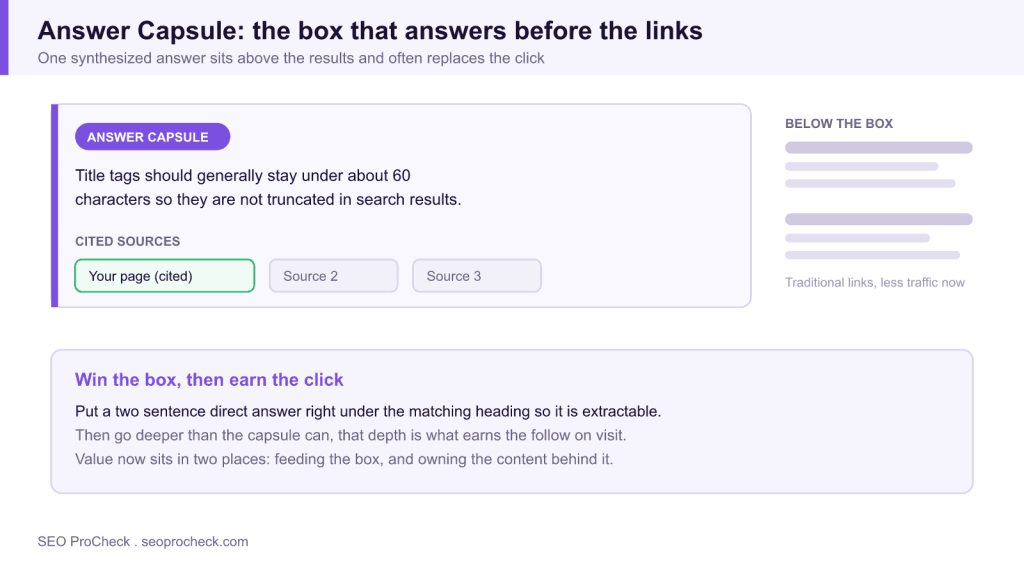
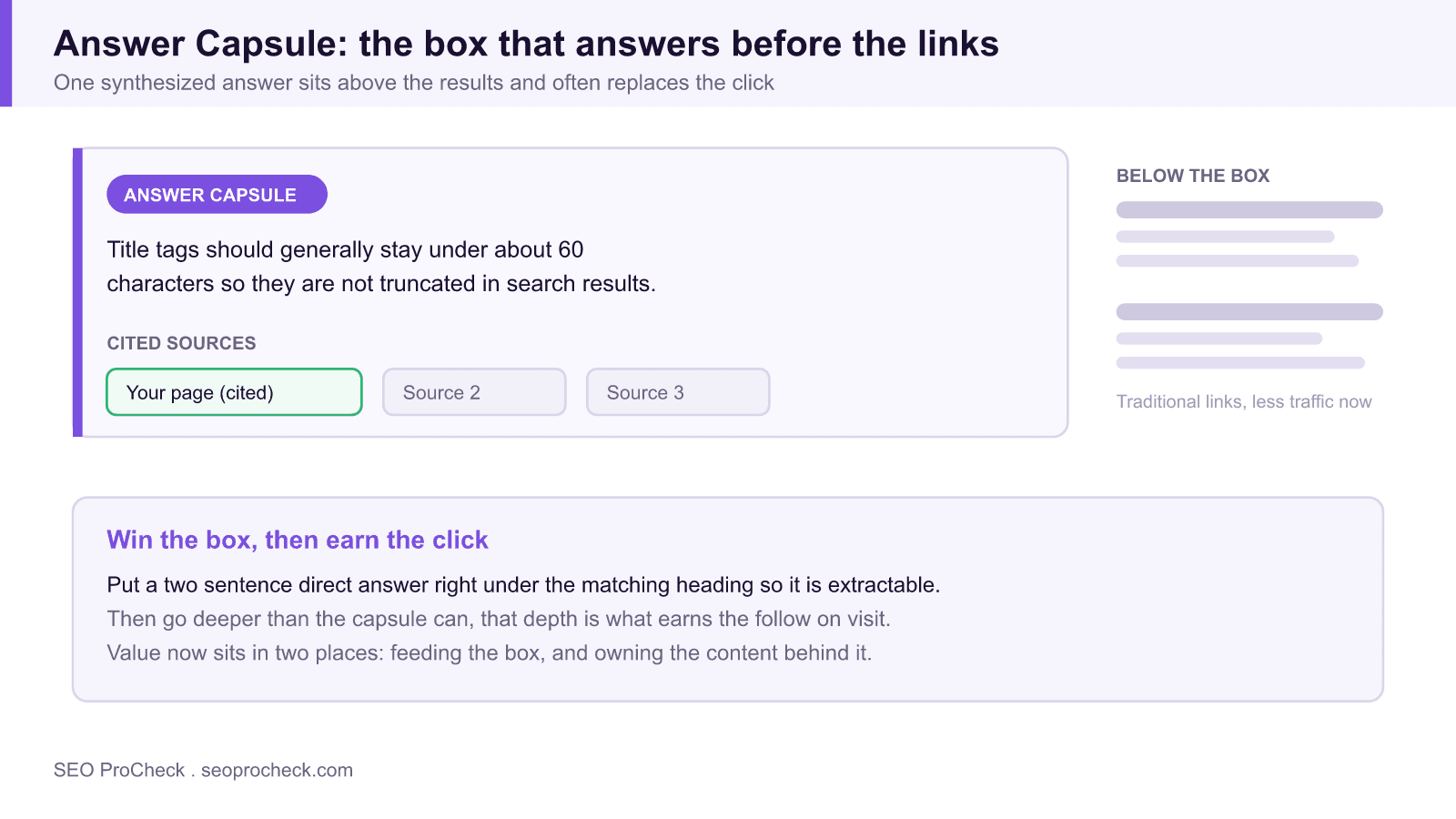
Search "how long should a title tag be." Instead of ten links, you often get a capsule that reads something like: "Title tags should generally be under about 60 characters so they don't get truncated in search results." Below it sit two or three cited sources. The searcher gets the number without visiting anyone. The sites named under the capsule still get a trickle of trust and clicks; every other page on that topic gets nothing. That single box quietly replaced the old snippet-plus-clicks flow.
Answer capsule vs. the formats it spans
| Format | Where it appears | How the answer is built | Citation behavior |
|---|---|---|---|
| Featured snippet | Top of classic Google results | Extracted verbatim from one ranking page | One source, linked |
| AI Overview | Top of Google results, AI-generated | Synthesized from multiple pages | Several sources, linked panel |
| Assistant summary | Chat answer in Copilot, ChatGPT, etc. | Generated from retrieved sources | Inline or footnoted citations |
| People Also Ask | Expandable box in results | Extracted per sub-question | One source per answer |
"Answer capsule" is the generic term for all of these: a short answer block that stands in for the page. The mechanics differ, but the strategic problem is the same everywhere.
Why the capsule reshaped the traffic math
For twenty years the deal was straightforward: rank well, earn the click, get the visit. The answer capsule breaks that chain. The engine now reads your page, extracts or synthesizes the answer, and hands it to the searcher inside the box. The user's need is met before your site ever loads. That is not a bug to be fought; it is the new default behavior of search, and it applies to informational queries most of all.
What changes strategically is where the value sits. Two things still have worth: being the source that feeds the capsule, and owning the deeper content a curious searcher clicks through to after the box whets their appetite. A page that only restates the obvious answer loses on both counts, because the capsule already delivered the obvious answer. A page that answers cleanly up top and then goes further than the box possibly can is the one that both wins the capsule and earns the follow-on visit. That is the shape to aim for.
How to check whether you are winning capsules
- List your money questions. Write out the actual question-phrased queries your audience asks, not just head keywords.
- Run each one live. Search it and note whether a capsule appears, and if so, which sources feed or sit under it.
- Diagnose the winners. Read the pages that got picked. Look at how early and how cleanly they answer the exact question.
- Find your gap. If your page ranks but is not in the capsule, the usual culprit is that your answer is not extractable near the top.
- Restructure and re-check. Add a direct answer block, then re-run the query a few weeks later to see if you moved into the box.
Common mistakes and how to fix them
- Answering the question 500 words in. Capsules pull from the cleanest, earliest answer. Fix: put a two-sentence direct answer right under the matching heading.
- Fighting the capsule instead of feeding it. Trying to hide the answer to force a click usually just hands the box to a competitor. Fix: win the capsule, then earn the click with depth below it.
- Ignoring the sub-questions. Capsules often break a topic into pieces. Fix: cover the related follow-ups on the same page so you can win several boxes.
- Assuming a capsule is permanent. These boxes get rewritten as the engine re-crawls. Fix: monitor your priority queries on a schedule, not once.
- Vague, unsourced claims. Engines prefer answers they can corroborate. Fix: attach specific, checkable facts to the answer block.
FAQ
Is an answer capsule the same as a featured snippet?
A featured snippet is one kind of answer capsule, the older extractive version pulled from a single page. The broader term also covers AI Overviews and assistant summaries that synthesize multiple sources. All of them are short answer blocks that sit above the links.
Do I still get traffic if I win the capsule?
Some, but less than the old click-through on a top rank. Many searchers are satisfied by the box alone. The value is a mix of the residual clicks plus the visibility and authority of being the named source.
Can I stop my page from being used in a capsule?
You can use standard controls like nosnippet to limit extraction, but that usually costs you the visibility entirely rather than winning back clicks. For most sites, competing to be the cited source beats opting out.
How do capsules differ across engines?
The layout and how many sources they show vary, but the core behavior is the same: a short synthesized or extracted answer up top with a handful of citations. Optimize for extractable, verifiable answers and you improve your odds across all of them.
How do I make my content more likely to feed a capsule?
Answer the exact question in the first sentence or two under a heading that matches how people phrase it, then support it with specific, checkable facts. Clean structure, direct phrasing, and verifiable detail are what engines extract and trust.
Are answer capsules only for informational queries?
They appear most on informational and question style searches, where a short answer genuinely satisfies the intent. Transactional and navigational queries trigger them less often, though comparison and how to questions increasingly surface them too.
Related terms
- Citation Optimization, the discipline of structuring content so it feeds or gets cited under the capsule.
- AI Overviews, Google's specific AI-generated flavor of the answer capsule.
- AI Citation, the attribution shown beneath the capsule.
- How Google AI Overviews Selects Sources, what drives which pages feed the box.
Claude Vincent is a technical SEO consultant focused on crawlability, rendering, and AI-search visibility. He writes the field guides and case studies at SEO ProCheck, with a bias toward the durable, unglamorous work that decides whether search engines and AI answer engines can actually read and cite a site.
About SEO ProCheck
Technical SEO consulting and GEO strategy with 20 years of enterprise experience. Case studies, resources, and tools for search and AI visibility.
Work With Me
Technical SEO audits, GEO strategy, site migrations, and international SEO. Hourly consulting for teams who need hands-on support, not just reports.
Subscribe to our newsletter!



Recent Posts
- Can AI Crawlers Actually Read Your Site? I Measured 400 of the Biggest September 5, 2026
- The Pre-Publish Quality Gate for AI-Assisted Content August 6, 2026
- AGENTS.md vs llms.txt vs llms-full.txt: Which Agent File Does What July 18, 2026