

Finding a Competitor's Sitemap, and Turning It Into a Change Log
- September 15, 2026
- SEO Strategy
TL;DR
A competitor's XML sitemap is a dated list of every page they want indexed. Snapshot it on a schedule and the differences between snapshots are a change log they publish without meaning to. The hard part is not the diffing, it is finding the file.
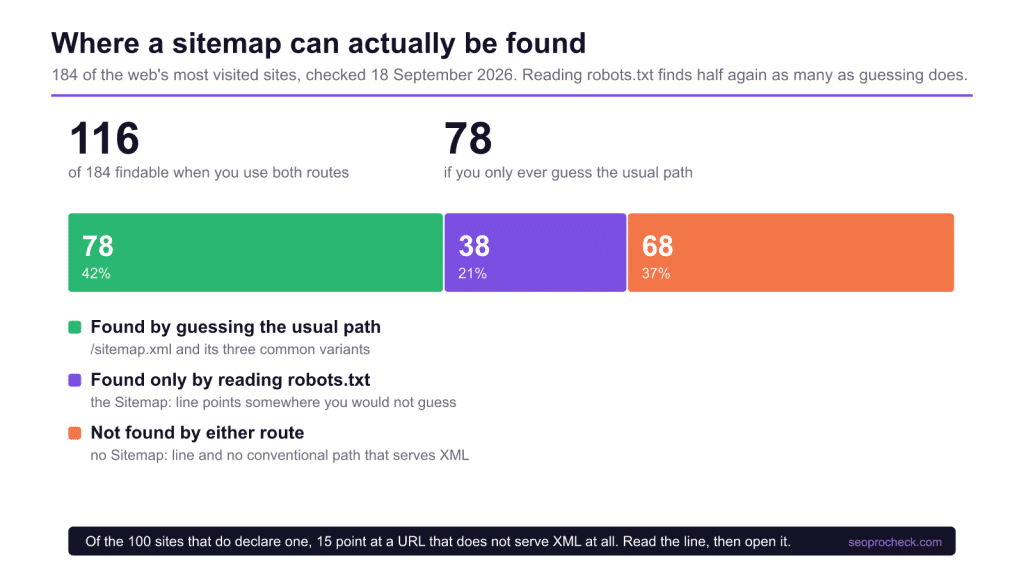
- I checked 184 of the most visited sites on the web. Guessing the usual paths found a sitemap on 78. Reading the
Sitemap:line in robots.txt found 38 more, so both routes together reach 116. - 68 of the 184 (37%) gave up nothing by either route. No declaration, no conventional path.
- Of the 100 sites that do declare one, 15 point at a URL that serves no XML, so the line is worth reading and then opening.
- Declared paths are frequently nothing you would have guessed, and some sites declare dozens of files rather than one.
- There is no way to backfill this. The first snapshot is a baseline and nothing more, which is the argument for starting it today rather than when you need it.
Why the file is worth watching
An XML sitemap is a declaration of intent. It lists the URLs a site wants crawled, and most generators stamp each one with a lastmod date. That combination is more useful than it looks. New entries tell you what they launched. Disappeared entries tell you what they retired or quietly folded into something else. A cluster of lastmod dates all moving in the same week tells you a team went through a section on purpose.
None of that requires a tool licence or a login. It is a text file they publish for crawlers, and you are allowed to read it. The only thing you need is a copy from last month to compare against, which is the part nobody has when they want it.
Step one, find the file
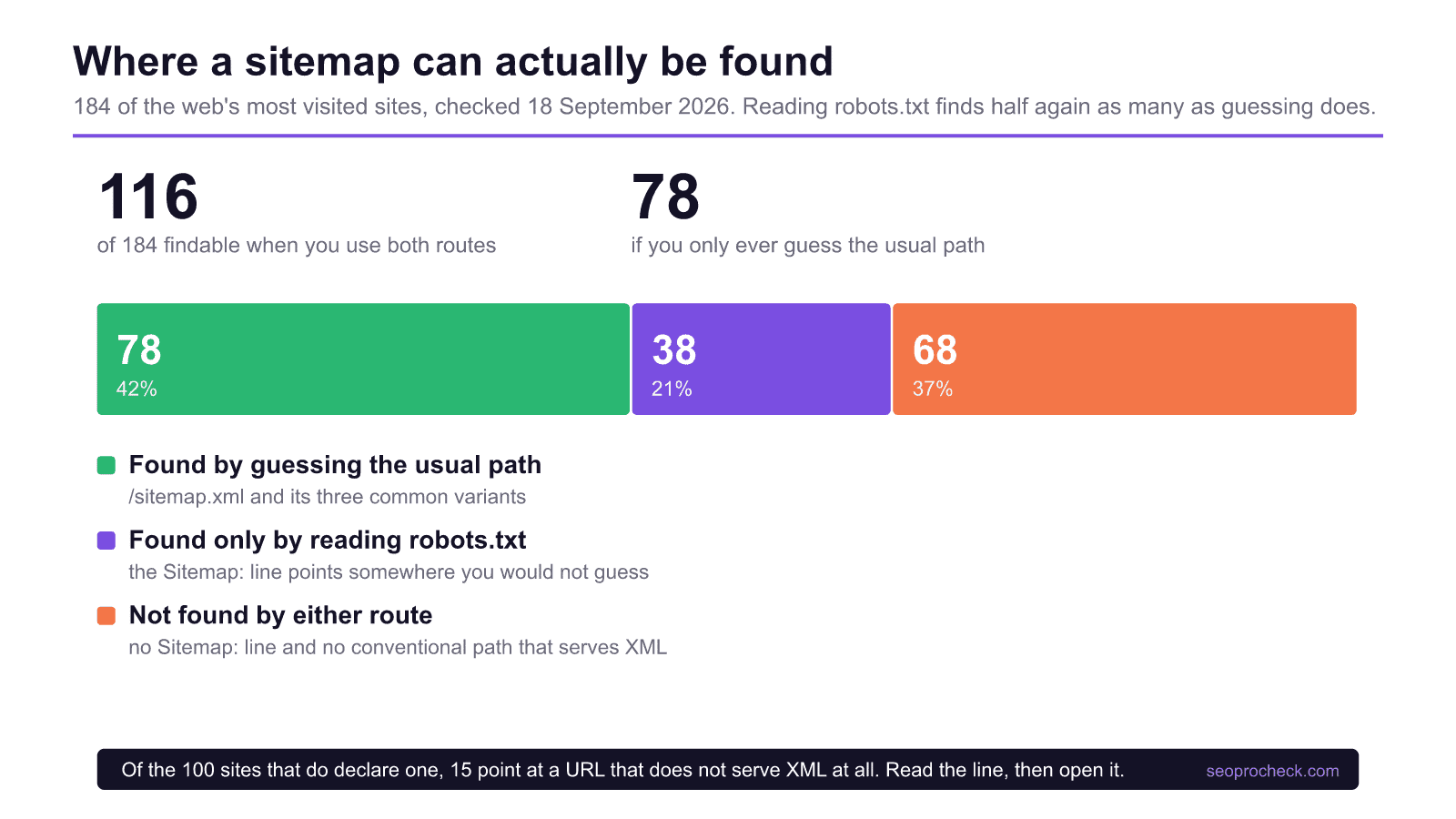
Before any of this works you have to locate the thing, and that turns out to be the step that fails. I ran two routes against 184 sites: guess the conventional paths, and read the Sitemap: line out of robots.txt. Neither route is close to complete on its own.
| Route | Sites where it works | Share |
|---|---|---|
| Guess the conventional paths | 78 of 184 | 42.4% |
| Read the Sitemap: line in robots.txt | 100 of 184 | 54.3% |
| Either route | 116 of 184 | 63.0% |
| Both routes agree | 62 of 184 | 33.7% |
| Only the robots.txt line works | 38 of 184 | 20.7% |
| Only the guess works | 16 of 184 | 8.7% |
| Neither route | 68 of 184 | 37.0% |
The guess covers /sitemap.xml, /sitemap_index.xml, /sitemap-index.xml, /wp-sitemap.xml and /sitemap1.xml. Of the 78 hits, 74 were plain /sitemap.xml, which is why guessing feels more reliable than it is.
The practical lesson sits in the middle row. Reading one extra file takes you from 78 sites to 116, and the sites you pick up that way are not obscure ones. Microsoft, YouTube, Wikipedia, Pinterest, X and Vimeo are all in the group where a guess returns nothing and the declaration works.
It is worth seeing how little you would have guessed:
wikipedia.org   /w/rest.php/site/v1/sitemap/0
nytimes.com     /sitemaps/new/news.xml.gz
vimeo.com       /marketing.xml.gz
paypal.com      /paypal-sitemap-index.xml
discord.com     /servers/servers-sitemap-index.xml
ibm.com         /content/sitemap/href-sitemap-index.xml
dropbox.com     /sitemapindex.xml
And the declaration is not a guarantee. Of the 100 sites that declared a sitemap, the first declared URL served real XML on 81. 15 served none at all, split between four that answered with a 403 or a 404 and eleven that answered 200 with something that was not XML, which in most cases looked like the same bot handling I measured in the crawler access study. A further 4 declared a gzipped file, which is perfectly valid and simply beyond the plain reader I used.
Step two, take the baseline
Fetch the file, parse out every URL with its lastmod, and save that as a dated snapshot. That is the whole job. The snapshot is worthless on its own, which is the thing worth being honest about: a change log cannot be created retroactively. The archive services do not reliably keep copies of XML sitemaps, and a site that rebuilt its sitemap last week has already overwritten the evidence.
So the first run buys you nothing and the fourth run is where it starts paying. Weekly is the sensible cadence for most sectors, because it is frequent enough to attribute a change to a week and slow enough that the diffs stay readable.
Two things to store beyond the URL list. Keep the declared sitemap set from robots.txt, because sites add and remove sitemap files and that is itself a signal. And keep the URL count per file, since a file that drops from 40,000 entries to 12,000 is worth knowing about even before you look at which URLs went.
Step three, read the diff
Three categories come out of a comparison, and they are worth different amounts.
| What changed | What it usually means | How much to trust it |
|---|---|---|
| URLs that appeared | New pages, a new section, a new template rolled out across a category | High. A URL in a sitemap is a deliberate act by their CMS. |
| URLs that disappeared | Retired pages, a consolidation, or a section moved behind a login | High for the fact, low for the reason. Check whether the URL still resolves before concluding anything. |
| lastmod moved | Someone edited the page, or the CMS touched every page in a deploy | Low on its own. Treat a cluster as the signal, never a single date. |
The lastmod caveat is the one that catches people. Plenty of platforms stamp the current date on every URL whenever anything is published anywhere on the site, which makes the field pure noise. The test is cheap: if a diff shows every single URL updated on the same date, the field is decorative on that site and you should ignore it from then on. If a diff shows forty URLs in one directory moving and nothing else, somebody did a content refresh and you have just watched it happen.
The traps, all of which I hit
The sitemap is usually not one file. A sitemap index points at children, and the children are what hold URLs. Some sites go much further than that: samsung.com declares 94 sitemap lines in robots.txt, hp.com 89, hostinger.com 88. Fetching "the sitemap" on one of those and calling it done gives you a fraction of the picture.
Gzipped files are normal. Six of the sites I checked declare a .gz first. Anything reading these needs to decompress, or it will report an empty sitemap and you will believe it.
A 200 is not a sitemap. Eleven declared URLs answered 200 with HTML. Check that the body actually starts with an XML declaration before you parse it, or a bot challenge page becomes a sitemap with zero URLs and your diff reports a catastrophic overnight deletion that never happened.
Sitemaps sometimes point at the wrong host. Staging hostnames and localhost URLs turn up in production sitemap indexes more often than anyone would like. If a child sitemap will not resolve, read the URL before assuming the fetch failed.
Watch your own request volume. A site with 90 sitemap files is 90 requests, and doing that to one host in a burst is how you get rate limited or firewalled. Space them out. If you are fetching a lot of files from a single origin, treat it the same way you would treat a crawl.
What this is not
A sitemap tells you what a site publishes. It says nothing at all about what works. A competitor can add 400 pages that earn nothing, and the diff will look identical to 400 pages that earn well. Structure describes activity, and only ranking or traffic data describes results, so a change log is the question rather than the answer. It is very good at telling you where to point the next question.
It is also not a substitute for reading the pages. The most useful version of this habit is a weekly diff that takes two minutes, followed by opening the three most interesting new URLs and actually looking at them.
Related reading on the same file from the technical side: the 403 URLs in XML sitemaps check covers what it means when your own sitemap lists a URL that refuses crawlers, which is the mirror image of the trap above. And if you are here because of the AI crawler question, the current crawler names and which ones sites block is the companion piece to this one.
Questions people ask about this
Is reading a competitor's sitemap allowed?
It is a file published for automated clients to read, linked from robots.txt, and fetching it is an ordinary web request. Keep the volume low and identify yourself honestly in your user agent, the same courtesy you would want from anyone reading yours.
How far back can I go if I start today?
Nowhere. The first snapshot is a baseline with nothing to compare against, and archive services do not reliably keep copies of XML sitemaps. This is the one reason to set it up before you have a reason to want it.
How often should I snapshot?
Weekly suits most sectors. Daily produces diffs dominated by CMS noise, and monthly loses the ability to tie a change to a particular week. News and retail move fast enough to justify more often.
What if the competitor has no sitemap?
That happened on 68 of the 184 sites I checked, so it is common. Fall back to the other public lists of their pages: internal linking from their own navigation, their RSS or news feed, and their paginated category archives, which are often more complete than a sitemap anyway.
Can I trust lastmod at all?
Treat it as a hypothesis rather than a fact. Run one diff and look at the shape: if every URL shares a single date, the field is generated and useless on that site. If dates vary and cluster by directory, it is meaningful and worth watching.
Does a new URL in their sitemap mean the page is live?
Usually, but confirm it. Sitemaps are generated from a CMS and occasionally list things ahead of publication or after removal, so check that the URL returns a 200 with real content before you treat it as a launch.
Method: for each of 184 hosts, robots.txt was fetched once and every Sitemap: line recorded, then the first declared URL was fetched, then up to five conventional paths were tried. A hit means HTTP 200 with a body beginning in an XML declaration. Measured 18 September 2026 from a single residential connection in the United States. The sample is the same 184 hosts that returned 200 and HTML to a browser in the September crawler access study.
Claude Vincent is a technical SEO consultant focused on crawlability, rendering, and AI-search visibility. He writes the field guides and case studies at SEO ProCheck, with a bias toward the durable, unglamorous work that decides whether search engines and AI answer engines can actually read and cite a site.
About SEO ProCheck
Technical SEO consulting and GEO strategy with 20 years of enterprise experience. Case studies, resources, and tools for search and AI visibility.
Work With Me
Technical SEO audits, GEO strategy, site migrations, and international SEO. Hourly consulting for teams who need hands-on support, not just reports.
Subscribe to our newsletter!







Recent Posts
- Finding a Competitor's Sitemap, and Turning It Into a Change Log September 15, 2026
- AI Crawler User Agents: The Current Names, and Which Ones Sites Actually Block September 9, 2026
- Can AI Crawlers Actually Read Your Site? I Measured 400 of the Biggest September 5, 2026