AI Summary
A seasonal product page ranks best when it lives on one permanent URL that you refresh on a yearly cycle, instead of publishing a fresh page every season and losing the accumulated links, reviews, and history. Ramp the page 8 to 12 weeks before demand, update the title, on-page copy, and Product schema availability, then keep the page live and softened during the off season so its equity compounds year after year.
- Keep one evergreen URL per recurring season and never delete or 301 it when demand fades.
- Begin the pre-season refresh 8 to 12 weeks before the demand window so Google can recrawl and rerank in time.
- Update the
availabilityandpricevalues in Product schema as stock and promotions change. - Off season, soften the hero and CTA but retain the body copy and reviews that hold the page's ranking history.

Seasonal products create a recurring SEO trap. Demand for a holiday gift guide, a summer patio range, or a back to school bundle spikes for a few weeks, then vanishes for most of the year. The instinct is to build a new landing page each season and take it down afterward. That instinct quietly destroys ranking equity: every new URL starts from zero, and every deleted page throws away the backlinks, reviews, and crawl history you earned last year. This guide covers the strategy that keeps that equity intact, the calendar that gets you ranked before the demand window opens, and the on-page details that separate a page that peaks on time from one that peaks a month late.
The foundation for everything below is a strong, permanently indexable product template. If your underlying pages are thin or slow, no seasonal calendar will save them, so fix the fundamentals first with our guide to ecommerce product page SEO.
Use one evergreen URL, not a new page each season
The single most important decision is URL permanence. A page at /christmas-gift-guide/ that stays live all year, and gets refreshed each autumn, accumulates links and authority across every cycle. A page at /christmas-gift-guide-2025/ that you delete in January forces you to rebuild from nothing in 2026, and it leaves a dead URL that either 404s or needs a redirect. Keep the year out of the slug. If you must reference the year, put it in the title tag and on-page copy where you can edit it freely, never in the permanent address.
When demand ends, do not delete the page and do not 301 it to a category. Both actions tell search engines the resource is gone, and both surrender the history you will want back in a few months. Instead, move the page into an off-season state: it stays at HTTP 200, stays indexable, and keeps its core content while the promotional urgency is dialed down.
The seasonal calendar: ramp 8 to 12 weeks out
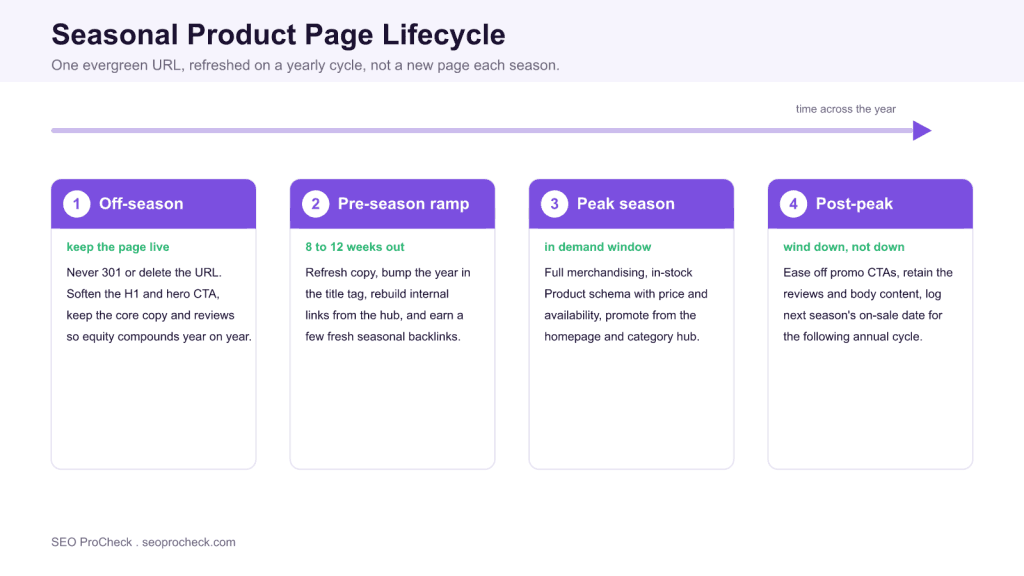
Search engines need time to recrawl an updated page and rerank it against competitors who are also gearing up. If you refresh a Halloween page in mid October, you are already too late for the shoppers searching in September. Work backward from the demand peak and give yourself a runway. The table below maps the four phases of the annual cycle to the concrete work each one requires.
| Phase | Timing | Page state | Primary work |
|---|---|---|---|
| Off season | Most of the year | Live, indexable, softened | Keep URL at 200, retain copy and reviews, remove countdowns |
| Pre-season ramp | 8 to 12 weeks out | Refreshed, promoted | Update title and copy, rebuild internal links, earn seasonal backlinks |
| Peak season | Demand window | Fully merchandised | In-stock schema, homepage and hub links, live pricing and offers |
| Post-peak | 2 to 4 weeks after | Winding down | Ease off CTAs, keep content, log next year's on-sale date |
The 8 to 12 week window is not arbitrary. It gives Googlebot several crawl cycles to see the refreshed content, lets any new internal links get discovered and passed, and allows fresh backlinks to be found and counted before shoppers start searching. High-authority sites that get crawled daily can compress this window, but planning for the longer end protects you if a crawl is slow.
What to update each season on the page
When the pre-season ramp begins, the refresh is not cosmetic. Work through a fixed checklist so nothing is missed:
- Title tag: update the year and any freshness cue, for example a bracketed year or the word "new," while keeping the primary keyword in the same position.
- H1 and intro: restate the current season and the shopper's intent so the page reads as this year's guide, not a stale archive.
- Body copy: swap in this season's featured products, refresh any trend commentary, and add a short "what's changed since last year" note where the category moves quickly.
- Images and alt text: replace dated product photography and rewrite alt text to match.
- Structured data: update the Product or ItemList schema so
availability,price, and anypriceValidUntilreflect the current run.
For the exact properties and validation rules on the schema side, follow our Product schema guide, and for collection style seasonal pages that list many items, the ItemList schema reference covers the markup that earns carousel treatment.
Availability and price signals during peak
During the demand window, your Product schema does real work in the search result. An availability value of https://schema.org/InStock paired with a current price can drive rich result treatment and reassure shoppers before they click. The moment a seasonal line sells out, flip the value to OutOfStock rather than leaving a stale InStock claim that erodes trust and can trigger a manual action for structured data that does not match the page. If you run limited drops, set priceValidUntil honestly so the markup expires when the promotion does.
Merchandising and internal links at the peak
A seasonal page cannot rank on its own signals alone; it needs internal prominence during the window. In the weeks around peak demand, link to it from the homepage, from the parent category hub, and from any relevant blog content or gift guides. Those contextual links pass authority and, just as importantly, tell Google the page is currently the important destination for that query. When demand ends, remove the homepage feature but keep a quieter link from the category so the page is never fully orphaned. For sibling seasonal ranges, cross-link between related pages such as your collection page SEO hubs so the whole seasonal cluster reinforces itself.
Handling the off season without losing ground
The off-season state is where most sites go wrong. They either delete the page, which throws away equity, or they leave a loud "SALE ENDS TONIGHT" banner running in July, which reads as neglect. The correct off-season page stays live at 200, keeps its evergreen body content and every review it has earned, and simply softens the promotional layer: remove countdown timers, swap the urgent CTA for an "notify me" or "back in season" prompt, and update the intro to acknowledge the page is between seasons. This keeps the URL crawlable and indexable, preserves the ranking history, and means next year's ramp starts from a position of strength rather than from scratch.
Key takeaways
Treat each recurring season as a cycle on a permanent URL, not a disposable campaign page. Keep the URL live and indexable all year, start the refresh 8 to 12 weeks before demand, update the title, copy, and schema each cycle, merchandise hard with internal links at peak, and soften rather than delete in the off season. Done consistently, the page gets stronger every year instead of resetting to zero, and it arrives at each demand window already ranked.
No. Use one permanent URL that you refresh each cycle. A new page every year starts from zero authority and abandons the backlinks, reviews, and crawl history the old page earned. Keep the year out of the slug and change it only in the title and on-page copy.
Begin the refresh 8 to 12 weeks before the demand window. Search engines need several crawl cycles to see the updates, rediscover internal links, and count fresh backlinks before shoppers start searching, so an update made during the peak arrives too late to rank.
Keep it live at HTTP 200 and indexable. Remove countdowns and urgent CTAs, but retain the body content and every review. Softening the page rather than deleting it preserves the ranking history so next season's ramp starts from strength.
No. A 301 tells search engines the resource has permanently moved and surrenders the page's own history. Leave it live in an off-season state instead. Only redirect if you are genuinely retiring the product line for good.
Update the availability and price values as stock and promotions change, and flip to OutOfStock the moment a line sells out. Set priceValidUntil to match limited runs so the markup expires with the offer and never contradicts what the page shows.
No. A softened, still useful page does not harm the site, and it holds the equity you need for next season. The risk comes from the opposite direction: a stale page that still shows expired offers and countdowns signals neglect, so update the promotional layer even when the season is over.
Is your seasonal catalog losing equity every year?
Deleted seasonal pages and stale schema quietly reset your rankings each cycle. An audit finds the pages leaking authority and the ones ready to compound.
Claude Vincent is a technical SEO consultant focused on crawlability, rendering, and AI-search visibility. He writes the field guides and case studies at SEO ProCheck, with a bias toward the durable, unglamorous work that decides whether search engines and AI answer engines can actually read and cite a site.
About SEO ProCheck
Technical SEO consulting and GEO strategy with 20 years of enterprise experience. Case studies, resources, and tools for search and AI visibility.
Work With Me
Technical SEO audits, GEO strategy, site migrations, and international SEO. Hourly consulting for teams who need hands-on support, not just reports.
Subscribe to our newsletter!