

AI Summary
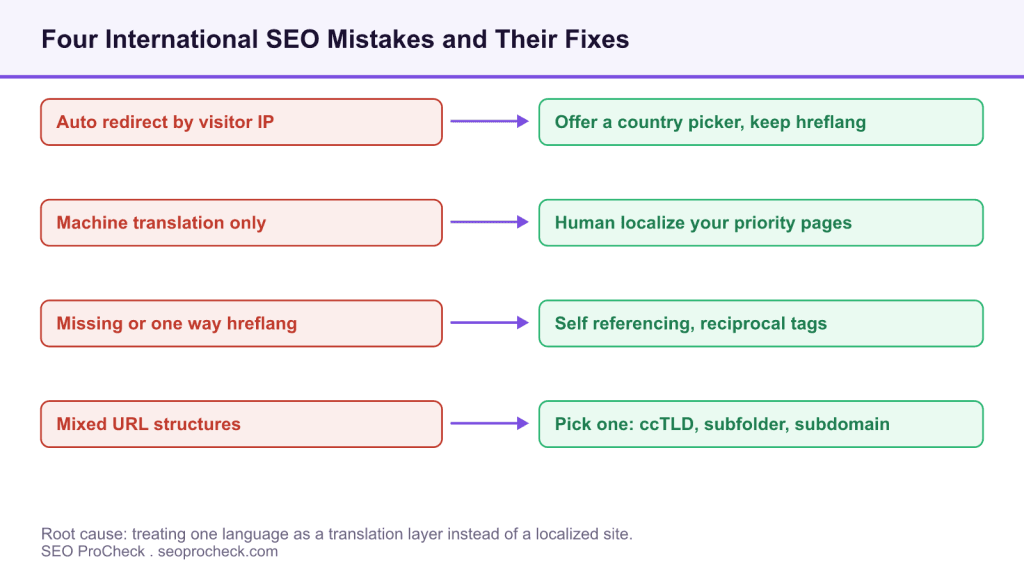
International SEO usually fails on strategy, not on tags: sites force redirects by visitor IP, ship machine translated pages, and bolt on broken hreflang instead of building a genuinely localized site. Avoid the common mistakes by letting people choose their region, localizing the pages that matter, and keeping hreflang reciprocal and self referencing.
- Never force a redirect by visitor IP. Offer a clear country or language picker and let hreflang guide search engines.
- Machine translation alone rarely ranks. Localize your priority pages with someone who knows the market.
- hreflang must be reciprocal and self referencing, and every tag must point at an indexable, canonical URL.
- Pick one URL structure (ccTLD, subfolder, or subdomain) and apply it consistently across every market.

How to avoid international SEO mistakes provides valuable insights for SEO practitioners. This resource examines approaches and considerations that can improve organic search performance.
The mistakes that actually sink international SEO
The tag level problems get all the attention, but the failures that cost the most traffic are strategic. In audit after audit the same four patterns show up, and each has a clean fix.
- Auto redirecting by visitor IP. Sending every German IP to the German page feels helpful and breaks in practice: it blocks a searcher who wants the English page, and it can trap Googlebot, which mostly crawls from United States IPs, on one regional version. Offer a picker and remember the choice instead.
- Machine translation only. Auto translated pages read as thin, duplicate them across markets, and rarely match how locals actually search. Translate the money pages with a human who knows the idiom and the local query language.
- One way or missing hreflang. hreflang has to be reciprocal: if the English page points at the French page, the French page must point back. It also has to be self referencing and point only at indexable, canonical URLs.
- Mixing URL structures. Half your markets on ccTLDs and half on subfolders makes authority and reporting a mess. Choose one model up front.
For a deeper walkthrough of the tag itself, see our hreflang and international SEO guide.
hreflang, the piece everyone gets wrong
Most hreflang errors come from three habits: forgetting the return tag, forgetting the self reference, and forgetting the x-default. A minimal, correct set on the United States English page looks like this:
<link rel="alternate" hreflang="en-us" href="https://example.com/us/" />
<link rel="alternate" hreflang="en-gb" href="https://example.com/uk/" />
<link rel="alternate" hreflang="fr-fr" href="https://example.com/fr/" />
<link rel="alternate" hreflang="x-default" href="https://example.com/" />
Three rules keep it valid. First, the language and region codes follow ISO 639 and ISO 3166, so it is en-gb, not en-uk. Second, every alternate in the set, including the page itself, appears on every page in the set. Third, x-default names the fallback for a searcher whose language you do not target. Remember that hreflang is a signal, not a directive: Google uses it to pick the right version to show, not to decide which pages to index.
Choosing a URL structure
There is no universally correct answer, only trade offs. The table below is the version we hand to clients before a build.
| Structure | Example | Strengths | Costs |
|---|---|---|---|
| ccTLD | example.de | Strongest geotargeting signal, clear local trust | Most expensive, authority is split across domains |
| Subdomain | de.example.com | Cheap, can sit on separate infrastructure | Weaker consolidation of authority, easy to misconfigure |
| Subfolder | example.com/de/ | Authority stays on one domain, simplest to maintain | Weakest standalone geo signal, one platform for all markets |
Whichever you choose, set expectations in Search Console and keep it consistent. Our comparison of ccTLD versus subdirectory versus subdomain works through the decision with real examples, and the geotargeting settings entry covers what you can still control now that the old country targeting report is gone.
A launch checklist you can reuse
- Decide the URL structure and lock it for every market.
- Localize, do not just translate, the pages that drive revenue. Reserve machine translation only for low value, long tail pages, if at all.
- Add reciprocal, self referencing hreflang with a valid
x-default. - Localize currency, dates, phone formats, and units, not just the body text.
- Remove any automatic IP redirect and replace it with a remembered picker.
- Validate hreflang after launch and recheck it after every migration.
What has changed since this guidance first ran
Two things are worth updating if you read older international SEO advice today. First, Google Search Console retired the International Targeting report, so the old country targeting toggle no longer exists for most sites; geotargeting now leans on ccTLDs, hreflang, and genuinely localized content rather than a dashboard switch. Second, Google has expanded translated results, which now surface your pages to searchers in languages you never explicitly targeted, so clean structure and plain phrasing matter more than ever. The hreflang fundamentals themselves have not changed: reciprocity, self reference, and canonical, indexable targets remain the whole game.
Frequently asked questions
No. hreflang does not raise rankings. It tells Google which language or regional version to show a given searcher, which prevents the wrong page from appearing and reduces duplicate content confusion across markets.
Avoid automatic IP redirects. They frustrate users who want another version and can trap crawlers on a single regional page. Offer a country or language picker, remember the choice, and let hreflang guide search engines.
Sometimes. If you run separate English pages for different regions, such as United States and United Kingdom versions, hreflang with region codes helps Google show the right one. If there is only one English page, you do not need it.
It names the fallback page for searchers whose language or region you do not specifically target. A global English or language selector page is a common x-default. It is optional but strongly recommended for multi region sites.
Rarely for pages that matter. Machine translation often reads unnaturally, misses local search terms, and can look like thin or duplicate content. Localize your priority pages with a human who knows the market, and reserve automation for low value pages.
There is no single best option. ccTLDs give the strongest local signal but split authority and cost the most. Subfolders keep authority consolidated and are simplest to run. Subdomains sit in between. Pick one and apply it consistently.
This resource contributes to the knowledge base SEO practitioners need for effective optimization in an evolving search landscape.
Source: https://searchengineland.com/how-to-avoid-international-seo-mistakes-380435
Claude Vincent is a technical SEO consultant focused on crawlability, rendering, and AI-search visibility. He writes the field guides and case studies at SEO ProCheck, with a bias toward the durable, unglamorous work that decides whether search engines and AI answer engines can actually read and cite a site.
About SEO ProCheck
Technical SEO consulting and GEO strategy with 20 years of enterprise experience. Case studies, resources, and tools for search and AI visibility.
Work With Me
Technical SEO audits, GEO strategy, site migrations, and international SEO. Hourly consulting for teams who need hands-on support, not just reports.
Subscribe to our newsletter!







Recent Posts
- Can AI Crawlers Actually Read Your Site? I Measured 400 of the Biggest September 5, 2026
- The Pre-Publish Quality Gate for AI-Assisted Content August 6, 2026
- AGENTS.md vs llms.txt vs llms-full.txt: Which Agent File Does What July 18, 2026