


AI Summary
Financial content authority means proving, through verifiable signals, that Your Money or Your Life pages are written and checked by qualified people and grounded in primary sources. Build it with credentialed named authors, expert review, regulator citations, dated figures, and honest disclaimers, and mark it up so both Google and AI engines can read the trust chain.
- Finance is a YMYL topic, so Google applies its highest bar for expertise and trust
- Name a credentialed author and a separate reviewer, then expose both with author and reviewedBy in Article schema
- Cite primary regulators: SEC EDGAR, IRS.gov, the Federal Reserve, FRED, and the BLS, with access dates
- Keep rates, limits, and thresholds current with a visible last updated date
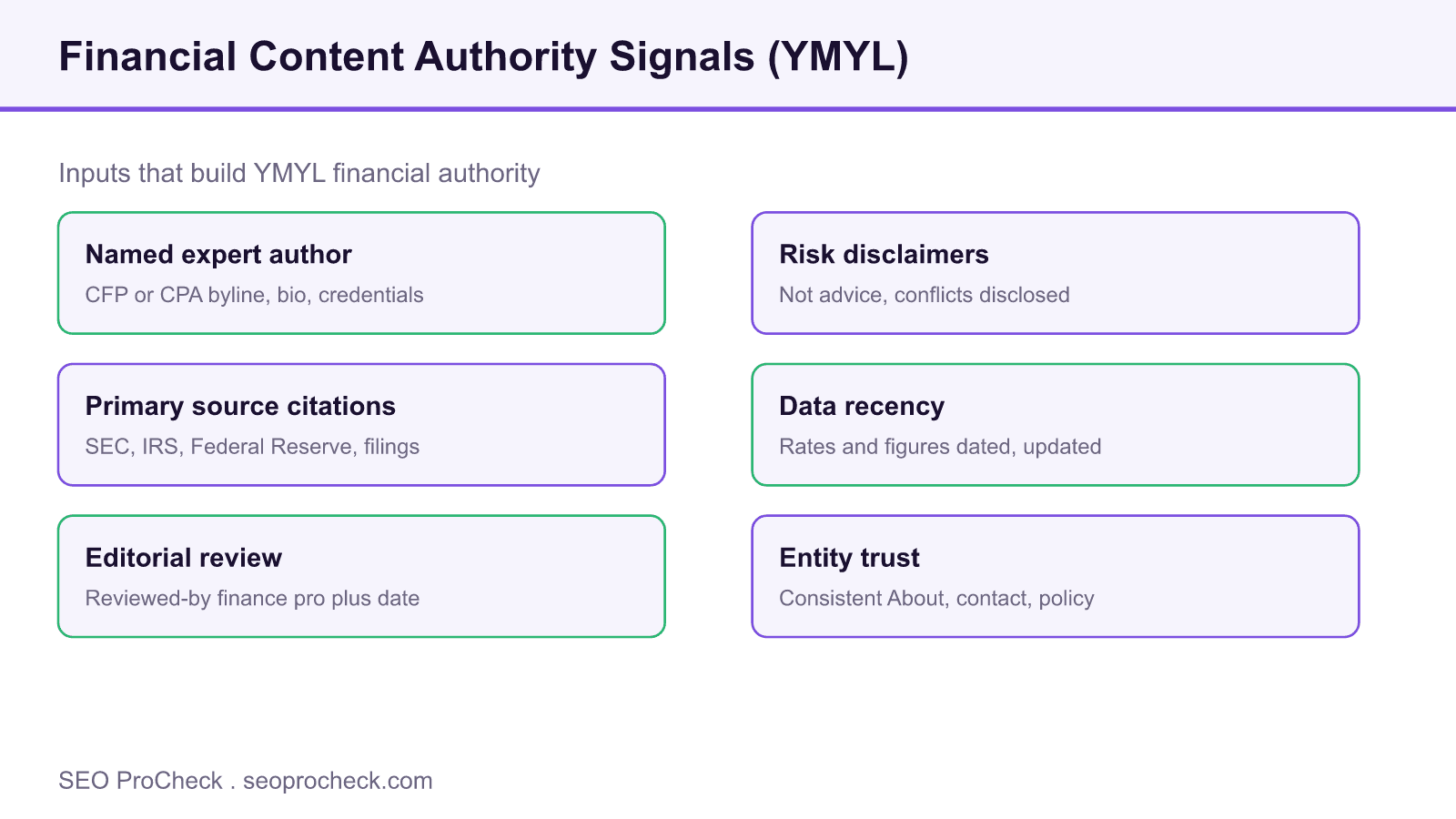
Financial topics sit squarely in the Your Money or Your Life category, the class of content Google says can meaningfully affect a person's wealth and wellbeing. That places financial pages under the strictest interpretation of E-E-A-T, where the burden is not just to be correct but to visibly demonstrate why a reader and an algorithm should trust you. This guide lays out the concrete authority signals that separate a credible financial publisher from generic content, and shows the markup that makes those signals machine readable.
Start with a credentialed, named author
Anonymous or generic staff bylines are a liability on financial content. Attach a real author with a verifiable professional designation: Certified Financial Planner, Certified Public Accountant, Chartered Financial Analyst, or a named securities license. The byline should link to a full bio page that states the credential, links to an external verification such as a FINRA BrokerCheck record or a state CPA registry, and lists relevant experience. Then encode the same facts so machines can parse them:
{"@type":"Person","name":"Jane Ruiz, CFP","hasCredential":{"@type":"EducationalOccupationalCredential","credentialCategory":"Certified Financial Planner"},"sameAs":["https://brokercheck.finra.org/individual/summary/0000000"]}
Our Person schema reference covers the full property set for author markup.
Add an expert review layer
For anything beyond basic explainers, separate the writer from the reviewer. A qualified professional who verifies the article and is shown with a "reviewed by" line and a review date adds a second, independent trust signal. Represent the relationship in Article schema so it is explicit:
{"@type":"Article","author":{"@type":"Person","name":"Jane Ruiz, CFP"},"reviewedBy":{"@type":"Person","name":"Alan Cho, CPA"},"dateModified":"2026-07-21"}
Publish a public editorial policy page that describes how pieces are fact checked, who reviews them, and how corrections are handled, then link it from every financial article.
Cite primary sources, not secondary blogs
Authority collapses when a claim about tax rules links to another content site instead of the rule itself. Go to the origin:
- SEC EDGAR for company filings, prospectuses, and 10-K data
- IRS.gov for contribution limits, brackets, and deadlines
- Federal Reserve and FRED for interest rates and monetary data
- Bureau of Labor Statistics for inflation and employment figures
Link the specific document, quote the figure exactly, and note the date you retrieved it. This is also what AI answer engines look for when they decide which source to cite.
Keep figures dated and current
Financial numbers decay. A 401k contribution limit or a marginal tax bracket that was right last year is now a trust failure. Put a visible last updated date near the top of the article, tie it to dateModified in schema, and schedule a real review whenever the underlying figure changes. Never let a stale rate sit under a fresh looking design.
Disclaim honestly
Add a plain disclaimer that the content is educational and not individualized advice, and disclose any affiliate relationships or conflicts of interest. Far from weakening the page, this signals regulatory awareness and professionalism, the exact qualities a quality rater is trained to reward on money topics.
Financial authority signals and where to implement them
| Signal | Implementation | Where it lives |
|---|---|---|
| Credentialed author | Designation in byline plus hasCredential markup | Byline, bio page, Person schema |
| Expert review | Reviewed by line and reviewedBy property | Article header, Article schema |
| Primary citations | Deep links to SEC, IRS, Fed, BLS with dates | Body copy and reference list |
| Data recency | Visible last updated date, dateModified | Article header, schema |
| Disclaimers | Not advice notice, conflict disclosure | Article footer, editorial policy page |
These tactics are the finance specific application of a broader discipline. For the full framework, read our complete guide to E-E-A-T and the wider E-E-A-T optimization hub. If you work in fintech specifically, our fintech and finance SEO strategy guide goes deeper on category level tactics.
Frequently asked questions
Why is financial content treated more strictly by Google?
Financial content falls under Your Money or Your Life, the category where inaccurate information can damage a person's finances. Google's quality raters are told to apply the highest scrutiny to expertise and trust here, so authority signals that would be optional elsewhere become close to mandatory.
What credentials actually move the needle for finance articles?
Recognized professional designations such as CFP, CPA, CFA, or a relevant securities license carry the most weight, because they are verifiable and regulated. Display them in the byline and back them with a linked bio and a FINRA BrokerCheck or licensing profile so the claim is checkable, not just asserted.
Do I need a separate author and reviewer?
It helps for complex topics. A qualified reviewer who checks the piece for accuracy, shown with a reviewed by line and date, adds a distinct layer of trust on top of the writer. Represent both in Article schema using the author and reviewedBy properties.
Which primary sources should financial content cite?
Cite the original regulator or data owner rather than a secondary blog: SEC EDGAR for filings, IRS.gov for tax rules, the Federal Reserve and FRED for rates, and the Bureau of Labor Statistics for economic data. Link the specific document and note the date you accessed it.
How often should financial figures be updated?
Any rate, limit, or threshold that changes annually or more often needs a visible last updated date and a real refresh on that cadence. Contribution limits, tax brackets, and interest rates go stale fast, and outdated numbers are one of the clearest trust failures raters look for.
Do disclaimers help or hurt authority?
A clear disclaimer that the content is educational and not personalized advice, along with any conflicts of interest, strengthens trust rather than weakening it. It signals that you understand the regulatory context, which is exactly the professionalism raters expect from a credible financial publisher.
Take this with you
The assistant links open with a question about this page already written. Nothing is sent until you press enter.
Claude Vincent is a technical SEO consultant focused on crawlability, rendering, and AI-search visibility. He writes the field guides and case studies at SEO ProCheck, with a bias toward the durable, unglamorous work that decides whether search engines and AI answer engines can actually read and cite a site.
About SEO ProCheck
Technical SEO consulting and GEO strategy with 20 years of enterprise experience. Case studies, resources, and tools for search and AI visibility.
Work With Me
Technical SEO audits, GEO strategy, site migrations, and international SEO. Hourly consulting for teams who need hands-on support, not just reports.
Subscribe to our newsletter!








Recent Posts
- Most Top Sites Never Say Who They Are in Structured Data October 14, 2026
- Homepage Titles Are Mostly Too Short, Not Too Long October 8, 2026
- Who Actually Serves an llms.txt? 184 Top Sites Measured September 29, 2026