

AI Summary
A footer link strategy uses the sitewide footer to reinforce crawl paths and pass equity to your priority hub pages, alongside the utility and legal links users expect. It works when the footer is purposeful and restrained; it backfires when it becomes a dumping ground for keyword-stuffed location anchors.
- Footer links carry less weight than in-content links but appear on every page, so they aid crawling and equity flow.
- Group the footer into utility, priority hubs, and legal or social zones.
- Never stuff the footer with dozens of exact-match city or service links; it dilutes equity and reads as manipulation.
- Keep internal footer links followed so equity flows; reserve nofollow for paid or untrusted external links.
The footer is the most predictable block on a website. It appears on every page, which makes it a genuine site-architecture tool and, in the wrong hands, a genuine liability. A good footer link strategy uses that sitewide reach to reinforce crawl paths and push equity toward the pages you most want to rank, while giving visitors the utility and legal links they expect. A bad one treats the footer as free real estate for a hundred keyword-rich anchors and quietly drags the whole site down.
This guide covers what the footer is actually good for, how to structure it, how equity flows through it, and the over-optimisation trap that turns a helpful footer into a link-scheme signal.
What footer links are good at
Because footer links are present on every URL, they do two useful jobs. First, they create reliable crawl paths: whatever you link in the footer is one hop from every page, so search engines discover and recrawl those targets efficiently. Second, they distribute link equity sitewide toward those targets. The catch is prominence. Google understands that footer links sit at the bottom of the page and are boilerplate, so it generally weights them less than a link inside your main content. That is not a reason to ignore the footer, it is a reason to use it for reinforcement rather than as your primary ranking mechanism.
Structure the footer into three zones
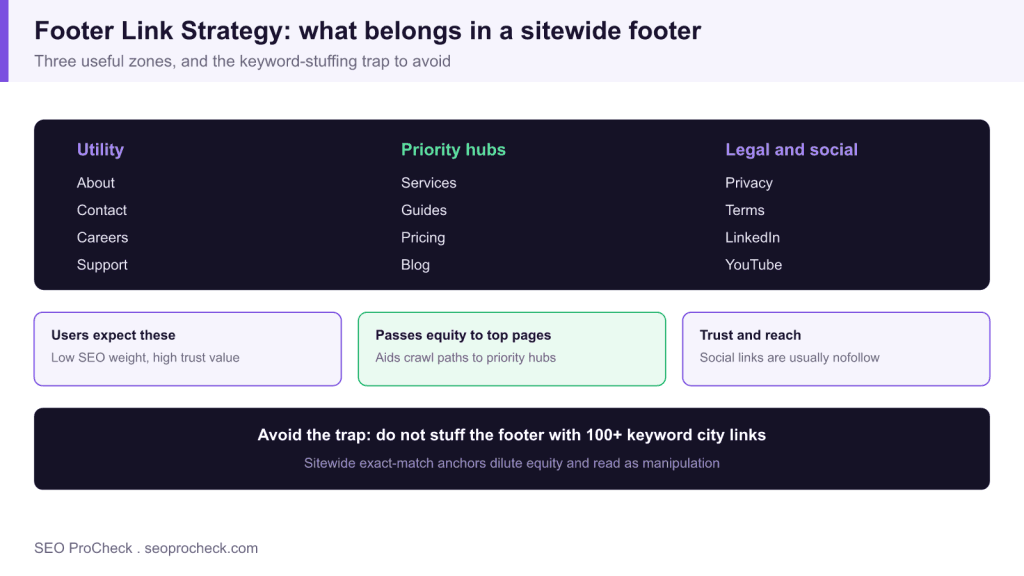
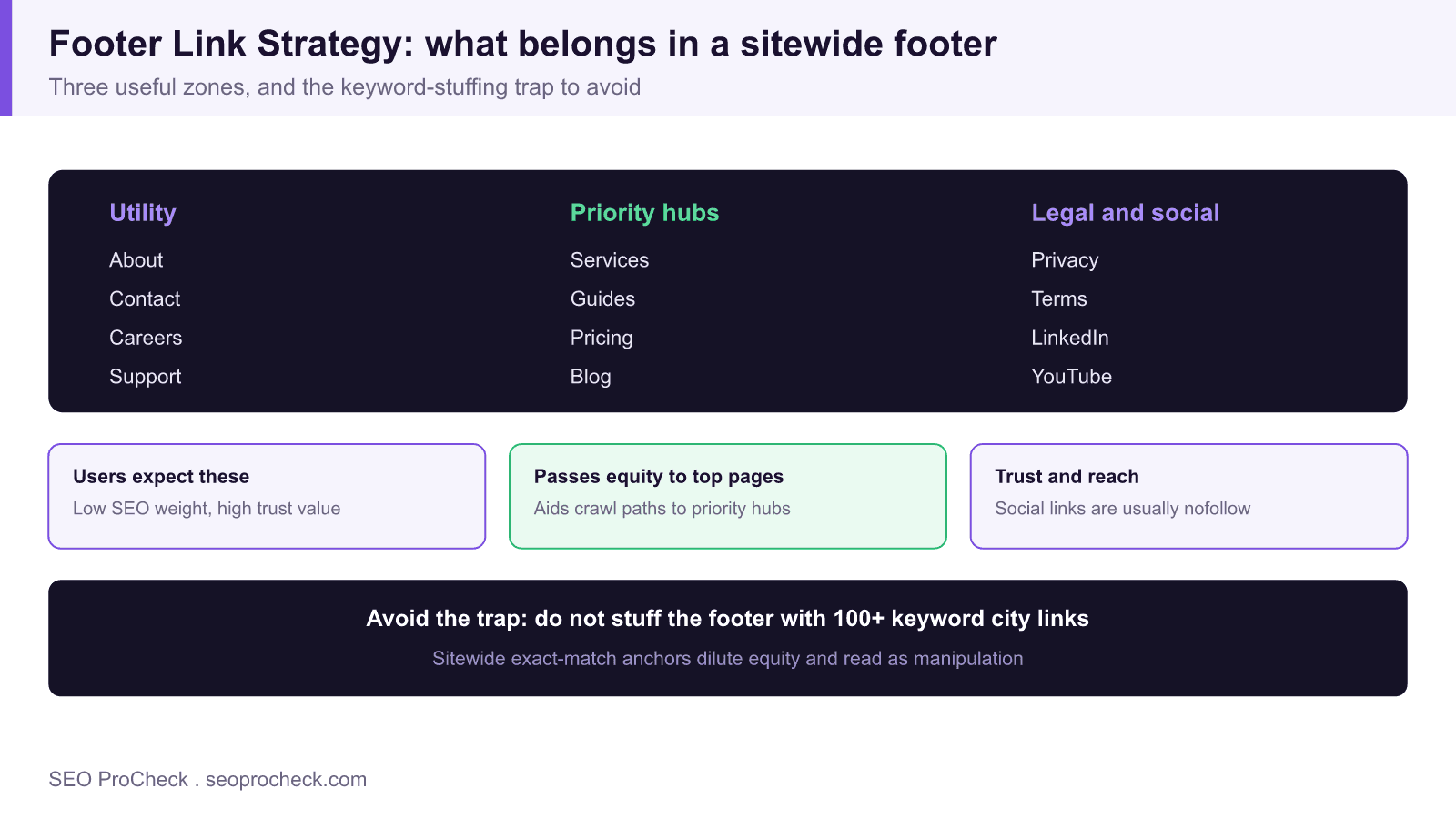
The cleanest footers separate links by purpose, which the diagram above illustrates. Thinking in zones keeps the footer useful for people and disciplined for SEO.
- Utility. About, contact, careers, support. Users expect these, and they build trust even though their direct SEO weight is low.
- Priority hubs. Your most important category, service, or resource pages. This is the SEO-active zone: linking hubs here reinforces crawl paths and channels equity to the pages that earn revenue or rankings.
- Legal and social. Privacy, terms, and social profiles. These support trust and reach; social links are frequently left as normal links, though some sites nofollow them.
Notice what is not a zone: a wall of exact-match keyword links. Everything in a healthy footer either helps a user complete a task or reinforces a page you have deliberately chosen to prioritise.
How equity flows through the footer
Every page divides its outbound link equity across all of its links. A page with a lean footer of, say, twenty carefully chosen links gives each target a meaningful share. The same page with a two-hundred-link footer gives each target a fraction of that, including the priority hubs you actually care about. This is why bloated footers are self-defeating: in trying to link everything, they weaken the links that matter.
| Footer pattern | Crawl and equity effect | Risk level | Verdict |
|---|---|---|---|
| Utility plus a few priority hubs | Focused equity to key pages | Low | Recommended |
| Full navigation duplicated | Equity spread thin | Low to medium | Trim to essentials |
| Dozens of city or service anchors | Diluted, exact-match footprint | High | Replace with a hub structure |
| Reciprocal links to unrelated sites | Passes equity off-site sitewide | High | Remove |
The over-optimisation trap
The most common footer mistake is the location or service dump: a business that serves many areas lists every "service in city" variation in the footer, sitewide, with exact-match anchors. This does three bad things at once. It dilutes equity across hundreds of links, it creates a sitewide exact-match anchor footprint that looks manipulative, and it usually points at thin or nonexistent landing pages. If you genuinely serve many locations, build a real, crawlable hub and spoke structure with substantive pages, and link to the hub from the footer rather than cramming every leaf into every page. Our complete guide to internal linking walks through how to build that hierarchy properly.
A practical footer audit
To review an existing footer, crawl the site and count the outbound links present on every URL. Then ask three questions of each footer link. Does a real user need it. Does it point at a page you actually want to prioritise. Is its anchor a natural label rather than a stuffed keyword phrase. Links that fail all three are candidates for removal. Pay special attention to whether footer links create orphan-avoidance value, since a page reachable only through the footer is weakly supported; if a page matters, it should also earn contextual links, a problem we cover in our note on missing internal links. Cutting a bloated footer almost always concentrates equity where you want it and simplifies the crawl at the same time.
Rendering, mobile, and accessibility
A footer only helps if search engines can see it in the rendered HTML. If your footer links are injected by JavaScript that runs late or behind an interaction, some crawlers may miss them, so confirm the links appear in the rendered source using a tool such as the URL Inspection live test. Collapsing the footer into an accordion on mobile is fine for users as long as the links remain in the DOM rather than being loaded only on tap. Accessibility and SEO align here: descriptive, human-readable anchor text that names the destination helps screen-reader users and gives search engines a clear signal at the same time. Icon-only social links should carry an accessible label so both audiences understand where they lead. A footer that renders server-side, keeps its links in the markup, and uses plain labels satisfies crawlers, assistive technology, and visitors together.
Footer strategy checklist
- Group links into utility, priority hubs, and legal or social zones.
- Keep the total link count purposeful, not exhaustive.
- Use natural anchors, never repeated exact-match keyword phrases.
- Keep internal footer links followed; reserve nofollow for paid or untrusted external links.
- Replace location dumps with a real hub page structure.
Treated as a reinforcement layer rather than a ranking shortcut, the footer quietly strengthens crawlability and pushes equity to the pages that deserve it. That is the whole job, and it is enough.
Frequently asked questions
Do footer links help SEO?
Yes, modestly and mostly for crawlability and equity distribution. Footer links appear on every page, so they create reliable crawl paths to whatever you place there and pass some link equity sitewide. They carry less weight than prominent in-content links, so use the footer to reinforce priority hubs, not to rank a page on footer links alone.
How many links should a footer have?
There is no hard limit, but keep it purposeful. A footer with a few dozen relevant links to hubs, utility pages, and legal or social destinations is fine. A footer with a hundred or more exact-match keyword links, especially location lists, spreads equity thin and looks like manipulation. If a link does not help users or a priority page, leave it out.
Are sitewide footer links bad for SEO?
Sitewide links are not inherently bad; your own navigation and footer are sitewide by design. The risk is with sitewide links that use commercial exact-match anchors at scale, which Google can treat as a footprint. Internal footer links to your own pages are safe; the caution mainly applies to external sitewide links and keyword-stuffed anchors.
Should footer links be nofollow?
Internal footer links to your own pages should be normal followed links, so equity flows through your site. External links such as social profiles are commonly left as normal links too, though some sites nofollow them. Reserve rel=nofollow or rel=sponsored for external links that are paid or that you do not want to vouch for.
Can too many footer links dilute link equity?
Yes. Link equity from a page is shared across its outbound links, so a footer with hundreds of links gives each one a smaller share, including your important ones. Trimming a bloated footer to the links that genuinely matter concentrates more equity on your priority hubs, which is usually a net gain.
What should never go in a footer for SEO reasons?
Avoid long lists of keyword-rich location or service-plus-city links added purely to rank, hidden links, and reciprocal link blocks with unrelated sites. These are classic over-optimisation and link-scheme signals. If you serve many locations, use a real, crawlable hub page structure instead of cramming every variation into every page footer.
Claude Vincent is a technical SEO consultant focused on crawlability, rendering, and AI-search visibility. He writes the field guides and case studies at SEO ProCheck, with a bias toward the durable, unglamorous work that decides whether search engines and AI answer engines can actually read and cite a site.
About SEO ProCheck
Technical SEO consulting and GEO strategy with 20 years of enterprise experience. Case studies, resources, and tools for search and AI visibility.
Work With Me
Technical SEO audits, GEO strategy, site migrations, and international SEO. Hourly consulting for teams who need hands-on support, not just reports.
Subscribe to our newsletter!







Recent Posts
- Finding a Competitor's Sitemap, and Turning It Into a Change Log September 15, 2026
- AI Crawler User Agents: The Current Names, and Which Ones Sites Actually Block September 9, 2026
- Can AI Crawlers Actually Read Your Site? I Measured 400 of the Biggest September 5, 2026