

Hreflang Implementation: Complete Technical Guide
- March 9, 2020
- International SEO and Hreflang, Technical SEO
AI Summary
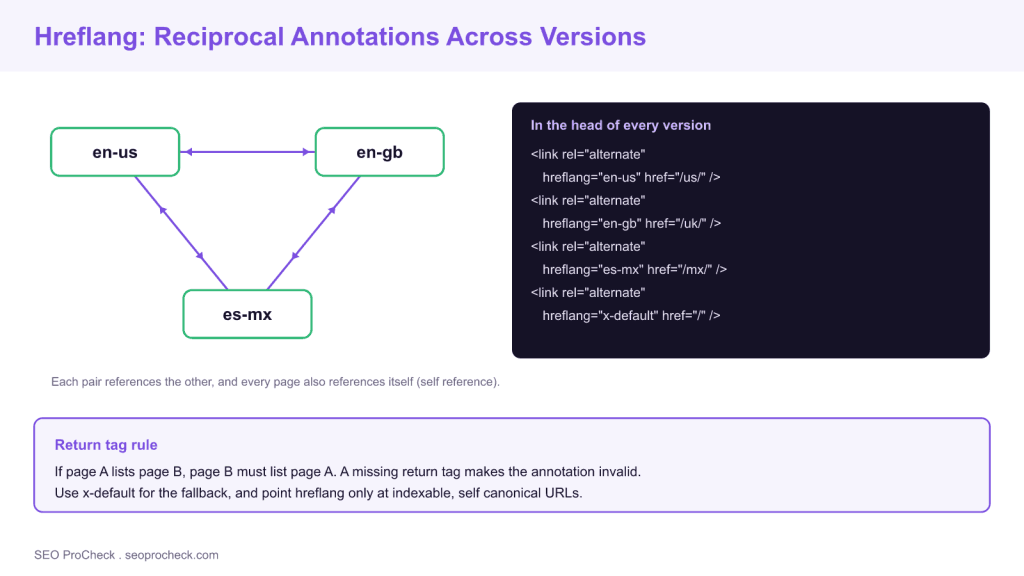
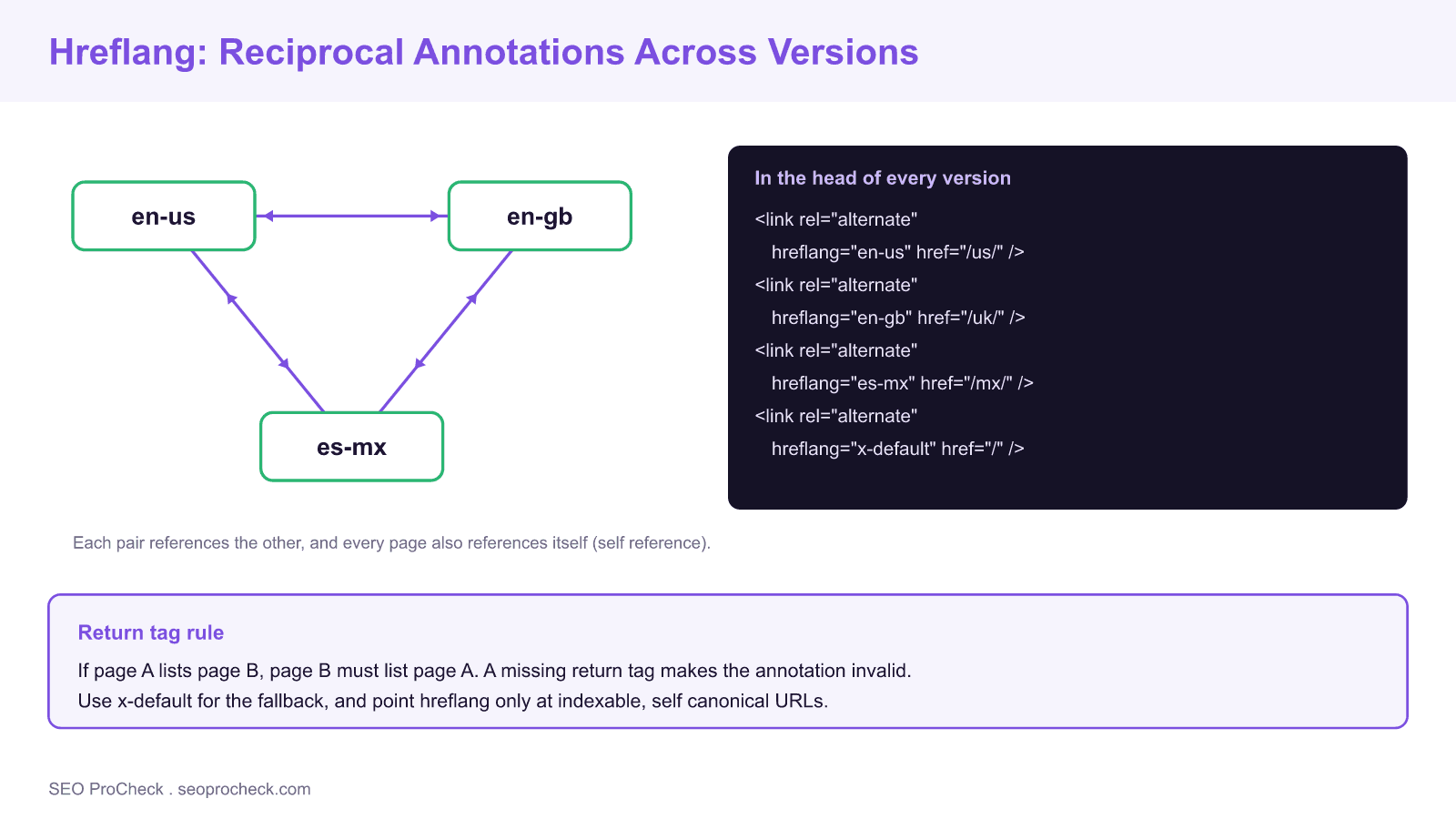
Hreflang annotations tell search engines which language and regional version of a page to serve, using ISO language codes optionally paired with region codes. Every version in a set must reference all others plus itself, and the annotations must point only at indexable, self canonical URLs or they are ignored.
- Use language codes (en, es) or language plus region codes (en-us, es-mx), and add x-default for the fallback.
- Make annotations reciprocal: if page A lists page B, page B must list page A (the return tag rule).
- Pick one delivery method (HTML head, HTTP header, or XML sitemap) and do not mix methods for the same URLs.
- Never point hreflang at redirected, noindexed, or non canonical URLs.
Understanding Hreflang
The hreflang attribute tells search engines which language and regional versions of a page exist, helping serve the right version to users in different locations or language preferences. Proper hreflang implementation prevents duplicate content issues across language versions and improves user experience by directing visitors to content in their preferred language. While hreflang is primarily a Google signal (Bing uses different methods), it's essential for any site targeting multiple languages or regions.
Hreflang Syntax and Format
Hreflang uses ISO 639-1 language codes (en, es, fr) optionally combined with ISO 3166-1 Alpha 2 region codes (en-US, en-GB, es-MX). The x-default value indicates the fallback page for users not matching any specified language/region. Every page in a hreflang set must reference all other versions including itself (self-referencing). This bidirectional confirmation prevents unauthorized sites from claiming relationship with your content.
| Code | Targets | Use Case |
|---|---|---|
| en | English speakers, any region | Single English version for all regions |
| en-US | English speakers in United States | US-specific content, pricing, spelling |
| en-GB | English speakers in United Kingdom | UK-specific content |
| es | Spanish speakers, any region | General Spanish content |
| es-MX | Spanish speakers in Mexico | Mexico-specific content |
| x-default | Users not matching other versions | Language selector page or global default |
Implementation Methods
Three implementation methods exist with identical SEO effect. HTML link elements in the head section work for smaller sites but add code to every page. HTTP headers suit non-HTML content like PDFs. XML sitemap implementation centralizes management and is recommended for large sites, though it requires careful sitemap maintenance. Choose based on your CMS capabilities and site size. Never mix methods for the same URL set, as this can create conflicts.
Common Hreflang Errors
Return tag errors occur when page A references page B, but page B doesn't reference page A. Missing self-referencing annotations break the hreflang set. Incorrect language/region codes invalidate annotations. Non-canonical URLs in hreflang create conflicts between canonicalization and language targeting. Pointing hreflang to redirected, 404, or noindexed URLs wastes the annotation. Google Search Console's International Targeting report shows hreflang errors, though it samples rather than reports all issues. Use crawling tools to audit hreflang at scale.
Hreflang Strategy Decisions
Not every page needs every language version. Implement hreflang only between pages that are true equivalents in content. For partially translated sites, include only the languages that exist for each specific page. Consider whether to use language-only codes (en) or language-region codes (en-US) based on how different your regional versions actually are. If US and UK English content is identical, use single "en" version rather than creating artificial regional variants. Use x-default strategically, typically pointing to an international landing page with language selection or your primary market's version.
Choosing a Delivery Method
The three delivery methods produce the same result, so the choice is operational. HTML link tags in the head are simplest to reason about but add weight to every page and are easy to break during template edits. HTTP headers are the only option for non HTML files such as PDFs. XML sitemap annotations keep the markup out of the page and centralise maintenance, which suits large catalogues, but a stale or partial sitemap silently drops annotations. Whatever you choose, apply it consistently and never describe the same URL set with two competing methods.
| Method | Where It Lives | Best For | Main Risk |
|---|---|---|---|
| HTML link tags | Page head | Small to mid sites, quick setup | Page weight, template breakage |
| HTTP headers | Server response | PDFs and other non HTML files | Harder to audit and debug |
| XML sitemap | Sitemap file | Large catalogues, central control | Stale sitemap drops annotations |
For a step by step build, see our companion walkthrough on how to implement hreflang tags.
Auditing Hreflang at Scale
Manual checks do not survive contact with a large multilingual site, so audit programmatically. Crawl the site with a tool that extracts hreflang, then verify four things for each set: every URL returns 200 and is self canonical, every annotation is reciprocal, the language and region codes are valid, and x-default is present exactly once. The Search Console International Targeting report surfaces return tag errors but only samples, so treat crawler output as the source of truth. When you find breakage, the usual culprits are canonical tags that point somewhere other than the annotated URL and annotations that survived a URL migration but the pages did not.
Hreflang decisions also interact with how you split regions across domains. If you are weighing ccTLDs against subfolders or subdomains, read our guide to international site structure and the tradeoffs in subdomain versus subdirectory. Because both hreflang and parameter handling depend on clean canonicalization, it is worth aligning them with your approach in the URL parameters guide.
Frequently Asked Questions
What is the difference between hreflang en and en-us?
The code en targets English speakers in any region, while en-us targets English speakers in the United States specifically. Use language only codes when one version serves all regions, and add a region code only when the content, pricing, or spelling genuinely differs by market.
Does hreflang help rankings?
Hreflang is not a ranking boost. It helps search engines serve the correct language or region version to each user and prevents duplicate content confusion across versions. Better targeting improves click through and user experience, which supports performance indirectly.
What is a return tag error?
A return tag error occurs when page A references page B in its hreflang set but page B does not reference page A back. Hreflang requires reciprocal confirmation, so a missing return tag causes search engines to ignore the annotation entirely.
Do I need x-default?
The x-default value is recommended but not mandatory. It names the fallback page for users who do not match any specified language or region, typically a language selector or your primary market version. Include it exactly once per set to avoid ambiguity.
Should hreflang URLs be canonical?
Yes. Every URL in a hreflang set should be self canonical and indexable. Pointing hreflang at a URL whose canonical tag names a different page creates a conflict between canonicalization and language targeting, and search engines will usually drop the annotation.
Does Bing use hreflang?
Bing does not use hreflang. It relies on the content language meta tag and its own geotargeting signals. Hreflang is primarily a Google signal, so international sites targeting Bing should also set language metadata and configure geotargeting where available.
Take this with you
The assistant links open with a question about this page already written. Nothing is sent until you press enter.
Claude Vincent is a technical SEO consultant focused on crawlability, rendering, and AI-search visibility. He writes the field guides and case studies at SEO ProCheck, with a bias toward the durable, unglamorous work that decides whether search engines and AI answer engines can actually read and cite a site.
About SEO ProCheck
Technical SEO consulting and GEO strategy with 20 years of enterprise experience. Case studies, resources, and tools for search and AI visibility.
Work With Me
Technical SEO audits, GEO strategy, site migrations, and international SEO. Hourly consulting for teams who need hands-on support, not just reports.
Subscribe to our newsletter!







Recent Posts
- Finding a Competitor's Sitemap, and Turning It Into a Change Log September 15, 2026
- AI Crawler User Agents: The Current Names, and Which Ones Sites Actually Block September 9, 2026
- Can AI Crawlers Actually Read Your Site? I Measured 400 of the Biggest September 5, 2026