

AI Summary
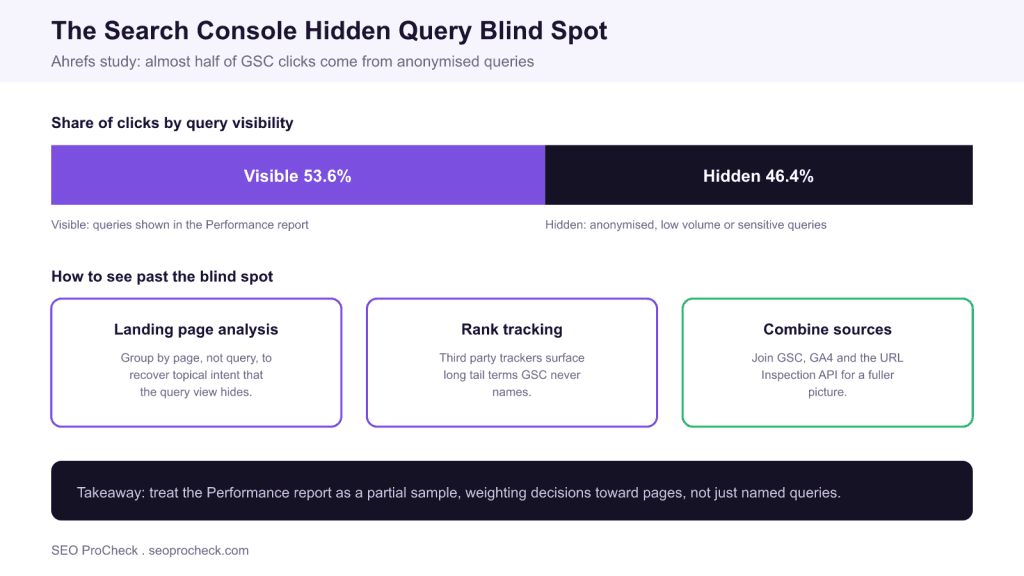
Ahrefs found that about 46.4 percent of the clicks Google Search Console reports come from queries it anonymises, so the visible Performance report is only a partial sample. Practitioners should read query data as directional, lean on the page level view, and cross check with rank trackers and analytics to see the long tail that GSC hides.
- Roughly half of your organic clicks are attributed to queries GSC never names.
- Smaller sites lose more query visibility because their traffic skews to low volume long tail terms.
- The page level Performance report has no query anonymisation gap, so group by page to recover intent.
- Combine GSC, GA4, the URL Inspection API and a rank tracker to rebuild the missing picture.
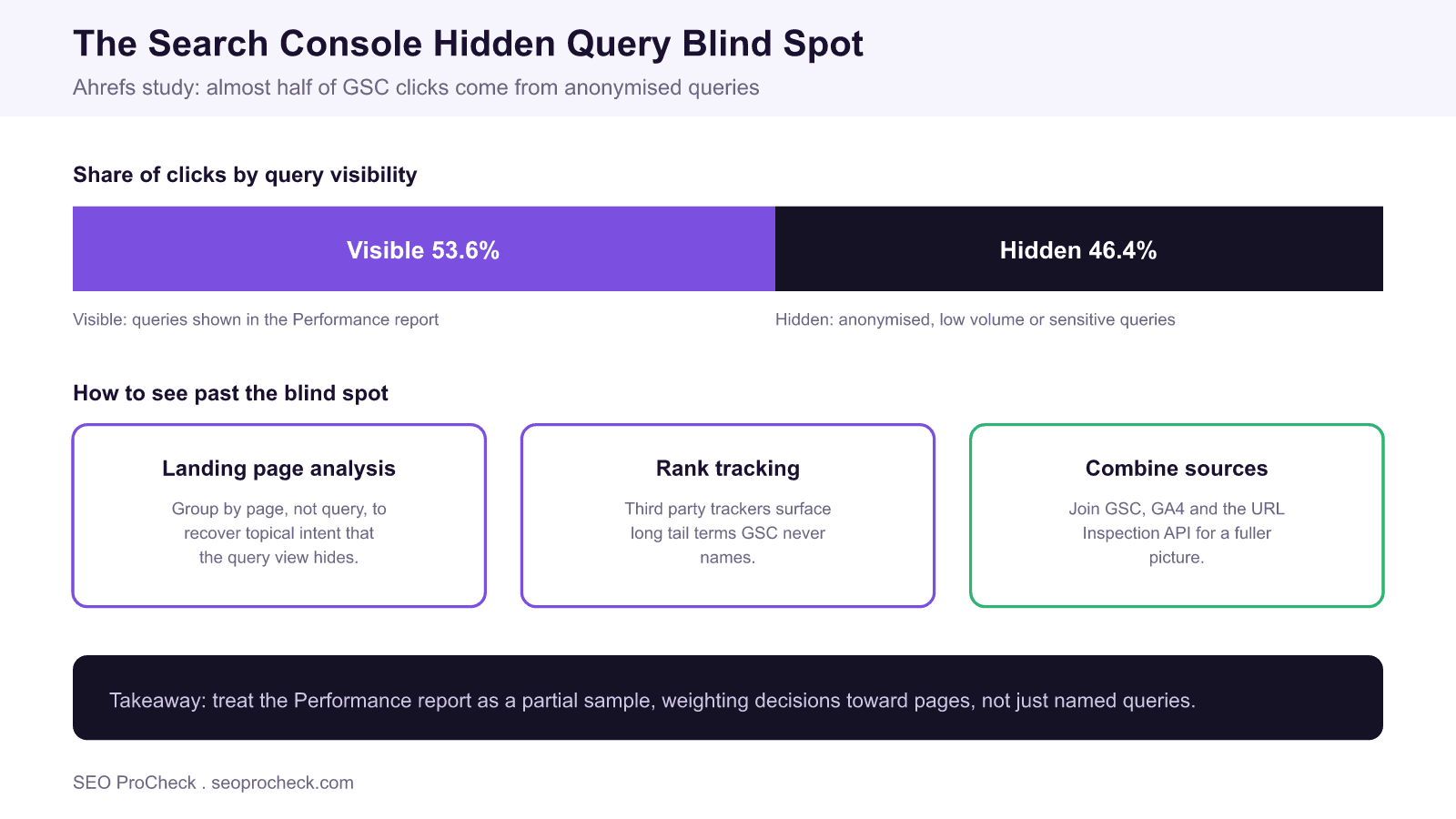
Ahrefs published research revealing that nearly half of clicks reported in Google Search Console come from queries that are hidden or anonymized by Google. The study quantifies a significant blind spot in SEO analytics that affects how practitioners understand their search visibility.
The Hidden Query Problem
Google Search Console anonymizes queries when search volume falls below certain thresholds or when queries are deemed sensitive. The study found that approximately 46.4% of clicks came from these hidden queries. This means SEOs are making decisions with incomplete data about nearly half of their organic traffic.
Impact by Site Size
Smaller sites with less traffic saw higher percentages of hidden queries because more of their traffic came from low-volume long-tail terms. Larger sites with significant branded search traffic had more visible query data. This creates a data disadvantage for smaller publishers trying to understand their search performance.
Working Around the Limitation
The research suggested strategies for inferring hidden query performance. Landing page analysis can reveal topical patterns when query data is unavailable. Third-party rank tracking tools can supplement GSC data. Combining GSC with other analytics data helps build a more complete picture despite the limitations.
Strategic Implications
Understanding that reported queries represent only partial data should temper confidence in GSC-based decisions. Traffic from hidden terms often represents valuable long-tail opportunities. Content strategies shouldn't focus exclusively on visible high-volume terms while ignoring the substantial traffic from hidden queries.
Source: Ahrefs Blog
Field Notes: Working With a Partial Sample
Google anonymises a query when it cannot show it without risking the privacy of the people who searched it, which in practice means rare, unique or sensitive strings fall below a reporting threshold and get bundled into the unnamed remainder. That is why the gap is largest for the long tail: the more your traffic depends on unique phrasings, the more of it lands in the anonymised bucket. Treat the query table in the Google Search Console Performance report as a sample of your strongest terms, not a census of demand.
The reliable workaround is to pivot from the query dimension to the page dimension. In the Performance report, switch to the Pages tab: page level clicks and impressions are not subject to the same query anonymisation, so the totals reconcile with your real traffic. Sort pages by clicks, then open a single high traffic URL and add the Queries filter to see which named terms Google will admit for that page. The delta between the page total and the sum of its named queries is a rough measure of the hidden share for that URL. For repeatable reporting, pull the same data programmatically with the Search Console API using the page dimension, and reconcile it against the Page indexing report so you are only analysing URLs Google actually indexes.
To recover the intent behind the hidden terms, layer three more sources. A third party rank tracker surfaces the specific long tail keywords you choose to monitor, which fills part of the void GSC leaves. GA4 landing page reports show which entrance pages convert, letting you value traffic even when the query is invisible. Bing Webmaster Tools applies different thresholds and often names queries Google will not, so it is a useful, free cross check. None of these is a full substitute, but together they turn a 54 percent sample into a workable estimate of the whole.
| Data source | What it reveals | Key limitation |
|---|---|---|
| GSC Performance, query view | Named queries above the privacy threshold | About 46 percent of clicks stay anonymised |
| GSC Performance, page view | Clicks and impressions per URL with no query gap | No query attribution at all |
| URL Inspection API | Index state, canonical, crawl status per URL | No performance or query data |
| GA4 landing pages | Sessions and conversions by entrance page | No query, subject to sampling |
| Third party rank tracker | Estimated positions for terms you track | Limited to the keywords you choose |
| Bing Webmaster Tools | Query data under different thresholds | Smaller traffic share than Google |
What's Changed Since the Study
The blind spot the study measured has not closed. Google still applies query anonymisation in the Performance report for privacy reasons, and the Search Console query table remains capped at 1,000 rows per query with 16 months of retention, so the structural limits that produced the finding are all still in force. If anything the picture has grown harder to read: as AI Overviews and other generative features absorb more informational demand, some searches resolve without a classic result click, which further widens the distance between the queries people run and the query rows you can see. Read the original figure as a floor, not a ceiling, and keep validating your named queries against page level totals rather than assuming the query table is complete.
Frequently Asked Questions
Why does Google Search Console hide some search queries?
Google anonymises queries it considers too rare or too sensitive to show without risking user privacy. When a query has very low volume, naming it could identify an individual searcher, so it is grouped into an unnamed remainder. This is a deliberate privacy control, not a bug or a data delay.
What percentage of Search Console clicks are hidden?
The Ahrefs study found that approximately 46.4 percent of clicks reported in Search Console came from anonymised queries. That means nearly half of organic click data has no named query attached. The exact share varies by site depending on how much traffic comes from long tail terms.
Do smaller sites have more hidden queries than large sites?
Yes. Smaller sites tend to draw a larger share of traffic from low volume long tail phrases, and those are exactly the queries most likely to fall below the anonymisation threshold. Larger sites with heavy branded search have more terms that clear the threshold, so a bigger proportion of their query data is visible.
How can I see the queries that Search Console hides?
You cannot recover the exact hidden strings, but you can estimate the demand behind them. Switch to the page dimension to get complete click totals, use a rank tracker to monitor specific long tail terms, and cross reference GA4 and Bing Webmaster Tools. Together these approximate the traffic the query view omits.
Does the page level report also anonymise data?
No. Page level clicks and impressions are not subject to the query anonymisation threshold, so the page totals reconcile with your actual traffic. This is why grouping by page is the most reliable way to size the hidden query gap for any given URL.
Has Google fixed the hidden query problem?
No. The anonymisation is a permanent privacy feature rather than a limitation Google intends to remove. The 16 month retention window and per query row caps also remain, so the blind spot the study documented still applies to Search Console today.
Take this with you
The assistant links open with a question about this page already written. Nothing is sent until you press enter.
Claude Vincent is a technical SEO consultant focused on crawlability, rendering, and AI-search visibility. He writes the field guides and case studies at SEO ProCheck, with a bias toward the durable, unglamorous work that decides whether search engines and AI answer engines can actually read and cite a site.
About SEO ProCheck
Technical SEO consulting and GEO strategy with 20 years of enterprise experience. Case studies, resources, and tools for search and AI visibility.
Work With Me
Technical SEO audits, GEO strategy, site migrations, and international SEO. Hourly consulting for teams who need hands-on support, not just reports.
Subscribe to our newsletter!








Recent Posts
- Most Top Sites Never Say Who They Are in Structured Data October 14, 2026
- Homepage Titles Are Mostly Too Short, Not Too Long October 8, 2026
- Who Actually Serves an llms.txt? 184 Top Sites Measured September 29, 2026