

AI Summary
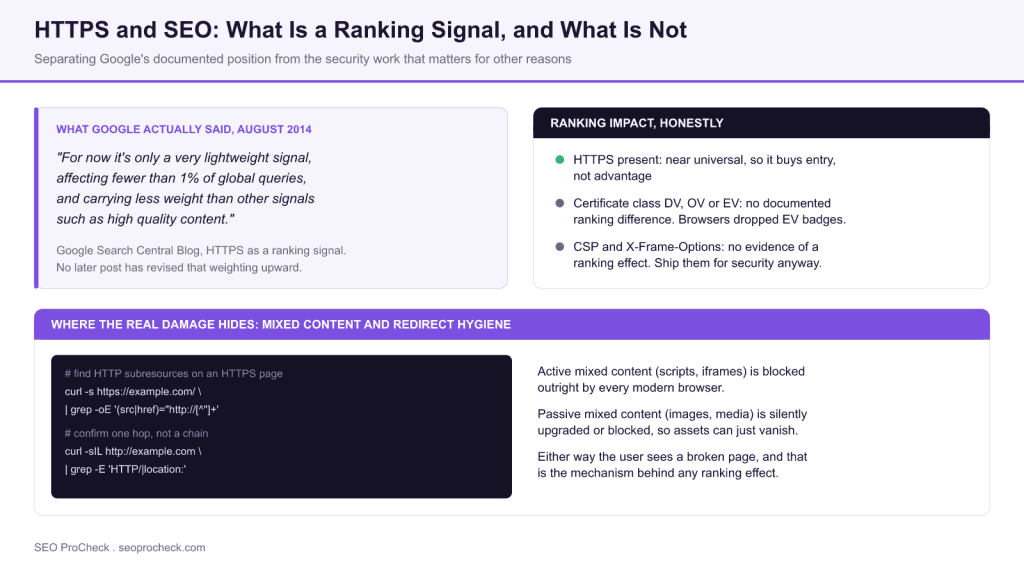
HTTPS is a confirmed Google ranking signal, but a deliberately tiny one: Google described it in August 2014 as "only a very lightweight signal, affecting fewer than 1% of global queries" and has never published a revision. Because adoption is now near universal, HTTPS buys you entry to the competition rather than an advantage within it.
- Certificate class (DV, OV, EV) has no documented ranking effect, and browsers removed the EV badge from the address bar in 2019.
- Security headers such as CSP and X-Frame-Options have no evidence of a ranking effect. Deploy them for security, not for SEO.
- Mixed content is the real risk: browsers block active mixed content, and Googlebot renders in Chromium under the same rules.
- The highest value checks are unglamorous: single hop redirects, HSTS, valid chain, https canonicals, https sitemap.
- Provenance note: the summary below is an uncited internal compilation with no retrievable published study behind it.
The summary that follows is attributed at the foot of this page to "HTTPS and security SEO research compiled". That is not a citation to a published, retrievable study, and we have not been able to locate an underlying dataset, sample size or methodology for it. We are keeping the summary and its attribution as published rather than quietly deleting them, but you should read its quantitative claims, including the assertion that HTTPS adoption among top ranking sites "approached 100%", as unverified. Everything after the summary is sourced to documentation you can check yourself, and is clearly separated from it.
The original summary, as published
Research examining HTTPS adoption and security signals analyzed whether encryption provides ranking advantages beyond baseline requirements. The study examined ranking patterns for secure versus insecure sites.
HTTPS as Baseline Requirement
HTTPS adoption among top-ranking sites approached 100%, making encryption a practical requirement rather than competitive advantage. Sites without HTTPS faced browser warnings and user trust issues beyond any ranking considerations. The ranking benefit from HTTPS is enabling competition, not winning it.
Security Headers and Rankings
Implementation of security headers (Content-Security-Policy, X-Frame-Options, etc.) showed no clear ranking correlation. However, security best practices correlate with overall site quality that does influence rankings. Well-maintained sites tend to implement both security headers and SEO best practices.
Mixed Content Issues
Sites with mixed content warnings (HTTPS pages loading HTTP resources) showed ranking disadvantages. Beyond rankings, mixed content creates user experience and functionality issues. Ensuring complete HTTPS implementation without mixed content should be a technical priority.
Certificate and Configuration
Certificate type (DV, OV, EV) showed no ranking differences. Proper certificate configuration ensuring no errors or warnings is more important than certificate category. Regular certificate renewal and monitoring prevent ranking-affecting security errors.
What Google has actually documented
There is exactly one primary source that matters here, and it is short. On 7 August 2014, Google Search Central announced HTTPS as a ranking signal, and was unusually specific about how small it was:
"For now it's only a very lightweight signal, affecting fewer than 1% of global queries, and carrying less weight than other signals such as high-quality content, while we give webmasters time to switch to HTTPS. But over time, we may decide to strengthen it."
Google Search Central Blog, HTTPS as a ranking signal, August 2014
Two things follow from that sentence, and practitioners routinely get both wrong. First, the signal is real, so people who claim HTTPS does nothing for SEO are contradicting Google's own statement. Second, it is explicitly described as weaker than content quality and touching under one percent of queries, so people who sell an HTTPS migration as a ranking strategy are overselling it by an enormous margin.
Google said it might strengthen the signal later. In the years since, no Search Central post has announced that it did. Absence of an announcement is not proof of absence, but it is the whole of the public record, and building a strategy on an unannounced strengthening is speculation.
The same 2014 post gave implementation advice that is still the clearest statement of what Google cares about: decide whether you need a single, multi domain or wildcard certificate; use 2048 bit key certificates; use relative URLs for same domain resources and protocol relative URLs for others; do not block your HTTPS site in robots.txt; and allow indexing rather than applying a noindex robots meta tag. Note what is not on that list: certificate class, security headers, cipher suites, or TLS version.
| Claim you will hear | What the documented record supports | Verdict |
|---|---|---|
| HTTPS boosts rankings | Google, August 2014: a very lightweight signal, fewer than 1% of global queries, less weight than high quality content | True but negligible |
| EV certificates signal trust to Google | No Google statement exists. Chrome and Firefox both removed the EV company name from the address bar in 2019 | No support |
| Security headers improve rankings | No Google statement exists. Ship them for security reasons | No support |
| Mixed content can hurt you | Browsers block active mixed content; Googlebot renders in Chromium and is subject to the same blocking | Supported by mechanism |
| HTTP sites are penalised | There is no HTTP penalty. There is a Chrome Not Secure interstitial label and the absence of a small positive signal | Misframed |
The distinction that matters: HTTPS is a small ranking input, but broken HTTPS is a rendering and user experience problem, which is a much larger and more measurable risk.
What has changed since that 2014 announcement
The ranking signal has not visibly changed. The environment around it has changed completely, and the changes all moved the cost of not having HTTPS out of search and into the browser.
- Free certificates became universal. Let's Encrypt turned a DV certificate into a zero cost, automatable commodity. Certificate acquisition stopped being a budget line, which is a large part of why adoption became near total.
- Chrome began labelling all HTTP pages as Not Secure. From Chrome 68 in July 2018, every plain HTTP page carried the warning in the address bar, regardless of whether it collected data. This is a conversion problem, not a ranking problem, and it is far more expensive than the sub one percent signal.
- Browsers retired the EV indicator. Chrome 77 and Firefox 70, both in 2019, removed the green company name from the address bar. Whatever user trust argument once existed for extended validation certificates largely disappeared with the visual treatment that carried it.
- Mixed content handling got stricter. Active mixed content was already blocked. Browsers then moved to auto upgrading passive mixed content such as images where possible and blocking it where not, which means assets can silently disappear rather than merely warn.
- HTTP/2 and HTTP/3 arrived, and browsers only negotiate them over TLS. This is now the strongest practical performance argument for HTTPS, and it routes into Core Web Vitals, which genuinely are used in ranking.
That last point is worth dwelling on. The honest 2026 case for HTTPS is not the 2014 ranking signal at all. It is that HTTPS is the entry requirement for the transport protocols that make your Largest Contentful Paint achievable, and Core Web Vitals carry considerably more weight than the HTTPS signal ever did.
Mixed content: the failure mode that actually costs you
The original summary is right that mixed content matters, and the mechanism is worth spelling out because it explains why the effect is real without needing to invoke a penalty.
Googlebot renders pages using a Chromium based browser. It applies browser security rules. If your HTTPS page references a script over HTTP, the browser blocks it, and Googlebot's render is missing whatever that script produced. On a client rendered site, that can mean Google indexes an empty shell. No penalty is required for the outcome to be bad.
# 1. Quick grep for http:// subresources in the raw HTML
curl -s https://example.com/ \
  | grep -oE '(src|href|action)="http://[^"]+'

# 2. Catch what only appears after JS runs, in the browser console:
#    Chrome DevTools > Console > filter on "Mixed Content"

# 3. Collect real violations from live traffic without breaking anything
Content-Security-Policy-Report-Only: \
  default-src https: ; \
  report-uri /csp-report-endpoint

# 4. Once clean, have the browser fix stragglers for you
Content-Security-Policy: upgrade-insecure-requests
The report only header in step three is the underused one. It lets you deploy a policy against production traffic, gather every violation your own crawl would miss, including resources injected by tag managers and third party scripts, and break nothing while you do it. Run it for a fortnight before you enforce anything.
The upgrade-insecure-requests directive in step four is a safety net, not a fix. It tells the browser to rewrite HTTP subresource requests to HTTPS. If the origin does not serve those assets over HTTPS, the request simply fails. Repair the references in your templates and database, then use the directive to catch what you missed.
The configuration checks worth running
| Check | How to run it | What good looks like |
|---|---|---|
| Single hop redirect | curl -sIL http://example.com | One 301 from http to https on the canonical host, no chains through www and non www |
| HSTS present | curl -sI https://example.com | grep -i strict | max-age=31536000; includeSubDomains; preload once you are confident |
| No mixed content | Browser console, or Screaming Frog Security tab | Zero blocked or upgraded requests on templates that matter |
| Certificate chain valid | SSL Labs server test, or openssl s_client | Complete chain, no expiry inside 30 days, monitored |
| Canonicals and hreflang on HTTPS | Crawl and inspect rel=canonical | Every self reference uses the https protocol, never a legacy http URL |
| Sitemap and robots on HTTPS | Fetch both directly | Sitemap lists https URLs; robots.txt does not block the https site |
Six checks that catch the overwhelming majority of real HTTPS problems. None of them concern certificate class.
The single most common finding in practice is not a certificate problem at all. It is redirect chains left over from the migration: http://example.com hopping to https://example.com, then to https://www.example.com, then to a trailing slash variant. Each hop costs latency and dilutes the signal, and they accumulate silently over years of platform changes.
# what you want to see: one hop, then 200
$ curl -sIL http://example.com | grep -E "HTTP/|^location:"
HTTP/1.1 301 Moved Permanently
location: https://www.example.com/
HTTP/2 200

# what you usually find on a site that migrated years ago
HTTP/1.1 301 Moved Permanently
location: https://example.com/
HTTP/2 301
location: https://www.example.com
HTTP/2 301
location: https://www.example.com/
HTTP/2 200
Where to put your effort instead
If your site is on HTTPS, has no mixed content, redirects in a single hop and renews its certificate automatically, there is essentially nothing left to gain here. The marginal hour is better spent on the signals that are documented to carry weight. Our Core Web Vitals checker is the right next stop, since HTTP/2 and HTTP/3 eligibility is the main performance dividend of TLS in the first place. For a structured pass over the whole technical surface, our technical SEO audit covers protocol, redirect and rendering issues together, and technical SEO versus content SEO is the honest framing for how much of your budget this whole category deserves.
FAQ
Yes, but a documented and deliberately small one. Google announced it in August 2014 as "only a very lightweight signal, affecting fewer than 1% of global queries, and carrying less weight than other signals such as high quality content." Google said it might strengthen the signal over time but has never published a statement that it did.
Almost certainly not on its own, because virtually every site you compete with already has it. The realistic gains come from the side effects: no browser Not Secure warning suppressing conversions, no blocked subresources, and eligibility for HTTP/2 and HTTP/3, which browsers only negotiate over TLS.
There is no documented ranking difference between domain validated, organisation validated and extended validation certificates. Google's own 2014 guidance simply told site owners to decide between single, multi domain or wildcard certificates and to use 2048 bit keys. Browsers have since removed the green EV company name from the address bar, so the user facing case for EV largely went with it.
There is no evidence that Google uses security response headers as a ranking input, and Google has never said it does. Ship them because they mitigate real attacks. A badly configured CSP can hurt you indirectly by blocking your own scripts or structured data injection, which is a rendering problem rather than a ranking signal.
Mixed content is an HTTPS page requesting subresources over plain HTTP. Browsers block active mixed content such as scripts, stylesheets and iframes outright, and either upgrade or block passive mixed content such as images. The SEO consequence is indirect but real: blocked resources can break rendering, and Googlebot renders your page in a Chromium based browser with the same rules.
Fastest route is a browser console check on key templates, since browsers log every blocked or upgraded request. At scale, crawl with Screaming Frog and use the Security tab, which flags mixed content directly. You can also deploy a Content-Security-Policy in report only mode with a reporting endpoint and collect real violations from live traffic without breaking anything.
Not sure whether your HTTPS setup is actually clean?
We check mixed content, redirect chains, HSTS, canonicals and certificate configuration across your real templates, and tell you which findings are worth fixing.
Source: HTTPS and security SEO research compiled
Claude Vincent is a technical SEO consultant focused on crawlability, rendering, and AI-search visibility. He writes the field guides and case studies at SEO ProCheck, with a bias toward the durable, unglamorous work that decides whether search engines and AI answer engines can actually read and cite a site.
About SEO ProCheck
Technical SEO consulting and GEO strategy with 20 years of enterprise experience. Case studies, resources, and tools for search and AI visibility.
Work With Me
Technical SEO audits, GEO strategy, site migrations, and international SEO. Hourly consulting for teams who need hands-on support, not just reports.
Subscribe to our newsletter!






Recent Posts
- Can AI Crawlers Actually Read Your Site? I Measured 400 of the Biggest September 5, 2026
- The Pre-Publish Quality Gate for AI-Assisted Content August 6, 2026
- AGENTS.md vs llms.txt vs llms-full.txt: Which Agent File Does What July 18, 2026