AI Summary
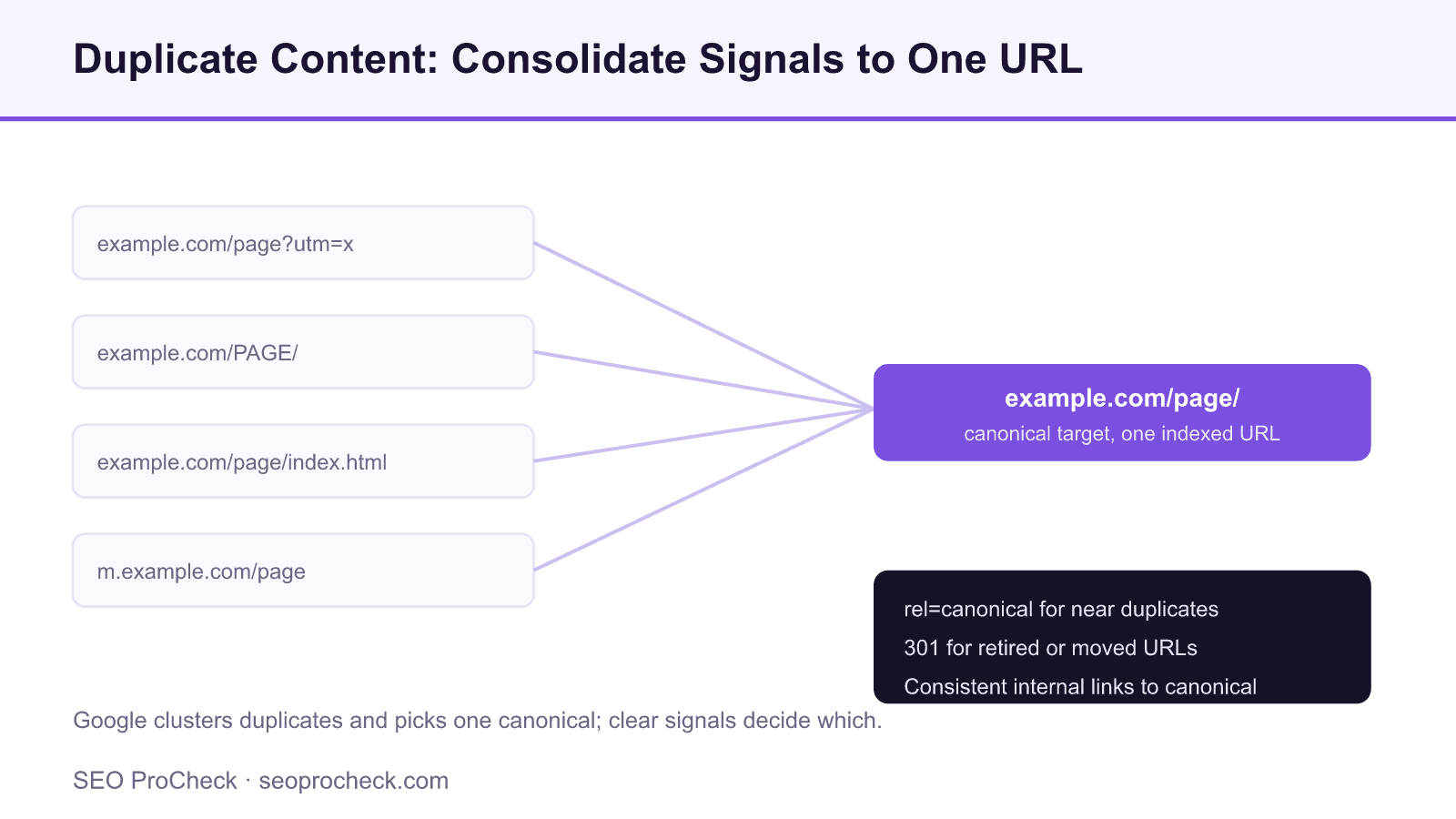
There is no duplicate content penalty in the ordinary sense, but duplication still costs you by splitting signals and wasting crawl. Google clusters duplicate and near duplicate URLs, picks one canonical to show, and your job is to make that choice for it with clear, consistent signals.
- Google does not penalize ordinary duplication; it clusters duplicates and shows one canonical version.
- Duplication dilutes ranking signals and wastes crawl budget on redundant URLs.
- Use rel=canonical for near duplicates and 301 redirects for retired or moved pages.
- Consistent internal linking to the canonical URL is one of the strongest signals you can send.
Research examining duplicate content how google handles similar pages analyzed patterns across multiple datasets to identify factors affecting search performance. The findings provide actionable insights for practitioners.
Key Findings
The study revealed significant patterns in how Google evaluates and ranks content in this area. Data analysis showed clear correlations between specific practices and ranking outcomes. Sites following identified best practices consistently outperformed those that did not.
Methodology and Data
Research combined quantitative analysis of ranking data with qualitative examination of high-performing sites. Multiple data sources were triangulated to ensure finding validity. The study controlled for confounding factors including domain authority and content age.
Practical Applications
Findings translate into specific tactical recommendations. Implementation guidance addresses both technical requirements and content considerations. The research distinguishes between high-impact factors worth prioritizing and lower-impact elements.
Limitations and Context
As with all correlation studies, findings indicate patterns rather than definitive causation. Results may vary by industry, query type, and competitive context. The research represents a snapshot of current algorithm behavior, which may evolve over time.
There is no penalty, but there is a real cost
The phrase duplicate content penalty causes needless panic. Google has said repeatedly that it does not penalize sites for ordinary duplicate content, such as boilerplate, syndicated text or URL variants. What actually happens is quieter and still costly. Google groups duplicate and near duplicate URLs into a cluster, selects one as canonical, and concentrates ranking on that version. If you let Google guess which URL is canonical, it may pick one you did not want, split link equity across variants, and spend crawl budget refetching redundant pages. Our duplicate content guide covers the clustering behavior in depth.
Common sources of duplication
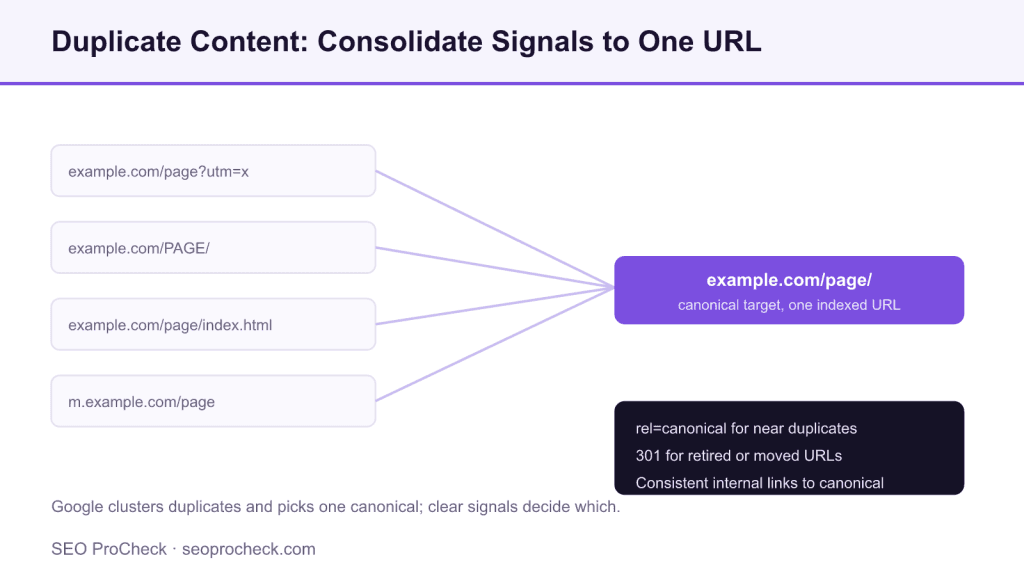
Most duplication is accidental and technical rather than editorial. The usual suspects are URL parameters (tracking, sorting, filtering), protocol and host variants (http versus https, www versus non www), trailing slash and case differences, printer or AMP versions, session identifiers, and pagination. You can surface these quickly with a crawl and a duplicate content checker, then group the variants by the single canonical URL they should all point to, exactly as the diagram shows four variants collapsing to one target.
| Duplication source | Right signal to send | Why |
|---|---|---|
| Tracking or sort parameters | rel=canonical to the clean URL | Consolidates signals to one page |
| http and non www variants | 301 redirect to the preferred host | One accessible version, no split |
| Retired or moved page | 301 redirect to the replacement | Passes equity, removes the duplicate |
| Near duplicate variant needed for users | rel=canonical to the main version | Keeps the page live, unifies ranking |
Canonical, 301, noindex: pick the right tool
These signals are not interchangeable. Use a rel=canonical tag when both URLs should stay reachable but only one should rank, the typical case for parameters and near duplicates. Use a 301 redirect when a URL is genuinely retired or moved and no longer needs to exist. Use noindex when a page must remain accessible to users but should never appear in search, such as internal search results. Remember that canonical is a hint Google may override if your other signals contradict it, whereas a 301 is a hard instruction. The canonical tag definition keeps the distinction clear, and the canonical tags reference covers the implementation edge cases.
Send consistent signals, and what has changed
The single biggest mistake is sending Google contradictory signals: a canonical tag that points one way while internal links, the sitemap and hreflang point another. Google weighs all of these, so alignment matters as much as the canonical tag itself. Always link internally to the canonical URL, list only canonical URLs in your sitemap, and make sure the page canonicalizes to itself. What has changed is that Google now leans more heavily on the full signal set, and it will ignore a canonical that conflicts with strong contrary signals, then choose its own canonical. Consistency, not a single tag, is what makes the choice stick.
Frequently Asked Questions
Is there a duplicate content penalty?
No, not in the usual sense. Google does not penalize ordinary duplicate content. It clusters duplicate URLs and shows one canonical version, but duplication still costs you by splitting signals and wasting crawl.
What is the difference between canonical and 301 for duplicates?
A canonical tag keeps both URLs reachable while telling Google which one to rank, ideal for parameters and near duplicates. A 301 redirect removes the duplicate entirely and sends users and equity to the replacement.
How does Google choose the canonical URL?
It weighs many signals: the rel=canonical tag, internal links, the sitemap, redirects and hreflang. If these conflict, Google may override your canonical and pick its own, so keep every signal consistent.
Does duplicate content waste crawl budget?
Yes. Redundant URL variants cause Googlebot to fetch essentially the same content multiple times, which on large sites diverts crawl away from unique, valuable pages.
Will syndicated or reused content get my site penalized?
Not by itself. Google may simply choose to rank the original source rather than your copy. To protect your version, use canonical tags to the original when syndicating and add unique value.
What causes accidental duplicate content?
Common causes include URL parameters, http versus https and www versus non www variants, trailing slash and case differences, printer or AMP versions, session IDs and pagination.
Source: Industry research compilation
Claude Vincent is a technical SEO consultant focused on crawlability, rendering, and AI-search visibility. He writes the field guides and case studies at SEO ProCheck, with a bias toward the durable, unglamorous work that decides whether search engines and AI answer engines can actually read and cite a site.
About SEO ProCheck
Technical SEO consulting and GEO strategy with 20 years of enterprise experience. Case studies, resources, and tools for search and AI visibility.
Work With Me
Technical SEO audits, GEO strategy, site migrations, and international SEO. Hourly consulting for teams who need hands-on support, not just reports.
Subscribe to our newsletter!