

AI Summary
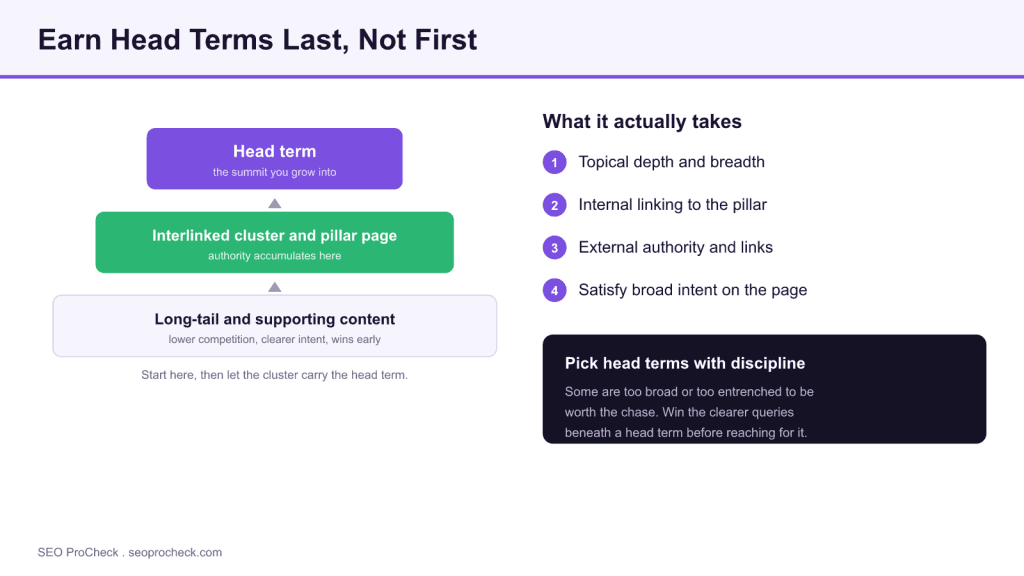
Head terms are short, broad, high volume keywords that established sites dominate, and you rarely win them by targeting them directly. You earn them by building deep long-tail and supporting content first, then letting an interlinked pillar page inherit the authority a head term demands.
- Treat the head term as the prize at the end of a cluster strategy, not the opening move.
- Long-tail pages win visibility early and feed relevance to the pillar.
- Internal links concentrate authority on the page meant to own the term.
- Be honest: some head terms are too broad or too entrenched to be worth chasing.
TL;DR
Head terms are short, broad, high-volume keywords that the strongest sites fight over. You rarely win them by targeting them directly. You earn them by building deep, well-linked topical coverage with long-tail and supporting content first, then letting a comprehensive pillar page inherit the authority head terms demand. Treat the head term as the prize at the end of a cluster strategy, not the opening move, and be honest about which ones are worth the chase.
Why head terms are hard
A head term is the shortest, broadest way someone can describe a topic. Think "running shoes," "project management," or "car insurance." These queries carry enormous search volume, which is exactly why they are so hard to rank for. Every serious competitor wants them, so the results are crowded with established brands that have spent years earning trust.
The second problem is intent. A long-tail query like "best waterproof trail running shoes for wide feet" tells you precisely what the searcher wants. "Running shoes" could mean someone ready to buy, comparing types, looking for a local store, or just starting to learn. Search engines respond by filling those results with pages that satisfy many intents at once, which raises the bar for what your page must deliver. Competing here means out-resourcing sites that already have the authority, breadth, and link profiles to answer a broad question comprehensively.
Earn them last, not first
The most common mistake is to point a brand-new page at a head term and wait. Strong sites do not rank for broad terms because of one page. They rank because they have demonstrated authority across the entire topic, and the head term is the natural summit of that work.
The reliable sequence runs opposite to how most people start. You begin with long-tail and supporting content, where competition is lower, intent is clearer, and you can win visibility early. As that coverage accumulates, your site becomes a recognized resource on the subject. Only then does the head term become realistically winnable, because the page targeting it now sits on a foundation of interlinked content that signals genuine expertise. The head term is something you grow into, not something you reach for on day one.
What it actually takes
Ranking for a head term rests on a few reinforcing pillars. The first is depth and breadth of topical coverage: address the subtopics, questions, and adjacent concerns around the broad keyword, so search engines associate your site with the whole subject rather than a single page.
The second is internal linking. Supporting pages should connect deliberately to the page meant to win the head term, passing relevance and signaling which page is your authoritative hub. The third is external authority. Broad terms favor sites that others reference and trust, which is where durable link building fundamentals matter most. The fourth is satisfying broad intent on the page itself: it must be comprehensive enough to serve the many reasons people search it, with clear structure and obvious next steps. Increasingly this also means being legible as a recognizable entity, which is why entity SEO is part of the same conversation.
A realistic roadmap
Start by mapping the cluster. Identify the head term you ultimately want, then list the long-tail queries, questions, and subtopics that orbit it. Each becomes a supporting page with its own clear intent and its own chance to rank quickly.
Designate one page as the pillar, built to eventually own the head term. Keep it comprehensive, link every supporting page back to it, and link outward to the relevant ones in turn. Publish the supporting content first and let it gather traffic, links, and engagement. As the cluster matures and the pillar accumulates authority from both internal structure and external references, the head term gradually moves into reach. This is a campaign measured in steady progress, not a single launch.
Honest caveats
Not every head term is worth chasing. Some are so broad that the traffic converts poorly, or so dominated by entrenched players that the effort is better spent elsewhere. If a head term's intent is genuinely split across shopping, learning, and navigation, a single page may never satisfy it well, and you are better served by winning the cluster of clearer queries beneath it. Pick your head terms with the same discipline you bring to the content.
Head terms vs long-tail queries
The two query types play different roles in the same campaign. This is why the sequence matters: the long-tail work you can win now is what eventually makes the head term reachable.
| Attribute | Head term | Long-tail query |
|---|---|---|
| Example | running shoes | waterproof trail running shoes for wide feet |
| Search volume | High | Lower per query, large in aggregate |
| Intent clarity | Broad and mixed | Specific and easy to satisfy |
| Competition | Entrenched brands | Often winnable early |
| When to target | After the cluster matures | From the start |
| Page role | Pillar that owns the topic | Supporting page that feeds the pillar |
FAQ
Should I ever target a head term directly from the start?
Rarely. Unless your site already holds strong authority in the topic, a fresh page aimed at a broad term usually stalls. Build the supporting cluster first and let the head term become winnable over time.
How do I know if a head term is worth pursuing?
Check whether its intent aligns with what you offer and whether the results are dominated by sites far stronger than yours. If the intent is split or the competition is entrenched, the clearer long-tail queries beneath it often deliver better returns.
What role does internal linking play?
It tells search engines which page is your authoritative hub. Supporting pages linking to your pillar concentrate relevance on the page meant to earn the head term, which is essential for competitive broad queries.
How long does it take to rank for a head term?
There is no fixed timeline, but it is a campaign measured in months of steady cluster building, not a single launch. The head term moves into reach as supporting pages accumulate traffic, links, and internal signals that concentrate authority on the pillar.
How many supporting pages does a pillar need?
Enough to cover the real subtopics, questions, and adjacent concerns around the head term, not a fixed count. Map the cluster from actual search demand, then publish until the topic is genuinely covered rather than chasing an arbitrary number.
Want to know which head terms you can actually win?
An advanced SEO audit maps your topical authority, internal linking, and competitive position so you target the broad terms realistically in reach.
Take this with you
The assistant links open with a question about this page already written. Nothing is sent until you press enter.
Claude Vincent is a technical SEO consultant focused on crawlability, rendering, and AI-search visibility. He writes the field guides and case studies at SEO ProCheck, with a bias toward the durable, unglamorous work that decides whether search engines and AI answer engines can actually read and cite a site.
About SEO ProCheck
Technical SEO consulting and GEO strategy with 20 years of enterprise experience. Case studies, resources, and tools for search and AI visibility.
Work With Me
Technical SEO audits, GEO strategy, site migrations, and international SEO. Hourly consulting for teams who need hands-on support, not just reports.
Subscribe to our newsletter!








Recent Posts
- Most Top Sites Never Say Who They Are in Structured Data October 14, 2026
- Homepage Titles Are Mostly Too Short, Not Too Long October 8, 2026
- Who Actually Serves an llms.txt? 184 Top Sites Measured September 29, 2026