AI Summary
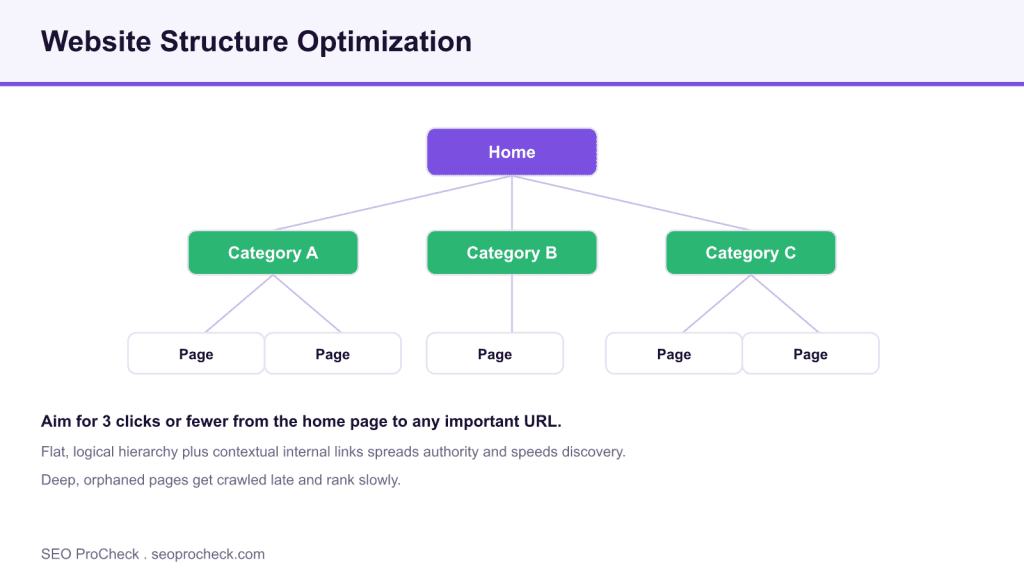
Website structure optimization means organizing your URLs, navigation, and internal links so that people and crawlers can reach any important page in as few clicks as possible. A flat, logical hierarchy with strong internal linking spreads authority, speeds up indexing, and makes topical relationships clear to search engines.
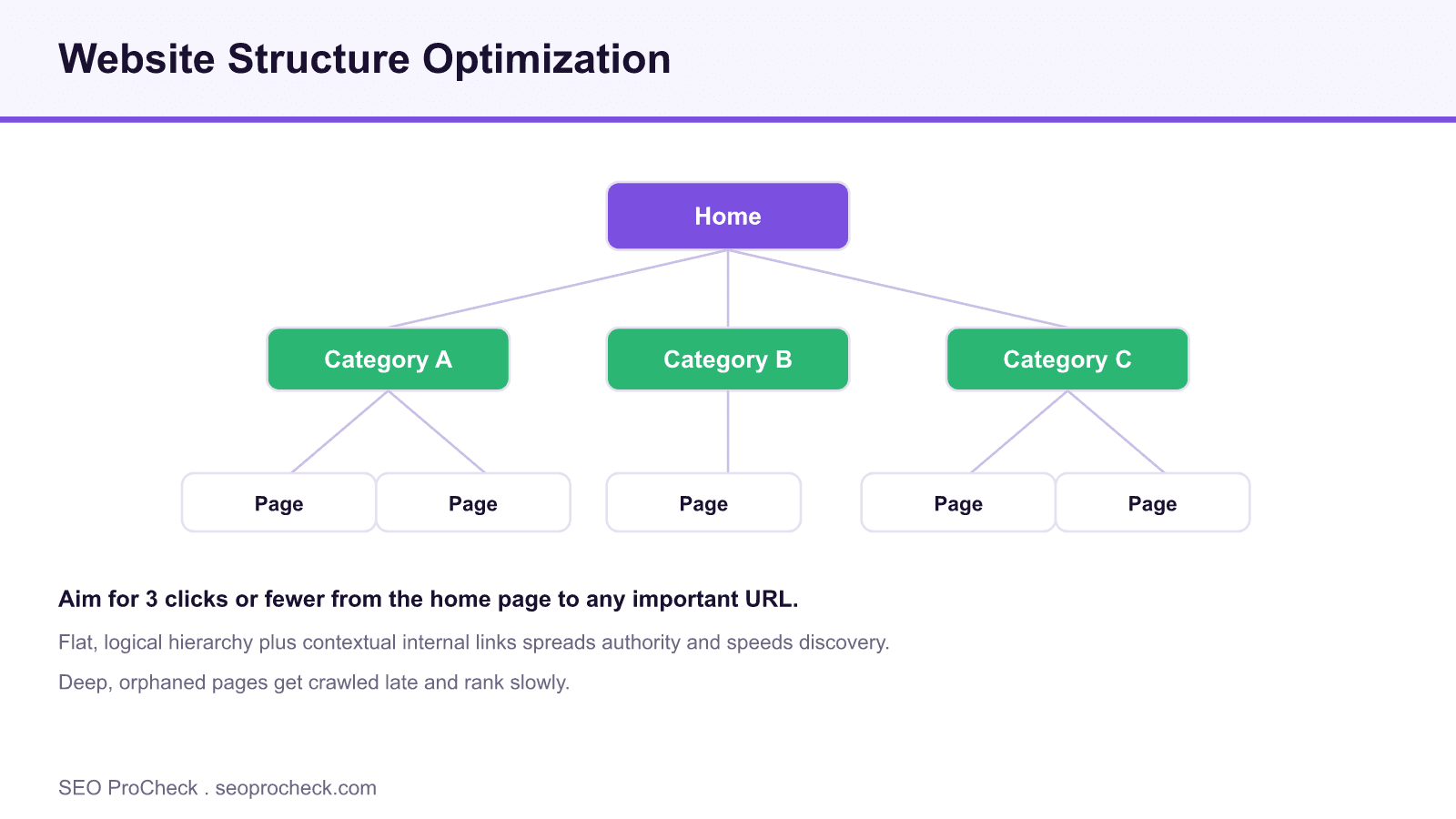
- Aim for a click depth of three or fewer from the home page to any key page.
- Group pages into clear categories and clusters that match search intent.
- Use descriptive, stable URLs that mirror the hierarchy.
- Contextual internal links, not just the menu, carry authority to the pages that need it.
How to do Website Structure Optimization: Ultimate Guide provides valuable insights for SEO practitioners. This resource examines approaches and considerations that can improve organic search performance.
What site structure actually means
Site structure is how your pages relate to one another through hierarchy, navigation, URLs, and internal links. A good structure lets a visitor form a mental map of the site in seconds and lets a crawler reach every important page without guessing. It is the skeleton the rest of your SEO hangs on.
Structure is not the same as design. Two sites can look identical yet perform very differently in search because one buries key pages five clicks deep while the other keeps them within easy reach and links to them from relevant context.
Flat versus deep architecture
A flat architecture keeps important pages close to the home page, ideally three clicks or fewer away. A deep architecture forces crawlers and users through long chains of clicks, which slows discovery and dilutes the authority that reaches the deepest pages.
Watch for orphan pages, which have no internal links pointing to them. Google can struggle to find and value them, and they often show up as thin or unindexed. Running a crawl and checking click depth is the fastest way to catch both problems. Deep, rarely linked pages also compete for crawl budget you would rather spend elsewhere.
Building silos and topic clusters
Group related pages into clear categories, then connect them with a pillar and cluster model: one broad pillar page links out to focused supporting pages, and each supporting page links back to the pillar and to its siblings. This signals topical depth and helps Google understand which page owns which query.
Internal links are the mechanism that makes clusters work. A page with no inbound internal links is invisible to that flow, which is why missing internal links is one of the most common structural issues we flag. Anchor text on those links also tells Google what the target page is about.
URL and navigation hygiene
Keep URLs short, lowercase, and descriptive, and let them mirror the hierarchy so the path itself communicates where a page sits. Add breadcrumbs so users and crawlers can see the trail back up the tree.
Use a consistent primary navigation, a useful footer, and a clean heading structure on each page so the on page hierarchy matches the site hierarchy. Consistency here is what turns a pile of pages into a coherent, crawlable whole.
| Structure element | Good practice | Common mistake |
|---|---|---|
| Click depth | Key pages three clicks or fewer from home | Important pages buried deep in the tree |
| Categories | Clear, intent based groupings | Overlapping or vague categories |
| Internal links | Contextual links plus descriptive anchors | Menu only links, orphan pages |
| URLs | Short, lowercase, mirror hierarchy | Long, parameter heavy, unstable slugs |
| Navigation | Consistent nav, breadcrumbs | Different menus on different templates |
What has changed since
- Topic clusters and entity based organization now matter more than keyword stuffed page counts, so structure signals topical authority.
- AI search and answer engines reward clearly structured, well linked content, which raises the stakes on clean architecture. See SEO vs AEO vs GEO.
- Core Web Vitals and mobile first indexing mean navigation must stay fast and usable on small screens, not just logically correct.
Key Concepts
Understanding the fundamental principles behind this topic helps inform strategic decisions. Whether optimizing for traditional search or emerging AI platforms, foundational concepts remain relevant. This resource covers the essential knowledge practitioners need.
Implementation Considerations
Moving from concept to execution requires understanding practical constraints and opportunities. Different situations call for different approaches. This resource provides guidance for applying concepts in real-world contexts.
Measuring Impact
SEO efforts require measurement to demonstrate value and guide optimization. Identifying appropriate metrics, establishing baselines, and tracking progress enables data-driven improvement. This resource addresses how to evaluate success.
This resource contributes to the knowledge base SEO practitioners need for effective optimization in an evolving search landscape.
Source: https://audisto.com/guides/structure-optimization/
Frequently asked questions
What is the ideal click depth for SEO?
Aim to keep important pages within three clicks of the home page. Pages that sit deeper get crawled less often and receive less internal authority, which slows indexing and ranking.
What is an orphan page?
An orphan page has no internal links pointing to it, so users and crawlers can only reach it by knowing the URL. Orphan pages are often missed by Google and tend to underperform, so link to them from relevant pages.
Do silos or topic clusters still work?
Yes. Grouping related pages and connecting them with a pillar and cluster model helps Google understand topical relationships and decide which page should rank for which query. The key is genuine internal linking, not just folder names.
How do internal links improve site structure?
Internal links distribute authority, define relationships, and give crawlers paths to follow. Descriptive anchor text also tells Google what the target page is about, which supports relevance for the right queries.
Should my URL structure match my site hierarchy?
It helps. URLs that mirror the hierarchy make the structure legible to users and crawlers and produce cleaner breadcrumbs. Keep slugs short, stable, and descriptive, and avoid changing them without redirects.
How do I audit my website structure?
Run a crawl, then review click depth, orphan pages, category overlap, and internal link counts per page. Fix the deepest and least linked important pages first, since they usually offer the biggest gains.
Claude Vincent is a technical SEO consultant focused on crawlability, rendering, and AI-search visibility. He writes the field guides and case studies at SEO ProCheck, with a bias toward the durable, unglamorous work that decides whether search engines and AI answer engines can actually read and cite a site.
About SEO ProCheck
Technical SEO consulting and GEO strategy with 20 years of enterprise experience. Case studies, resources, and tools for search and AI visibility.
Work With Me
Technical SEO audits, GEO strategy, site migrations, and international SEO. Hourly consulting for teams who need hands-on support, not just reports.
Subscribe to our newsletter!