

AI Summary
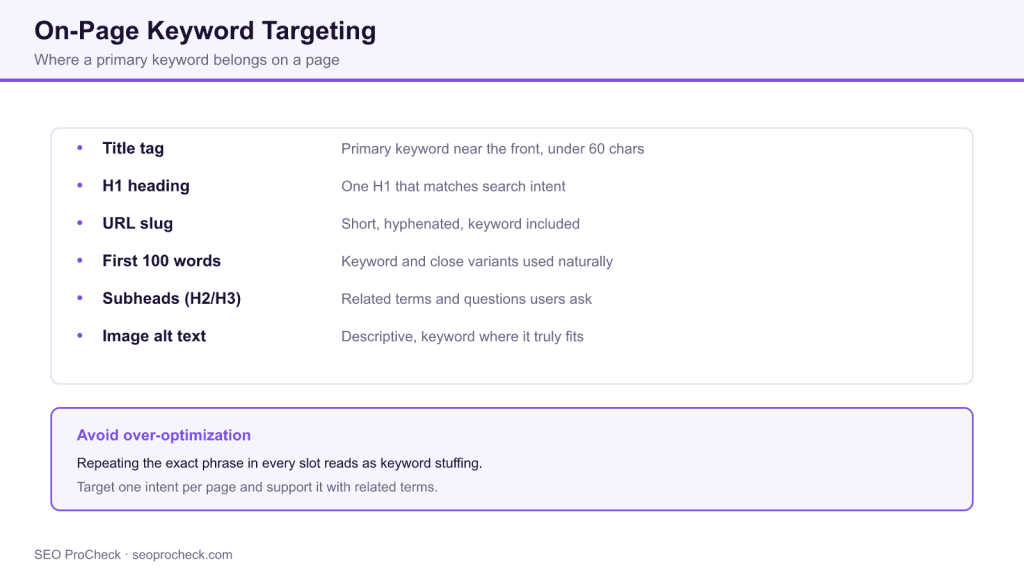
Keyword targeting is the practice of choosing one primary query per page and placing it in the handful of on-page slots that carry the most weight: the title tag, H1, URL, opening copy, subheads, and image alt text. Do it once per intent and support it with related terms rather than repeating the exact phrase, which reads as keyword stuffing to modern search engines.
- The Moz visual guide this page summarizes remains a solid map of on-page placement.
- Exact-match keyword density is a retired metric; intent and entity coverage replaced it.
- One page should target one dominant intent, not a bundle of near-duplicate queries.
- The same on-page clarity that helps Google now also helps AI answer engines quote you.

SEOmoz | Perfecting Keyword Targeting & On-Page Optimization provides valuable insights for SEO practitioners. This resource examines approaches and considerations that can improve organic search performance.
Key Concepts
Understanding the fundamental principles behind this topic helps inform strategic decisions. Whether optimizing for traditional search or emerging AI platforms, foundational concepts remain relevant. This resource covers the essential knowledge practitioners need.
Implementation Considerations
Moving from concept to execution requires understanding practical constraints and opportunities. Different situations call for different approaches. This resource provides guidance for applying concepts in real-world contexts.
Measuring Impact
SEO efforts require measurement to demonstrate value and guide optimization. Identifying appropriate metrics, establishing baselines, and tracking progress enables data-driven improvement. This resource addresses how to evaluate success.
This resource contributes to the knowledge base SEO practitioners need for effective optimization in an evolving search landscape.
Source: https://moz.com/blog/visual-guide-to-keyword-targeting-onpage-optimization
Practitioner commentary: what still holds up
The Moz visual guide to keyword targeting is one of the older on-page references in the field, and most of it has aged well because it describes structure rather than tricks. The core placements it maps, title tag, H1, URL slug, the first block of body copy, subheadings, and image alt text, are still the slots search engines weight most heavily when they work out what a page is about. What has changed is the mindset around how often the exact phrase should appear in those slots.
In day to day work the reliable pattern is one primary query per page, placed once near the front of the title and once in the H1, then supported by close variants and related entities through the body. If you find yourself writing the same phrase into every heading, you are optimizing for a keyword density number that Google stopped rewarding many years ago. The check that catches the failure mode is our keyword stuffing detection guide, and a related trap, using the same string for both the title and description, is covered in identical title and meta description.
A placement checklist that maps to intent
| On-page slot | What to put there | Common mistake |
|---|---|---|
| Title tag | Primary query near the front, under 60 characters | Stuffing every variant into one title |
| H1 | One H1 that restates the page intent | Multiple H1s or an H1 that ignores the query |
| URL slug | Short, hyphenated, includes the core term | Dates, IDs, and stop words bloating the path |
| First 100 words | The query and one natural variant | Burying the topic under a long preamble |
| Subheads | Related questions and supporting terms | Repeating the exact phrase in every H2 |
| Image alt text | Describe the image, include the term only if it fits | Keyword stuffed alt that misdescribes the image |
What's changed since the guide was written
Three shifts matter for anyone applying this material today. First, Google moved from matching strings to understanding entities and intent, so a page that covers a topic thoroughly can rank for hundreds of queries it never mentions verbatim. Second, exact-match anchor text and repeated exact-match keywords now carry risk rather than reward when overdone. Third, the same on-page clarity that earns rankings, a direct answer high on the page under a clear heading, is now what gets a page quoted inside AI Overviews and assistant answers. The placements did not change; the reason they matter widened.
Frequently asked questions
What is keyword targeting in SEO?
It is the practice of choosing one primary query for a page and placing it in the on-page elements search engines weight most: the title tag, H1, URL, opening copy, subheads, and alt text, while supporting it with related terms rather than repeating the exact phrase.
How many keywords should one page target?
One dominant intent per page. You can rank for many related queries from a single page, but trying to target several distinct intents on one URL usually weakens all of them and invites internal competition.
Does keyword density still matter?
No. Modern search engines evaluate topical coverage and intent, not a target percentage of exact-match phrases. Writing to a density figure tends to produce keyword stuffing, which is a quality risk rather than a ranking lever.
Where should the primary keyword appear on a page?
Near the front of the title tag, in the single H1, in the URL slug, within the first 100 words, and naturally across subheads and body copy. Include it in alt text only when it genuinely describes the image.
Is on-page optimization still relevant with AI search?
Yes, and arguably more so. The same clear structure that helps Google, a direct answer high on the page under a descriptive heading, is what AI answer engines extract and cite, so on-page clarity now serves two audiences.
What is the difference between on-page optimization and keyword stuffing?
On-page optimization places a query in the right structural slots once and supports it with related language. Keyword stuffing repeats the exact phrase unnaturally to hit a density target, which degrades readability and can suppress the page.
Claude Vincent is a technical SEO consultant focused on crawlability, rendering, and AI-search visibility. He writes the field guides and case studies at SEO ProCheck, with a bias toward the durable, unglamorous work that decides whether search engines and AI answer engines can actually read and cite a site.
About SEO ProCheck
Technical SEO consulting and GEO strategy with 20 years of enterprise experience. Case studies, resources, and tools for search and AI visibility.
Work With Me
Technical SEO audits, GEO strategy, site migrations, and international SEO. Hourly consulting for teams who need hands-on support, not just reports.
Subscribe to our newsletter!







Recent Posts
- Can AI Crawlers Actually Read Your Site? I Measured 400 of the Biggest September 5, 2026
- The Pre-Publish Quality Gate for AI-Assisted Content August 6, 2026
- AGENTS.md vs llms.txt vs llms-full.txt: Which Agent File Does What July 18, 2026