

AI Summary
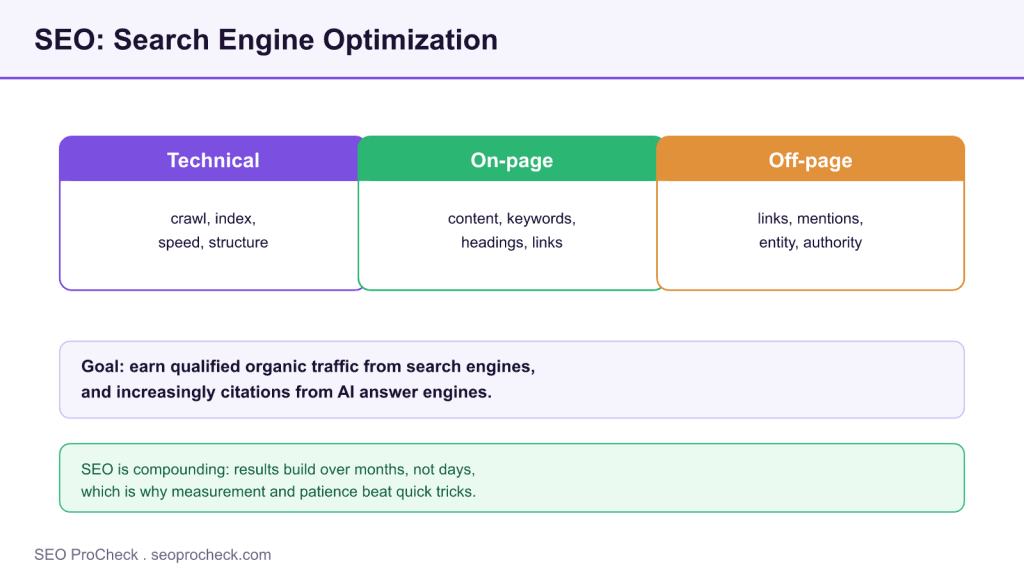
SEO stands for Search Engine Optimization, the practice of earning qualified organic traffic by making a site easy to crawl, genuinely useful and widely trusted. It rests on three pillars: technical, on-page and off-page, and increasingly it also means earning citations from AI answer engines.
- SEO = Search Engine Optimization: earn unpaid visibility in search and, now, in AI answers.
- Three pillars: technical (crawl and index), on-page (content and structure) and off-page (links and authority).
- It compounds over months, so measurement and patience beat quick tricks.
- AI Overviews and chatbots are new surfaces that reward the same fundamentals plus clear, quotable answers.
SEO provides valuable insights for SEO practitioners. This resource examines approaches and considerations that can improve organic search performance.
Key Concepts
Understanding the fundamental principles behind this topic helps inform strategic decisions. Whether optimizing for traditional search or emerging AI platforms, foundational concepts remain relevant. This resource covers the essential knowledge practitioners need.
Implementation Considerations
Moving from concept to execution requires understanding practical constraints and opportunities. Different situations call for different approaches. This resource provides guidance for applying concepts in real-world contexts.
Measuring Impact
SEO efforts require measurement to demonstrate value and guide optimization. Identifying appropriate metrics, establishing baselines, and tracking progress enables data-driven improvement. This resource addresses how to evaluate success.
This resource contributes to the knowledge base SEO practitioners need for effective optimization in an evolving search landscape.
Source: http://www.seomoz.org/articles
What SEO means
SEO stands for Search Engine Optimization: the ongoing practice of earning unpaid, qualified traffic from search engines by making a website easy to crawl, genuinely useful to people, and trusted by the wider web. Unlike paid ads, the visibility is earned and tends to compound: a page that ranks well can keep attracting visitors for years. Increasingly, SEO also means being surfaced and cited by AI answer engines, which is why the modern definition stretches beyond the classic ten blue links.
The three pillars of SEO
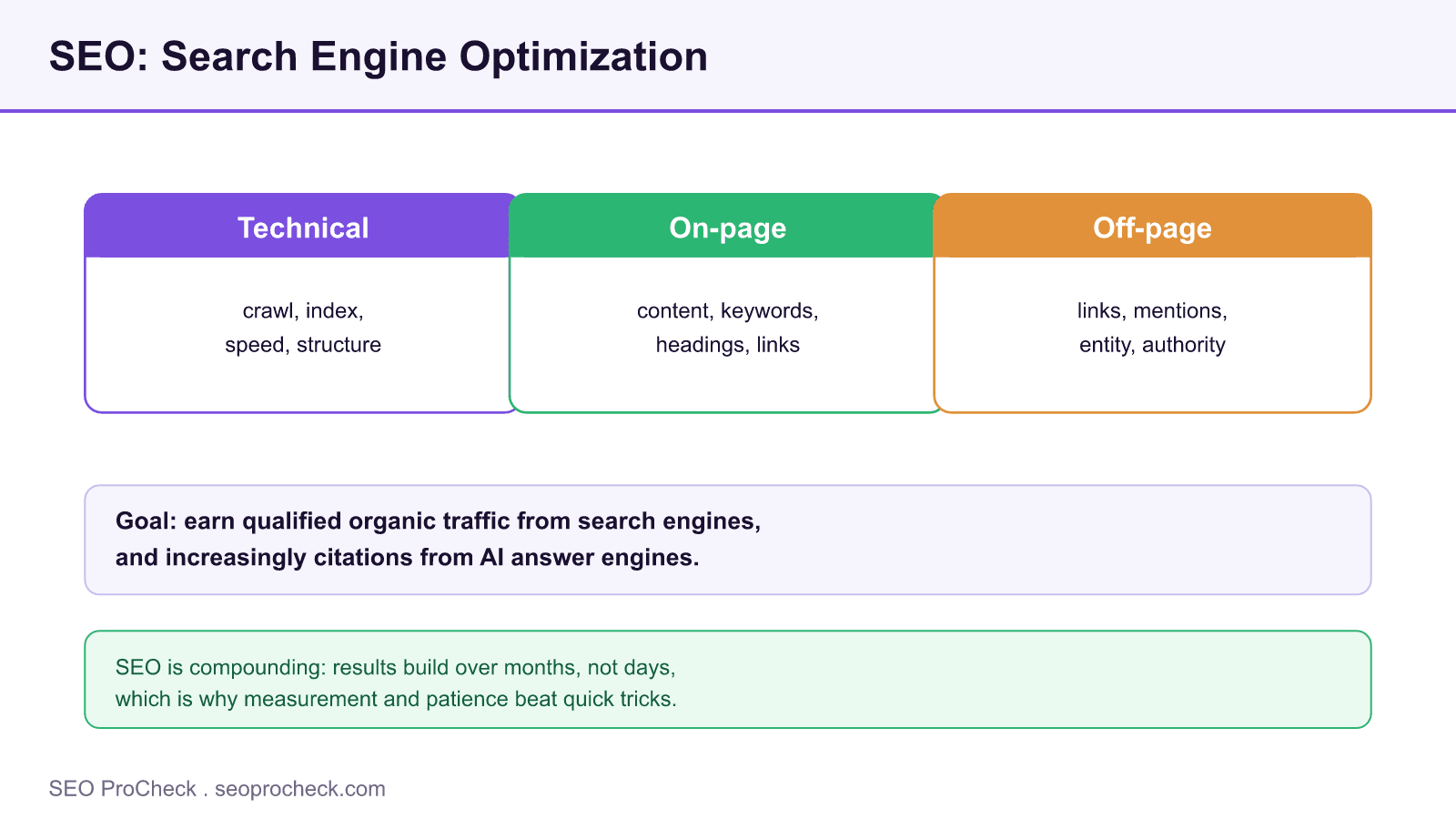
Practitioners usually split the work into three pillars, shown in the diagram above. They reinforce each other; neglect one and the others underdeliver.
| Pillar | What it covers | Representative tasks |
|---|---|---|
| Technical SEO | Whether engines can crawl, render and index your pages | Site speed, mobile rendering, crawlability, structured data, clean URLs |
| On-page SEO | Whether a page clearly satisfies a search intent | Useful content, keyword targeting, headings, internal links, metadata |
| Off-page SEO | Whether the wider web trusts and references you | Backlinks, brand mentions, entity presence, reputation |
How SEO actually works
Search engines crawl the web, index what they find, and rank results for a query by relevance and quality. Your job across the three pillars is to remove friction (technical), match intent better than competitors (on-page), and earn signals that you are a credible source (off-page). None of this is a trick; it is making a genuinely good resource that a machine can find, understand and trust. That is also why SEO rewards patience: results build over months as pages are recrawled, links accrue and the site earns authority.
SEO in the age of AI answers
The surfaces have multiplied. Beyond classic results, there are featured snippets, and now answer engine optimization for AI Overviews and chatbots. The umbrella term for optimizing toward generative systems is generative engine optimization. The good news for anyone learning SEO: the fundamentals still apply. Crawlable, well-structured, trustworthy content that answers a question clearly is exactly what both a ranking algorithm and an AI model want. AI simply adds a premium on quotable, self-contained answers and on being a recognizable entity.
How to start doing SEO
- Fix the technical basics. Make sure pages load fast, render on mobile, and can be crawled and indexed.
- Understand intent. For each target query, work out what the searcher actually wants and build the page that best delivers it.
- Structure the content. Clear headings, direct answers near the top, and descriptive internal links.
- Earn trust. Build genuine references and mentions over time; strengthen your entity footprint.
- Measure. Use Search Console and analytics to track what works, and iterate. Explore concrete checks in our technical GEO checks library.
Common mistakes
- Chasing tricks over quality. Manipulative shortcuts age badly and invite penalties. Durable results come from being genuinely useful.
- Expecting instant results. SEO compounds over months. Judging it in two weeks leads to bad decisions.
- Ignoring one pillar. Great content on a site engines cannot crawl, or a fast site with thin content, both underperform.
- Writing for machines, not people. Keyword-stuffed prose reads badly and no longer ranks. Write for the reader, structure for the machine.
FAQ
What does SEO stand for?
SEO stands for Search Engine Optimization: the practice of improving a website so it earns more qualified, unpaid traffic from search engines, and increasingly so it gets surfaced and cited by AI answer engines.
How long does SEO take to work?
It compounds over months rather than days. New content and links need to be crawled and evaluated, and authority accrues gradually. A realistic horizon for meaningful movement is several months, which is why patience and measurement matter.
Is SEO still relevant with AI search?
Yes. AI answer engines still draw heavily on content that is crawlable, well-structured and trustworthy, which are the same fundamentals SEO has always rewarded. The main additions are a premium on clear, quotable answers and on being a recognizable entity.
What are the three pillars of SEO?
Technical SEO (can engines crawl and index you), on-page SEO (does the page satisfy the query), and off-page SEO (does the wider web trust you). Strong results come from all three working together rather than any one in isolation.
Do I need to pay for SEO?
The traffic itself is unpaid, which is the whole point. You may invest in tools, content or expertise, but unlike advertising you do not pay per click. That is what makes well-executed SEO compound in value over time.
What is the difference between SEO and SEM?
SEO earns unpaid organic visibility; SEM (search engine marketing) usually refers to paid search advertising. They are complementary: paid delivers immediate placement you rent, while SEO builds durable visibility you own.
Claude Vincent is a technical SEO consultant focused on crawlability, rendering, and AI-search visibility. He writes the field guides and case studies at SEO ProCheck, with a bias toward the durable, unglamorous work that decides whether search engines and AI answer engines can actually read and cite a site.
About SEO ProCheck
Technical SEO consulting and GEO strategy with 20 years of enterprise experience. Case studies, resources, and tools for search and AI visibility.
Work With Me
Technical SEO audits, GEO strategy, site migrations, and international SEO. Hourly consulting for teams who need hands-on support, not just reports.
Subscribe to our newsletter!







Recent Posts
- Can AI Crawlers Actually Read Your Site? I Measured 400 of the Biggest September 5, 2026
- The Pre-Publish Quality Gate for AI-Assisted Content August 6, 2026
- AGENTS.md vs llms.txt vs llms-full.txt: Which Agent File Does What July 18, 2026