

AI Summary
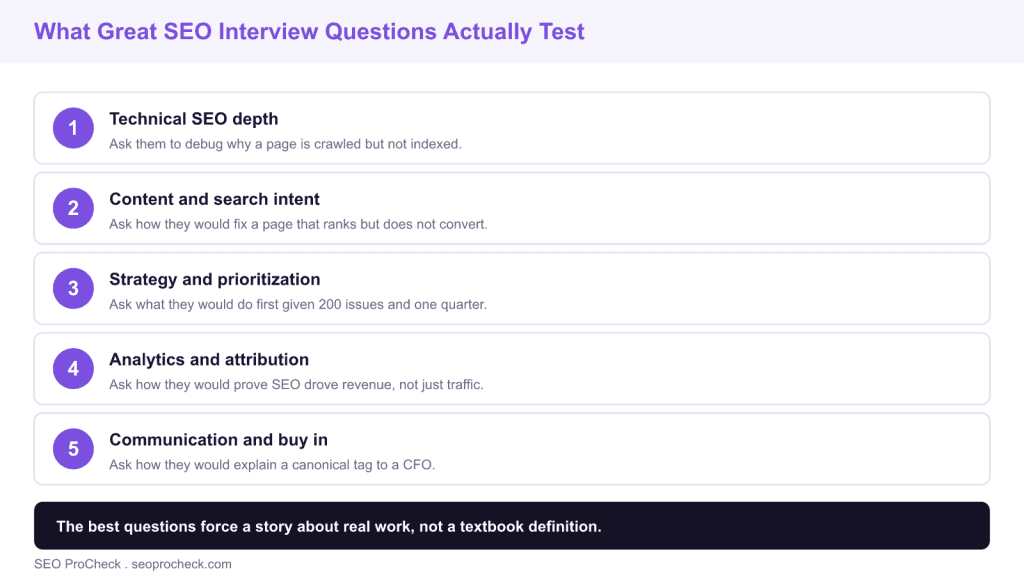
The best SEO interview questions make a candidate reason through a real situation rather than recite a definition. Across the favorites that experienced practitioners share, the strongest prompts probe five areas: technical depth, content and intent, strategy and prioritization, analytics and attribution, and communication.
- Great questions are open ended and scenario based, so the answer becomes a story about work the person actually did.
- Ask for a decision under constraints, for example what to fix first given a fixed budget and a long issue list.
- Probe measurement: a senior hire can connect SEO to revenue, not just to rankings and sessions.
- Communication matters as much as tactics, because most SEO work only ships once a stakeholder is convinced.
10 SEO experts share their favorite interview questions provides valuable insights for SEO practitioners. This resource examines approaches and considerations that can improve organic search performance.
Key Concepts
Understanding the fundamental principles behind this topic helps inform strategic decisions. Whether optimizing for traditional search or emerging AI platforms, foundational concepts remain relevant. This resource covers the essential knowledge practitioners need.
Implementation Considerations
Moving from concept to execution requires understanding practical constraints and opportunities. Different situations call for different approaches. This resource provides guidance for applying concepts in real-world contexts.
Measuring Impact
SEO efforts require measurement to demonstrate value and guide optimization. Identifying appropriate metrics, establishing baselines, and tracking progress enables data-driven improvement. This resource addresses how to evaluate success.
This resource contributes to the knowledge base SEO practitioners need for effective optimization in an evolving search landscape.
How to use this roundup
The linked Search Engine Land piece compiles favorite interview questions contributed by a group of named SEO practitioners, which is useful because it shows what experienced hiring managers actually reach for. Rather than repeat their individual picks, the commentary below turns that collection into a reusable framework you can apply on either side of the table, whether you are building an interview loop or preparing to sit in one.
The through line in almost every good question is the same: it refuses a textbook answer. A prompt like "what is a canonical tag" tests memory. A prompt like "walk me through the last time a canonical tag caused a problem you had to fix" tests judgment, ownership, and depth all at once.
What strong SEO interview questions actually test
Sort your questions into five competency areas so the loop covers the whole role instead of over indexing on trivia:
- Technical depth: can they diagnose crawling, indexing, rendering, and site architecture problems from symptoms, not just name them. A candidate who understands why a page shows as crawled but not indexed will also understand index bloat and how thin URLs dilute a site.
- Content and search intent: can they map a query to the job the searcher is trying to do, and restructure a page around that intent.
- Strategy and prioritization: can they choose what to do first when everything looks urgent, and defend the trade off.
- Analytics and attribution: can they prove impact, isolate SEO from other channels, and speak in terms of revenue and pipeline.
- Communication and buy in: can they translate a technical fix into a business case a non technical stakeholder will approve.
Modern loops increasingly add a sixth thread: how the candidate thinks about AI search. Asking how they would adapt a page for answer engines is a fast read on whether they keep current. Our explainer on SEO versus AEO versus GEO is a good baseline for what a strong answer sounds like.
Weak answers versus strong answers
| Question category | A weak answer sounds like | A strong answer sounds like |
|---|---|---|
| Technical depth | Recites a definition of the tag or status | Traces a real bug from symptom to root cause to fix |
| Content and intent | Talks about keyword density and word count | Starts from the searcher goal and the SERP shape |
| Prioritization | Says everything is important | Ranks by effort, impact, and confidence, then commits |
| Attribution | Reports traffic went up | Isolates SEO impact and ties it to revenue or pipeline |
| Communication | Uses jargon and assumes the audience keeps up | Reframes the fix as a business outcome and a risk |
Questions worth stealing for your own interviews
These are open ended prompts you can adapt. None have a single correct answer, which is the point:
- Tell me about a time your recommendation was wrong. How did you find out, and what did you change.
- You inherit a site with 200 flagged issues and one quarter. What are your first three moves and why.
- A page ranks in the top three but barely converts. Walk me through how you would investigate.
- How would you prove to a finance team that SEO, not brand or paid, drove a lift.
- Explain a canonical tag to someone who has never heard of one, in two sentences.
- What is something you believed about SEO two years ago that you have since changed your mind on.
The last question is quietly the most revealing. Practitioners who keep growing can name a belief they retired, and they usually connect it to evidence rather than fashion.
Green flags and red flags in candidate answers
Green flags: they ask clarifying questions before answering, they quantify with real numbers, they credit teammates, and they separate what they tested from what they assumed. When describing a win, they can also describe how they knew it worked, which is the same muscle behind a case study like SurveyMonkey scaling organic to 200M in annual revenue.
Red flags: absolutes with no context, secret tactics they cannot explain, blaming past teams for every failure, and confusing correlation with cause when they claim credit for a ranking change.
For candidates: how to prepare
Prepare three or four stories in advance, each with a situation, the action you took, and a measured result. Rehearse the measurement out loud, because that is where most answers get vague. Have one honest failure ready, and make sure it ends with what you changed. Finally, read the interviewing company recent content and be ready to critique it kindly, which signals both interest and judgment.
Frequently asked questions
What makes a good SEO interview question?
A good question is open ended and scenario based, so the candidate has to reason through a real situation rather than recite a definition. The strongest prompts ask for a decision under constraints and reveal how the person thinks, prioritizes, and measures impact.
What areas should SEO interview questions cover?
Cover five competencies: technical depth, content and search intent, strategy and prioritization, analytics and attribution, and communication. Many modern loops add a sixth thread on how the candidate approaches AI search and answer engines.
What are good SEO interview questions for senior candidates?
Ask them to prioritize a long issue list under a fixed budget, to prove SEO drove revenue rather than traffic, and to describe a recommendation that turned out wrong. Senior candidates answer with specifics, trade offs, and measured outcomes.
How do I evaluate answers to SEO interview questions?
Look for clarifying questions, real numbers, credit to teammates, and a clear separation between what was tested and what was assumed. Treat absolutes, unexplained secret tactics, and correlation mistaken for cause as red flags.
How should a candidate prepare for an SEO interview?
Prepare three or four stories with a situation, action, and measured result, and rehearse the measurement out loud. Keep one honest failure ready that ends with what you changed, and review the company recent content so you can discuss it.
Where can I find the original expert interview questions?
The favorites from named practitioners are compiled in the Search Engine Land roundup linked as the source of this page. It is a useful primary reference alongside the framework and example questions above.
Claude Vincent is a technical SEO consultant focused on crawlability, rendering, and AI-search visibility. He writes the field guides and case studies at SEO ProCheck, with a bias toward the durable, unglamorous work that decides whether search engines and AI answer engines can actually read and cite a site.
About SEO ProCheck
Technical SEO consulting and GEO strategy with 20 years of enterprise experience. Case studies, resources, and tools for search and AI visibility.
Work With Me
Technical SEO audits, GEO strategy, site migrations, and international SEO. Hourly consulting for teams who need hands-on support, not just reports.
Subscribe to our newsletter!







Recent Posts
- Can AI Crawlers Actually Read Your Site? I Measured 400 of the Biggest September 5, 2026
- The Pre-Publish Quality Gate for AI-Assisted Content August 6, 2026
- AGENTS.md vs llms.txt vs llms-full.txt: Which Agent File Does What July 18, 2026