AI Summary
Web governance is the set of standards, roles, workflows, and audits that keep a large website consistent and technically healthy as many teams change it. It matters for SEO because most enterprise ranking losses come not from a single bad decision but from slow, uncontrolled drift, and governance is the system that stops that drift before it costs traffic.
- Governance turns one off SEO fixes into repeatable rules that survive staff turnover and redesigns.
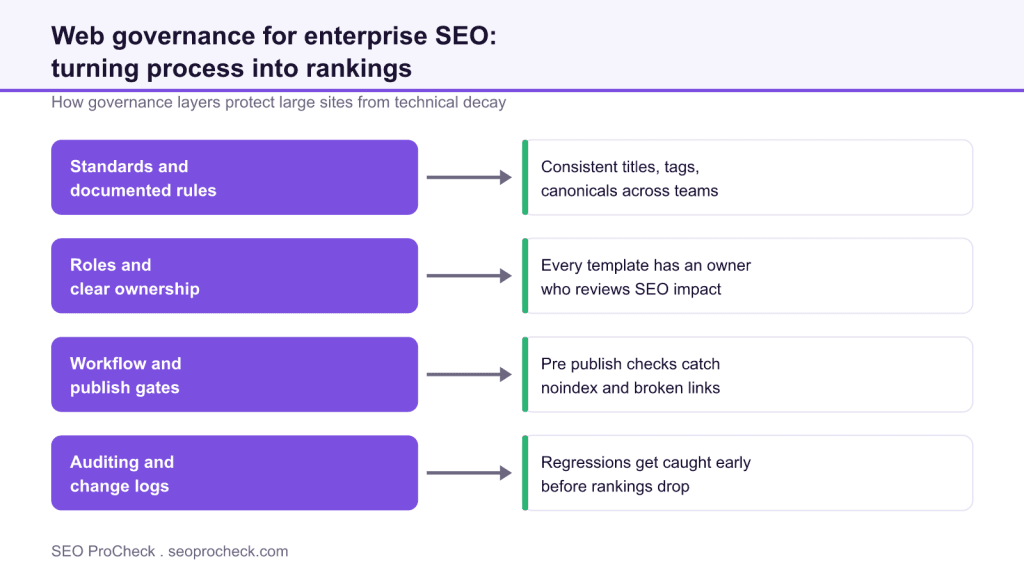
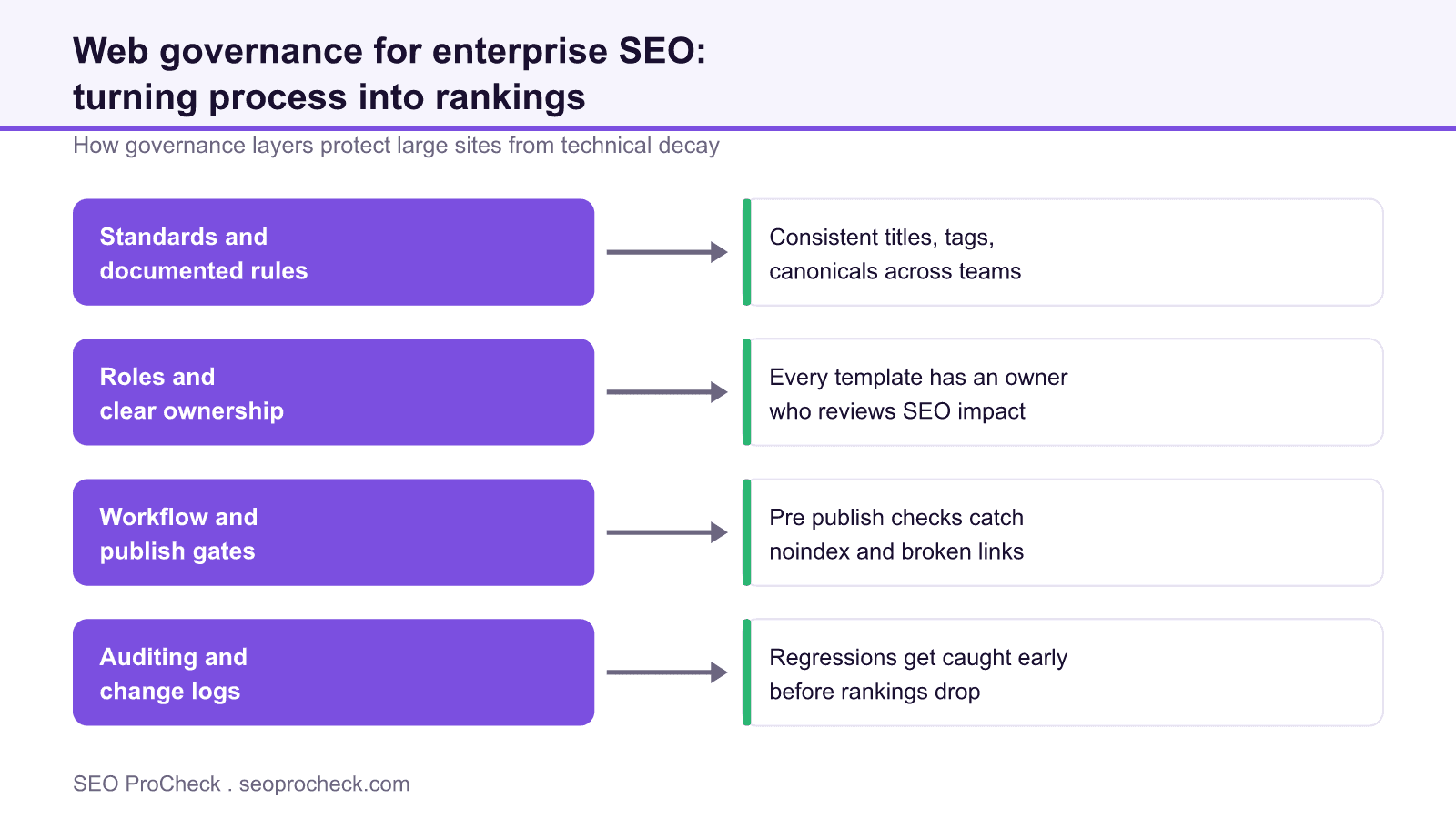
- The four practical layers are documented standards, clear ownership, publish workflows, and change auditing.
- Pre publish checks catch accidental noindex tags, broken canonicals, and dead links before they ship.
- On enterprise sites, preventing regressions is usually higher value than chasing new keywords.
Web governance is the unglamorous discipline that decides whether a large site stays healthy or slowly falls apart. On a small site one person holds the whole picture in their head. On an enterprise site, dozens of people across marketing, product, and engineering touch the same templates every week, and without a shared rulebook the SEO gains you fought for last quarter quietly erode. Governance is how you make good decisions stick.
Why enterprise SEO is a governance problem
Ask any in house SEO at a large organisation where their traffic losses come from and you rarely hear about a clever competitor. You hear about a template change that dropped a canonical tag, a migration that forgot a redirect map, a new CMS module that injected noindex on a whole section, or a marketing team that published thousands of thin pages without review. Each of these is a process failure, not a strategy failure. That is exactly what web governance exists to prevent.
The scale multiplies the risk. A single broken rule in a shared header template does not affect one page, it affects every page that uses the template, which can be hundreds of thousands of URLs. That is why the same mistake that would be trivial on a blog can be an emergency on an enterprise site.
The four layers of practical governance
Governance sounds abstract until you break it into the four layers that actually do the work:
- Standards and documented rules. Write down how titles, meta descriptions, heading structure, canonical logic, structured data, and internal linking should behave for each template. If it lives only in someone's memory, it will not survive the next reorganisation.
- Roles and clear ownership. Every template and every major section needs a named owner who signs off on SEO relevant changes. Ownership turns anonymous accidents into accountable decisions.
- Workflow and publish gates. Insert automated checks into the deploy pipeline so a page cannot go live with a stray noindex, a broken canonical, a missing title, or a link to a 404. This is the single highest leverage control most teams are missing.
- Auditing and change logs. Crawl the site on a schedule, diff the results against the last crawl, and alert on regressions. Catching a problem the day it ships is far cheaper than discovering it three months later in a traffic report.
A governance responsibility matrix
The fastest way to expose gaps is to map who owns each control. The table below is a starting matrix I hand to enterprise teams; fill the owner column with real names, and any blank cell is a risk waiting to happen.
| Governance control | What it prevents | Typical owner |
|---|---|---|
| Title and meta standards | Duplicate or missing titles at scale | SEO lead |
| Canonical and indexing rules | Accidental noindex and wrong canonicals | Technical SEO plus engineering |
| Redirect map on migration | Lost link equity and soft 404s | Migration owner |
| Publish gate checks | Broken pages shipping to production | Engineering |
| Scheduled crawl and diff | Slow undetected regressions | SEO operations |
Governance and the wider enterprise SEO picture
Governance does not replace strategy, it protects it. Many of the common enterprise SEO problems, from indexation bloat to inconsistent internationalisation, are really governance gaps wearing a technical costume. Fix the process and the symptoms stop recurring. Skip the process and you will keep paying consultants to clean up the same mess every year.
What has changed and what has not
The tools have improved. Continuous crawling, log file monitoring, and CI based SEO tests are far more accessible than they were a few years ago, and AI assisted review can now flag suspicious template changes before a human looks. What has not changed is the core lesson: technology enables governance but does not replace the human agreement about who owns what and which rules are non negotiable. A site that adds automated checks without assigning ownership just generates alerts nobody acts on. Start with the rulebook and the owners, then automate the enforcement.
The original summary and source for this entry are preserved below.
Web Governance, Mazeless, Enterprise SEO and Digital Marketing provides valuable insights for SEO practitioners. This resource examines approaches and considerations that can improve organic search performance.
Key Concepts
Understanding the fundamental principles behind this topic helps inform strategic decisions. Whether optimizing for traditional search or emerging AI platforms, foundational concepts remain relevant. This resource covers the essential knowledge practitioners need.
Implementation Considerations
Moving from concept to execution requires understanding practical constraints and opportunities. Different situations call for different approaches. This resource provides guidance for applying concepts in real-world contexts.
Measuring Impact
SEO efforts require measurement to demonstrate value and guide optimization. Identifying appropriate metrics, establishing baselines, and tracking progress enables data-driven improvement. This resource addresses how to evaluate success.
This resource contributes to the knowledge base SEO practitioners need for effective optimization in an evolving search landscape.
Source: https://www.mazeless.com/web-governance/
Frequently asked questions
What is web governance in SEO?
Web governance is the framework of standards, ownership, workflows, and audits that keeps a large website consistent and technically sound as many teams edit it. In SEO terms it prevents the slow drift that causes ranking losses on enterprise sites.
Why does web governance matter for large sites?
Because a single change to a shared template can affect hundreds of thousands of URLs. Governance catches those changes before they ship, so one mistake does not turn into a site wide traffic drop.
What are the main parts of a governance framework?
Documented standards, clear ownership of templates and sections, publish workflow checks, and scheduled auditing with change logs. Together they turn one off fixes into durable rules.
How is governance different from an SEO strategy?
Strategy decides what you want to achieve, governance protects those decisions over time. Without governance, good strategy erodes as teams unknowingly undo it.
What is the highest impact governance control?
Publish gate checks in the deploy pipeline. Blocking a page from going live with a stray noindex, broken canonical, or missing title prevents the most common and most costly enterprise SEO accidents.
Do small sites need web governance?
The formal version is aimed at large teams, but even small sites benefit from a written checklist and a review step before publishing. The principles scale down as easily as they scale up.
Claude Vincent is a technical SEO consultant focused on crawlability, rendering, and AI-search visibility. He writes the field guides and case studies at SEO ProCheck, with a bias toward the durable, unglamorous work that decides whether search engines and AI answer engines can actually read and cite a site.
About SEO ProCheck
Technical SEO consulting and GEO strategy with 20 years of enterprise experience. Case studies, resources, and tools for search and AI visibility.
Work With Me
Technical SEO audits, GEO strategy, site migrations, and international SEO. Hourly consulting for teams who need hands-on support, not just reports.
Subscribe to our newsletter!