

What web governance actually means for SEO
Strip away the corporate wrapping and web governance answers three questions: who is allowed to change the website, what standards those changes must meet, and how you find out when something breaks anyway. Most organizations can answer none of them. The site is edited by marketing, developers, an agency, a CMS plugin that auto-updates, and occasionally an intern with admin rights nobody remembers granting.
SEO lives or dies on this. Organic search performance is the cumulative product of thousands of small technical and editorial decisions: URL formats, internal links, title templates, canonical logic, robots directives, page speed budgets. When those decisions are made ad hoc by whoever touched the site last, entropy wins. I have audited enough enterprise sites to say this plainly: the majority of serious organic traffic losses I get called in for were self-inflicted, and almost all of them would have been caught by a basic governance process.
How sites lose rankings without governance
The failure patterns repeat so reliably you could print them on a bingo card:
- The staging leak. A developer copies staging config to production and ships a sitewide
noindexor a robots.txt that blocks everything. Nobody notices until traffic falls off a cliff two weeks later. - The parallel page factory. Paid media spins up dozens of landing pages that duplicate organic pages, splitting link equity and creating cannibalization that nobody owns.
- The redesign massacre. A rebrand changes every URL on the site, the redirect map covers the top 50 pages, and the other 9,000 return 404.
- The template drift. A CMS update silently rewrites title tags, drops breadcrumb markup, or injects render-blocking scripts, and the change never appears in any ticket.
None of these are exotic. They are what happens when a website has many parents and no guardian.
The four pillars of an SEO governance framework
You do not need a 60-page policy document. You need four things that people actually follow.
1. Standards. A short, written source of truth: URL formatting rules, redirect policy (301, one hop, no chains), metadata templates, canonical rules, robots and noindex policy, structured data requirements, and a performance budget. One page per topic, with examples.
2. Ownership. Every standard has a named owner, and every part of the site has a named owner. When the question is "who approves a URL structure change," the answer should be a person, not a meeting.
3. Change control. SEO review is a required checkbox for any change that touches templates, URLs, navigation, robots.txt, or the rendering pipeline. This is not bureaucracy; it is a two-line addition to your deployment checklist that prevents five-figure mistakes.
4. Monitoring. Because pillars one through three will fail sometimes, you verify continuously. Scheduled crawls, Search Console checks, and log file review catch what slips through.
Governance areas worth writing down first
| Area | Rule of thumb | Typical owner | Check cadence |
|---|---|---|---|
| URLs and redirects | Lowercase, hyphenated, 301 in one hop, full map before any migration | SEO lead | Weekly crawl |
| Robots and indexing | robots.txt and noindex changes require sign-off, staging blocked by auth not robots | SEO lead + DevOps | Daily automated check |
| Metadata and templates | Title and heading logic documented per template, changes diffed before release | Dev team | Per release |
| New page creation | Keyword and cannibalization check before publishing, one intent per URL | Content lead | Per page |
| Third-party scripts | Every new tag justified against the performance budget, reviewed quarterly | Web ops | Quarterly |
Monitoring: the pillar that saves you
Policies fail quietly; monitoring fails loudly, which is what you want. My baseline stack for any site over a few hundred pages:
- Scheduled crawls. Screaming Frog on a weekly schedule (or Sitebulb, or Lumar for large sites), with crawl comparison turned on so you see what changed, not just what exists. A sudden jump in noindex pages or a drop in internal links to a money section is a governance failure surfacing.
- Search Console. Page indexing report reviewed weekly, and the Performance report checked against known deploy dates. Correlating a traffic dip with a release ticket turns a mystery into a ten-minute fix.
- Server logs. For big sites, log analysis shows where Googlebot actually spends its budget. Crawl waste on parameter URLs or dead sections usually traces back to a change nobody reviewed.
- A change log. Boring and priceless. Every template, robots, or navigation change gets a dated line. When traffic moves, you read the log first.
DO and DON'T
- Write one-page standards with examples people can copy
- Name a single owner for URLs, robots, and templates
- Add SEO review to the deployment checklist for template and routing changes
- Run scheduled crawls with change comparison
- Keep a dated change log and read it whenever traffic moves
- Write a 60-page policy nobody reads instead of a checklist people use
- Let paid, dev, and content teams create pages with no shared rules
- Treat robots.txt as a file anyone can edit in production
- Launch a migration without a full redirect map and a rollback plan
- Assume the CMS upgrade left your templates alone
FAQ
Is web governance only relevant for enterprise sites?
Who should own web governance, SEO or IT?
How do I get buy-in without sounding like the process police?
What is the first thing to implement if we have nothing today?
An advanced SEO audit maps where uncontrolled changes are already costing you traffic and hands you the standards, owners, and monitoring setup to stop it.
Source: https://www.ingeniux.com/blog/web-governance-strategies-seo
Take this with you
The assistant links open with a question about this page already written. Nothing is sent until you press enter.
Claude Vincent is a technical SEO consultant focused on crawlability, rendering, and AI-search visibility. He writes the field guides and case studies at SEO ProCheck, with a bias toward the durable, unglamorous work that decides whether search engines and AI answer engines can actually read and cite a site.
About SEO ProCheck
Technical SEO consulting and GEO strategy with 20 years of enterprise experience. Case studies, resources, and tools for search and AI visibility.
Work With Me
Technical SEO audits, GEO strategy, site migrations, and international SEO. Hourly consulting for teams who need hands-on support, not just reports.
Subscribe to our newsletter!
Recent Posts
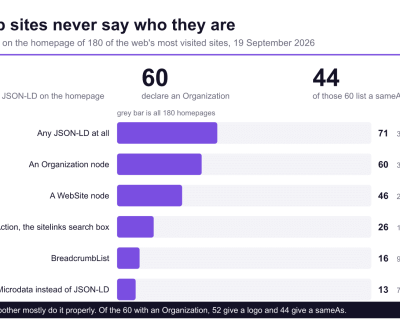
- Most Top Sites Never Say Who They Are in Structured Data October 14, 2026
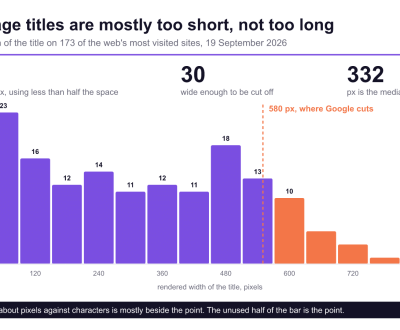
- Homepage Titles Are Mostly Too Short, Not Too Long October 8, 2026
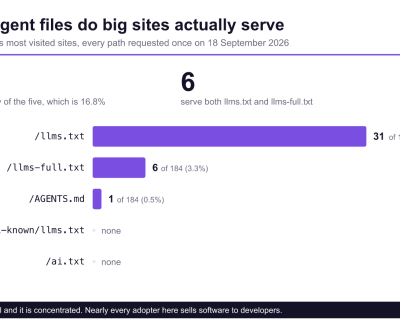
- Who Actually Serves an llms.txt? 184 Top Sites Measured September 29, 2026