

Growing a Marketplace to 100k Visits/mo: Captain Experiences’ CEO Jonathan Newar - Siege Media
- April 6, 2023
- Growth
AI Summary
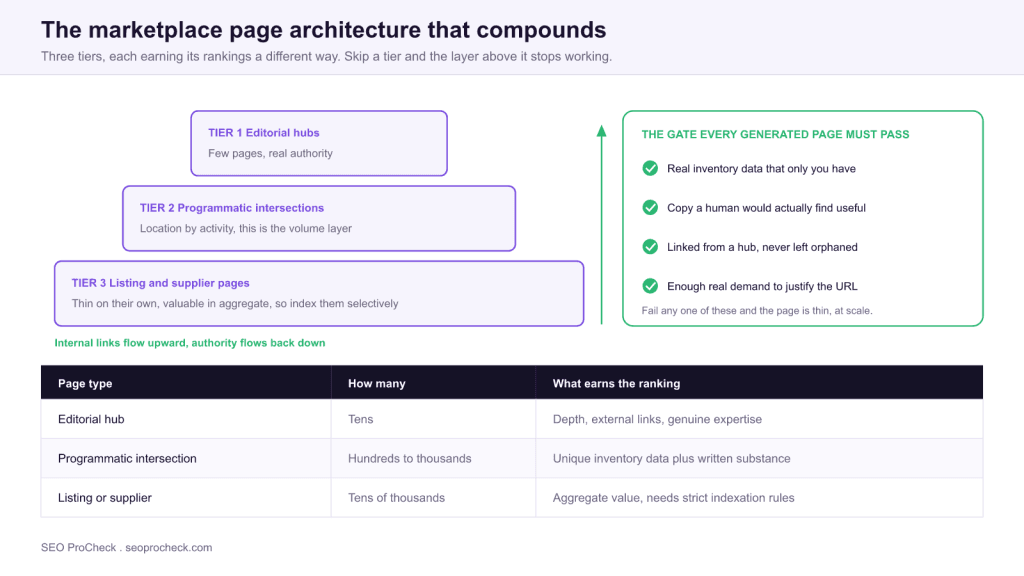
Marketplaces grow organic traffic by turning inventory into indexable pages, but only when each generated page carries data a competitor cannot copy and enough demand to justify its URL. The architecture that compounds has three tiers: a small number of editorial hubs, a programmatic intersection layer built from location and category combinations, and listing pages that are indexed selectively rather than by default.
- Build the intersection page only where both search demand and real inventory exist. Everything else is thin content waiting to happen.
- Decide up front what happens when inventory drops to zero, because on a marketplace it will.
- Split XML sitemaps by page type so Search Console gives you an indexed ratio per template instead of one useless site total.
- Programmatic pages orphan themselves by default. Linking them from hubs is what gets them crawled.

This case study documents a successful organic growth strategy, demonstrating how strategic SEO implementation drives measurable business results. The approach provides actionable insights for practitioners facing similar challenges.
Challenge and Context
Every successful SEO initiative begins with understanding the starting position and objectives. This case study reveals the initial challenges, competitive landscape, and business goals that shaped the strategy. Understanding context helps practitioners assess applicability to their own situations.
The starting position for a two sided marketplace is structurally different from a publisher or an ecommerce store, and the difference sets the whole strategy. A marketplace begins with an asset almost nobody else has, which is live inventory data: who is available, where, at what price, with what availability. It also begins with a liability, which is that this data arrives as database rows rather than as pages a search engine can rank. The entire job is converting the first into something indexable without generating the second.
There is also a cold start problem that content alone cannot solve. Early on, a marketplace has thin supply in most locations, which means most of the pages it could generate would show empty or near empty results. Publishing those pages to chase coverage is the single most common way marketplace SEO programmes fail: they create thousands of URLs that satisfy no query, get crawled once, and leave a site level quality problem that takes far longer to unwind than it took to create.
Strategic Approach
The methodology employed combined technical optimization, content strategy, and authority building in a coordinated approach. Key decisions around prioritization, resource allocation, and tactical execution provide a template for similar initiatives. The strategy balanced quick wins with sustainable long-term growth.
The three tiers, and what each one is for
Treating all marketplace pages as one project is why so many of these programmes stall. The three tiers earn rankings by completely different mechanisms and need different rules.
| Tier | Example URL shape | What earns the ranking | Indexation rule |
|---|---|---|---|
| 1. Editorial hub | /guides/fishing-in-texas/ | Depth, expertise, and the external links it attracts | Always index |
| 2. Intersection | /austin/bass-fishing/ | Inventory data plus written substance nobody else has | Index only if it passes the gate |
| 3. Listing | /trips/12345-half-day-bass/ | Aggregate coverage of long tail queries | Index selectively, never by default |
| Facets | /austin/bass-fishing/?sort=price | Nothing, these exist for users | Canonical to the clean URL, block crawling of parameters |
The fourth row is where crawl budget quietly dies. Every sort order, price filter and page number multiplies the URL space, and a marketplace with a few thousand real pages can easily expose several million crawlable parameter combinations. Decide the parameter policy before launching the intersection layer, not after Search Console starts reporting a crawled to indexed ratio that makes no sense.
The gate: which intersections deserve a URL
The decision rule that keeps this from becoming a thin content programme is a conjunction, and both halves have to be true. Build the page when there is measurable search demand for the combination and enough inventory to satisfy someone who arrives. Demand without supply produces a page that ranks and then disappoints, which converts nothing and earns bad engagement. Supply without demand produces a page nobody searches for, which is thin content by definition.
In practice that means holding two thresholds and reviewing them on a schedule. A minimum monthly search volume for the combination, and a minimum live listing count below which the page does not get generated or indexed. The specific numbers depend entirely on your category and inventory density, so derive them from your own data rather than adopting someone else's, but hold the discipline of having them written down. Without an explicit threshold, the default is always "generate everything," which is the failure mode.
The other half of the gate is the content itself. An intersection page that shows nothing but a list of results is a database view, and it competes poorly against pages that add context. What makes these pages defensible is the material only an operator has: what the season looks like locally, what the typical price range is and why it varies, what a first time buyer should ask before booking. That content also survives the inventory changing underneath it. The programmatic SEO done right guide covers this quality gate in more detail, and it is the difference between a scalable page type and a liability.
Implementation Details
Moving from strategy to execution required specific technical implementations, content creation processes, and measurement frameworks. This case study documents the practical steps taken, tools used, and workflows developed. These implementation details help practitioners translate strategy into action.
Handling inventory that disappears
On a marketplace, supply moves. A page that had twelve listings last month may have zero today, and the wrong response to that creates either soft 404s or a graveyard of empty pages. Decide the policy per scenario, implement it in the template, and it stops being a recurring fire.
| Situation | Do this | Why |
|---|---|---|
| Temporarily zero, supply expected back | Keep the URL live at 200, show nearby or related inventory | Preserves rankings and gives the visitor a next step |
| Seasonally zero, returns each year | Keep it indexed, add the season dates as content | "When is the season" is itself a query worth owning |
| Permanently zero, no realistic supply | 301 to the parent category or location | Consolidates any equity instead of discarding it |
| Never had supply, generated in error | Return 404 or 410 and remove from the sitemap | It should not have existed, do not launder it with a redirect |
| Individual listing expired | 301 to the closest category page, not the homepage | Homepage redirects at volume get treated as soft 404s |
Measurement that tells you something
A single site wide index coverage number is useless on a marketplace, because the tiers behave so differently that the average describes none of them. Split XML sitemaps by page type, submit each separately, and Search Console will give you an indexed ratio per template. That one change turns "we have an indexing problem" into "the intersection layer is at 40 percent while hubs are at 98 percent," which is an actionable statement.
/sitemap-index.xml
    /sitemap-hubs.xml            (editorial, tens of URLs)
    /sitemap-intersections.xml   (location by category, thousands)
    /sitemap-listings.xml        (only listings that pass the gate)
    /sitemap-static.xml          (about, pricing, help)
Three metrics are worth a standing dashboard. The indexed ratio per sitemap, which tells you whether the gate is strict enough. The share of intersection pages with at least one click in 90 days, which tells you whether the pages you built match real demand. And crawl requests per page type from your log files, which tells you whether Googlebot is spending its budget on the tier you care about or burning it on parameter combinations.
Orphaning is the failure that hides longest. Generated pages are typically reachable only through search or a sitemap, and a sitemap entry is a suggestion rather than a link. Build hub pages that link to the intersection layer in a structured way, and link laterally between related intersections, so crawlers have a genuine path. The internal linking guide covers the patterns; the building topical authority piece explains why the editorial tier is what makes the volume tier credible in the first place.
Results and Analysis
The outcomes demonstrate the effectiveness of the approach through measurable metrics: traffic growth, ranking improvements, and business impact. Analysis of what worked best and what could have been done differently provides learning value beyond the raw results.
Read marketplace growth curves with the timeline in mind. This page type compounds slowly and then quickly, because the intersection layer cannot rank until the hubs have earned enough authority to pass along, and the hubs take months to earn links. Programmes that get abandoned usually get abandoned in month four, at the point where the cost has been paid and the return has not yet arrived.
Be careful about which number you call the result. Sessions on a marketplace are easy to inflate with pages that rank for queries with no commercial intent. The metric that matters is whether the organic entrance produced a booking, an enquiry, or a supplier signup, segmented by page tier. It is common to find that the editorial tier drives volume while the intersection tier drives revenue, and that changes where the next quarter's effort goes. For the supply side view of the same problem, marketplace SEO for sellers covers what individual sellers can control.
This case study contributes to the evidence base for effective SEO strategy, helping practitioners learn from documented successes.
FAQ
By gating generation on two conditions at once: measurable search demand for the combination, and enough live inventory to satisfy a visitor who arrives. Pages that pass also need written substance beyond the results list, such as local seasonality, price context, and buying guidance. If a page would be nothing but a database view, it should not be generated.
Selectively, not by default. Listings are usually short lived, near duplicate, and thin individually, so indexing all of them creates exactly the site level quality pattern you want to avoid. Index the ones with substantial unique detail and durable availability, and let the category and intersection pages carry the rest.
It depends on whether supply is coming back. If it is temporary or seasonal, keep the URL live and returning 200, show nearby or related inventory, and state when availability returns. If it is permanent, redirect to the parent category. Only return 404 or 410 for pages that never should have been generated.
Decide the policy before you launch the layer. Canonical every filtered or sorted variant to the clean category URL, disallow the parameter patterns in robots.txt, and keep only the small set of facet combinations that have genuine search demand as real indexable URLs. Retrofitting this after millions of combinations are already discovered is far harder than preventing it.
Usually because they are too similar to each other and add nothing a competitor could not generate, which is a quality judgement rather than a technical fault. The second most common cause is orphaning: the pages exist only in the sitemap with no internal links pointing at them, so Google discovers them but has no signal that they matter. Fix the substance first, then the linking.
Longer than most plans allow, because the layers depend on each other. The editorial hubs have to earn authority before the intersection layer can convert impressions into positions, and link acquisition runs on its own timeline. Expect meaningful compounding on a horizon of quarters rather than weeks, and set the internal expectation accordingly so the programme is not cancelled just before it works.
Source: https://www.siegemedia.com/conversation/jonathan-newar
Claude Vincent is a technical SEO consultant focused on crawlability, rendering, and AI-search visibility. He writes the field guides and case studies at SEO ProCheck, with a bias toward the durable, unglamorous work that decides whether search engines and AI answer engines can actually read and cite a site.
About SEO ProCheck
Technical SEO consulting and GEO strategy with 20 years of enterprise experience. Case studies, resources, and tools for search and AI visibility.
Work With Me
Technical SEO audits, GEO strategy, site migrations, and international SEO. Hourly consulting for teams who need hands-on support, not just reports.
Subscribe to our newsletter!






Recent Posts
- Can AI Crawlers Actually Read Your Site? I Measured 400 of the Biggest September 5, 2026
- The Pre-Publish Quality Gate for AI-Assisted Content August 6, 2026
- AGENTS.md vs llms.txt vs llms-full.txt: Which Agent File Does What July 18, 2026