

"Can replacing the word ""Price"" with ""Cost"" in the title tag improve organic traffic?"
- April 6, 2023
- Metadata
AI Summary
Whether swapping "price" for "cost" in a title tag lifts organic traffic depends on your audience and page type, so the reliable answer is to run an SEO A/B test rather than guess. A split test compares a matched control group of pages against a variant group with the one word changed, then a causal model measures the real effect.
- SEO A/B tests split pages, not users, because you cannot serve Googlebot two versions of one URL.
- The two words differ in meaning: "price" is the sticker number, "cost" can imply total outlay or value.
- You need enough similar templated pages and traffic to detect an effect above noise.
- Results rarely generalize across sites, so the documented outcome is one site's result, not a rule.
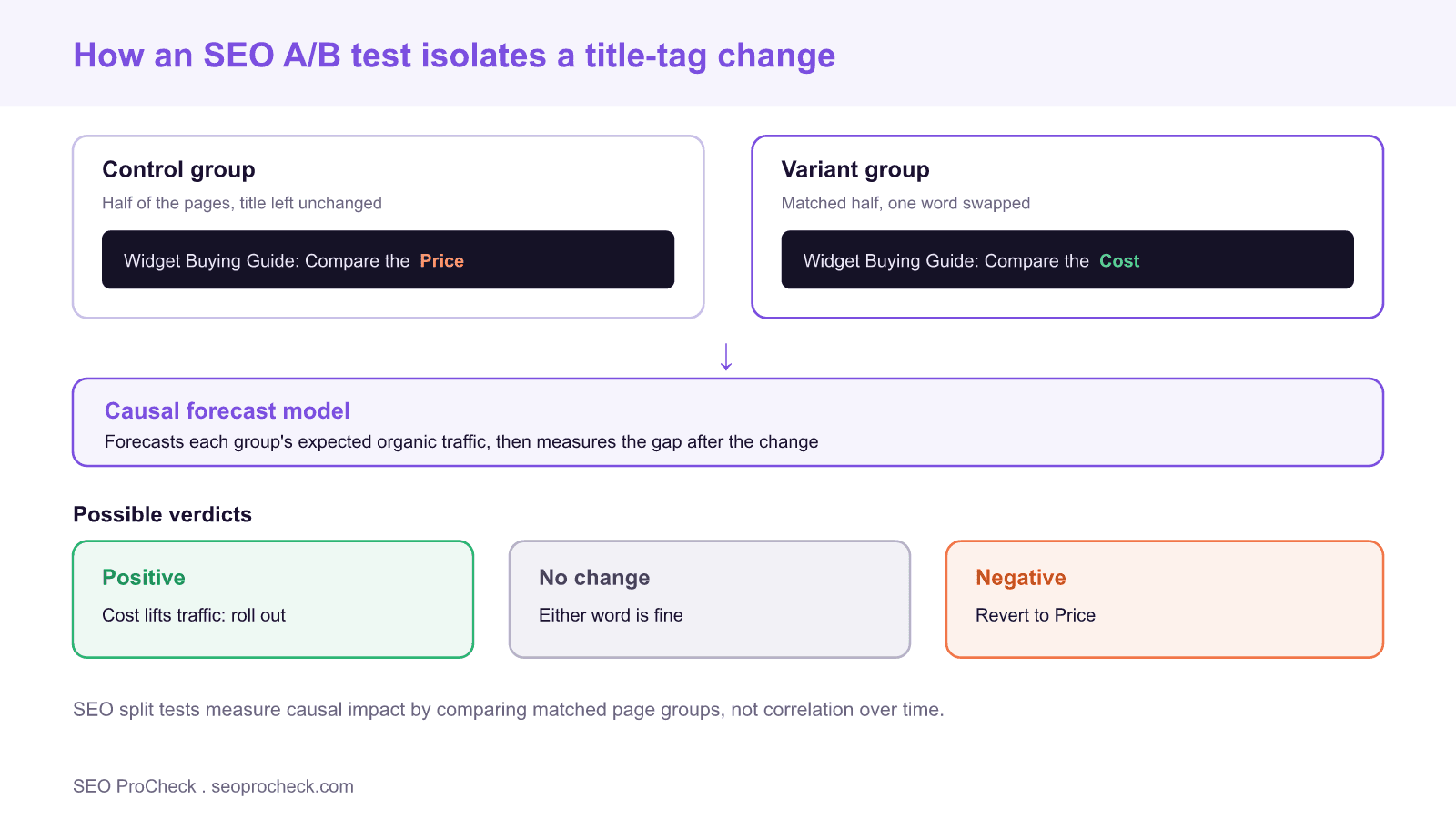
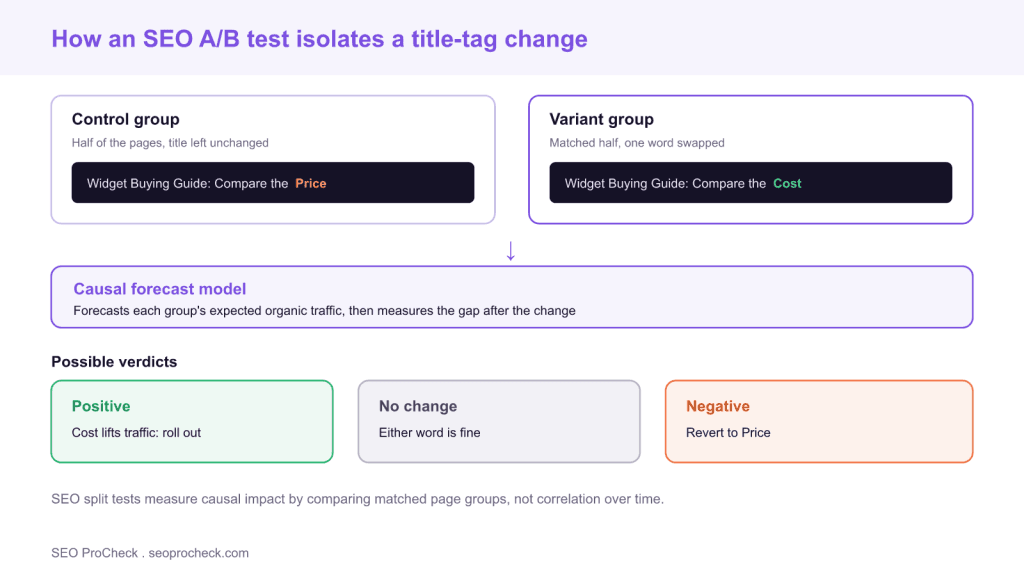
Can one word in a title tag change how much organic traffic a page earns? It is a fair question, because the title tag is one of the strongest on-page relevance and click-through signals you control. Swapping "price" for "cost" sounds trivial, yet the two words carry different meaning and match different searches. The only honest way to answer it is not to argue about the words but to run a controlled SEO A/B test, which is exactly what the SearchPilot case study this page summarizes did. The diagram above shows how that kind of test is structured.
This SEO case study documents a successful optimization initiative, providing actionable insights for practitioners. The documented approach demonstrates how strategic SEO implementation drives measurable results.
Why a single title-tag word can move traffic
The title tag does two jobs at once: it helps search engines understand what a page is about, and it is the headline searchers read before deciding to click. A word that better matches the language of the query can nudge both. "Price" and "cost" are near-synonyms in casual speech, but they are not identical in search: they have different volumes, and they hint at slightly different intent. The table below sketches how each word tends to land.
| Word | What it signals | Where it may fit best |
|---|---|---|
| Price | The sticker number, a direct transactional cue | Product and comparison pages where shoppers scan for the figure |
| Cost | Total outlay or value, often a broader consideration | Services, calculators, and "how much does X cost" queries |
| Search language | The two words have different query volumes and intent | Match the word your audience actually types |
None of this tells you which word wins for your pages, because that depends on your specific audience. It only tells you the change is plausible enough to be worth testing rather than dismissing.
Initial Situation
Understanding the starting point is essential context for evaluating any case study. This documentation covers the initial challenges, competitive position, and business objectives that shaped the SEO strategy.
The starting point for a test like this is a clear, testable hypothesis: "changing the title word from price to cost will increase organic traffic to these pages." Before running it, confirm the preconditions. Do you have a large enough set of similar, templated pages to split into two groups? Do those pages carry enough organic traffic for an effect to show above the noise? Which word do your competitors and your own search query data suggest users prefer? Framing the bet this precisely is the same discipline that lean SEO applies to every experiment.
Strategy and Approach
The strategic approach combined multiple SEO disciplines to address identified opportunities. Key decisions around prioritization and resource allocation provide a template for similar initiatives.
The strategy is a page-level SEO A/B test, which is fundamentally different from a conversion test. You cannot show Googlebot two versions of one URL, so instead of splitting users you split pages: a control group keeps the original title, and a statistically matched variant group gets the single-word change. A forecasting model predicts what each group's organic traffic would have been without any change, then measures the gap once the variant goes live. That gap, with its confidence interval, is the causal effect. The result comes back as positive, negative, or no detectable change, as shown in the verdict row of the diagram.
Implementation
Moving from strategy to execution required specific technical implementations, content development, and process changes. This case study documents the practical steps that translated strategy into action.
Implementation means building the test cleanly so the answer is trustworthy. Split the page set into comparable control and variant groups, change only the one word in the variant titles, and leave everything else on the page untouched. Let it run long enough to reach confidence, typically several weeks, so weekly patterns and short-term noise average out. If you do not have a dedicated split-testing platform, you can approximate the method with a matched control group and Search Console baselines. The requirements below are what separate a real test from a misleading before-and-after.
| Test requirement | Why it matters |
|---|---|
| Enough similar pages | You need comparable control and variant groups, so templated pages are ideal |
| Sufficient traffic | The effect has to be large enough to detect above normal fluctuation |
| One variable changed | Only the single word changes, so the result is attributable |
| Adequate run time | Usually several weeks, to reach confidence and cover weekly cycles |
| A forecast or control baseline | Separates the change from seasonality and overall trend |
Results and Learnings
The outcomes demonstrate effectiveness through measurable improvements in rankings, traffic, and business metrics. Analysis of successes and challenges provides learning value for practitioners.
Read the outcome against the three possible verdicts. A positive result means the new word lifted organic traffic beyond the confidence interval, so you roll it out. A null result means the change made no detectable difference, so either word is fine and you move on to a higher-impact test. A negative result means revert. Crucially, whatever this one test found applies to the tested pages and audience, not to every site, because search language varies by market and page type. Read the measured figures in the SearchPilot case study at the source below as that site's result. For the related question of how the framing of a title, not just one word, changes performance, see the companion study on commercial versus functional versus emotional titles, and remember that a reliable test still rests on the usual technical fundamentals.
Case studies like this contribute to the SEO knowledge base, helping practitioners learn from documented real-world experiences.
FAQ
No. The effect depends on how your audience phrases searches and on the page type, and results do not generalize across sites. That is exactly why you run a controlled test rather than assume. The documented SearchPilot case study at the source shows one site's measured outcome, not a universal rule.
It is a test that splits a group of similar pages into a control set and a variant set, applies one change to the variant, and uses a forecasting model to measure the causal impact on organic traffic. Unlike a conversion test, it operates at the page level rather than the individual user level.
Conversion tests split users on a single page and measure conversions. SEO tests split pages, not users, because you cannot show Googlebot two versions of the same URL. You compare matched groups of pages over time against a forecast, which isolates the change from seasonality and trend.
You need enough comparable, templated pages to form a control group and a variant group with sufficient combined organic traffic to detect an effect above normal fluctuation. In practice that usually means hundreds of pages on an e-commerce or listing template, not a handful of unique pages.
The title tag is a primary relevance and click-through signal. A word that better matches how searchers actually phrase their queries can improve both how the page is understood and how often people click it in the results, and small click-through gains across many pages add up.
You can approximate it by changing titles on a defined group of pages and comparing their organic performance against a matched control group and their own baseline in Search Console. Dedicated split-testing platforms do more, modeling seasonality and reporting statistical confidence, but the core idea is reproducible by hand.
Source: https://www.searchpilot.com/resources/case-studies/replacing-price-with-cost-in-title/
Guessing at title tags instead of testing them?
Title wording can move organic clicks across thousands of pages. An audit shows where a controlled title test is worth running on your templates.
Take this with you
The assistant links open with a question about this page already written. Nothing is sent until you press enter.
Claude Vincent is a technical SEO consultant focused on crawlability, rendering, and AI-search visibility. He writes the field guides and case studies at SEO ProCheck, with a bias toward the durable, unglamorous work that decides whether search engines and AI answer engines can actually read and cite a site.
About SEO ProCheck
Technical SEO consulting and GEO strategy with 20 years of enterprise experience. Case studies, resources, and tools for search and AI visibility.
Work With Me
Technical SEO audits, GEO strategy, site migrations, and international SEO. Hourly consulting for teams who need hands-on support, not just reports.
Subscribe to our newsletter!








Recent Posts
- Most Top Sites Never Say Who They Are in Structured Data October 14, 2026
- Homepage Titles Are Mostly Too Short, Not Too Long October 8, 2026
- Who Actually Serves an llms.txt? 184 Top Sites Measured September 29, 2026