

AI Summary
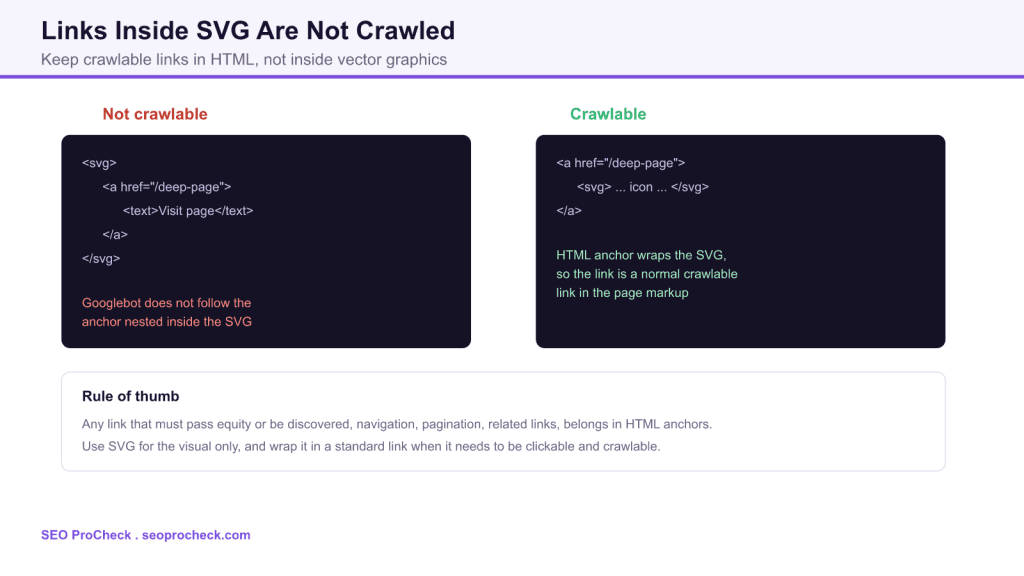
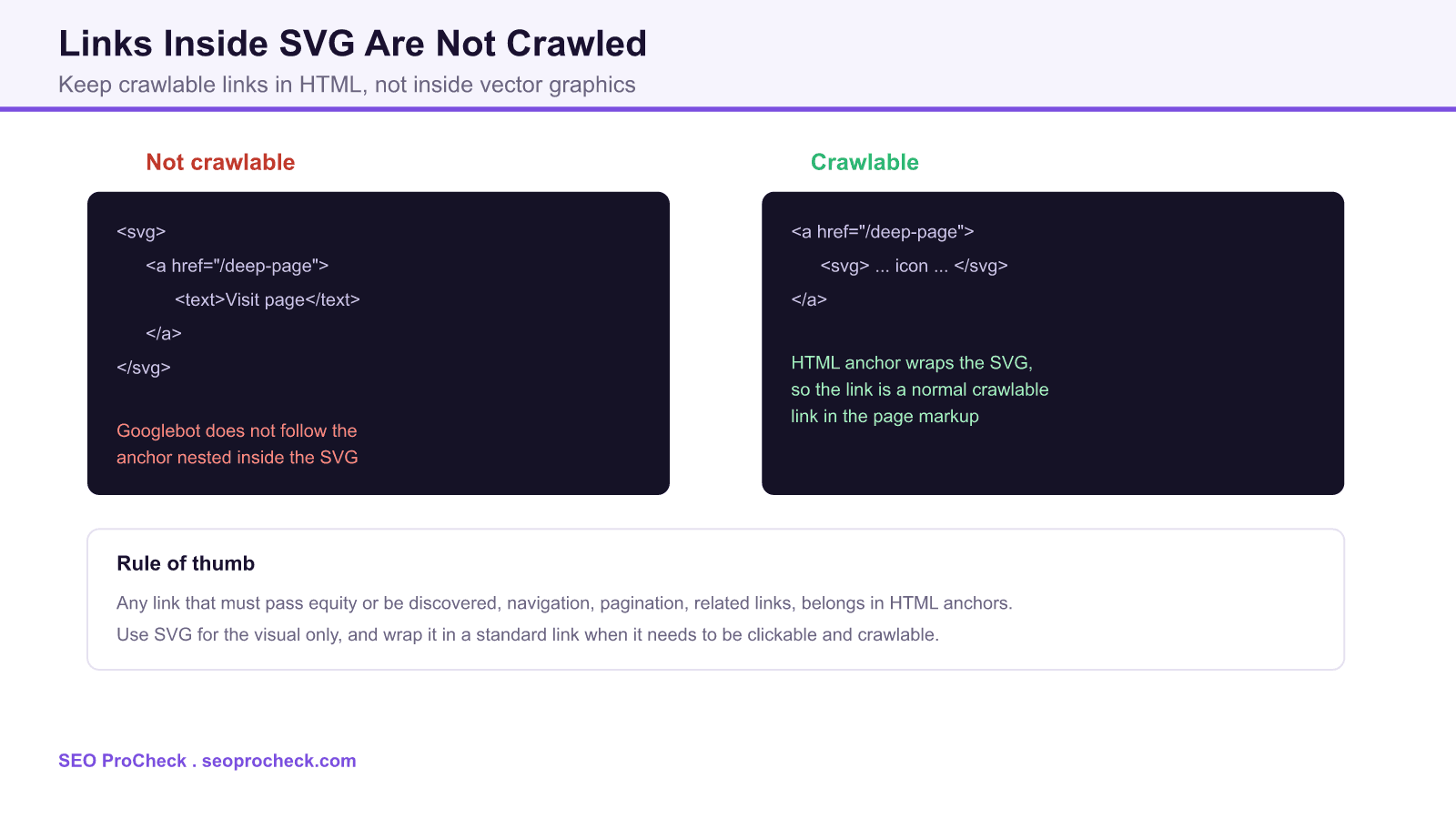
Google does not crawl or follow links placed inside an SVG file, so any URL that only exists as an in-SVG anchor is effectively undiscovered and passes no internal link equity. The fix is to wrap the SVG in a standard HTML anchor so the link lives in the page markup, and to reserve SVG for the visual only.
- An anchor nested inside an SVG is valid and clickable for users but ignored by Googlebot.
- Wrap the inline SVG in an HTML anchor so the link is crawlable and passes equity.
- SVGs loaded through an img tag have all internal links ignored.
- Audit templates for anchors sitting inside svg elements, since crawlers will not report them as outlinks.
Link acquisition remains a critical ranking factor. This case study documents effective approaches to earning links that improved domain authority and supported ranking growth.
Link Building Context
Every link building initiative operates within specific constraints: industry, resources, existing authority, and competitive landscape. This case study establishes the context that shaped link building strategy and tactics.
Strategy and Tactics
Sustainable link building requires approaches that earn editorial links rather than manufacture artificial signals. This case study details the specific tactics employed: content-driven outreach, digital PR, resource creation, or relationship building.
Outreach and Execution
Link building requires efficient outreach processes and compelling value propositions. This case study documents outreach methodology, response rates, and relationship development approaches that yielded results.
Impact Assessment
Link building value manifests in domain authority growth, ranking improvements for target keywords, and referral traffic from acquired links. This case study quantifies the impact of link building efforts and their contribution to overall SEO success.
Link building case studies help practitioners understand effective approaches in an increasingly sophisticated link landscape.
Source: https://edit.co.uk/blog/google-doesnt-crawl-links-scalable-vector-graphics/
What the finding actually says
The original piece from Edit documents a specific, easily missed technical trap: Google does not crawl or follow links that live inside a Scalable Vector Graphics file. SVG supports its own anchor element, so it is perfectly valid markup to place an anchor around text or shapes inside an SVG and expect it to behave like a link. It works for a human who clicks it, but Googlebot treats those in-SVG anchors as non-crawlable. Any URL that only exists as a link inside an SVG is, from Google point of view, undiscovered and passes no internal link equity. On a site that renders navigation, logos, or call to action buttons as SVG with embedded anchors, that can quietly orphan important pages.
This matters more than it first appears because SVG is now everywhere. Icon systems, inline logos, infographics, and interactive charts are frequently shipped as SVG for crisp rendering at any size. If a designer builds a clickable diagram where the hotspots are anchors inside the SVG, the destinations may never be crawled through that path. The pages might still be found through an XML sitemap or other HTML links, but you lose the crawl path and the internal link signal you thought you had.
The wrong pattern versus the right pattern
The problem pattern places the anchor inside the SVG, wrapping SVG text or shapes:
<svg viewBox="0 0 100 40" xmlns="http://www.w3.org/2000/svg">
  <a href="/deep-page">
    <text x="10" y="25">Visit page</text>
  </a>
</svg>
Googlebot does not follow that nested anchor, so the destination gains nothing from it. The fix is to invert the nesting: put a standard HTML anchor in the page markup and place the SVG inside it purely as the visual. The link then behaves like any other crawlable HTML link.
<a href="/deep-page">
  <svg viewBox="0 0 100 40" xmlns="http://www.w3.org/2000/svg" role="img" aria-label="Visit page">
    <path d="M4 20 L96 20" />
  </svg>
</a>
With this structure the SVG is decoration and the anchor is a real, crawlable link in the document. Add an accessible label so screen readers announce the destination, and keep the SVG focused on the graphic rather than the navigation.
How to audit your own site for buried SVG links
Start by viewing the rendered source of key templates and searching for anchor elements that sit inside svg elements. In practice, look for the string that opens an anchor appearing after an opening svg tag and before its closing tag. A crawler such as Screaming Frog will not report in-SVG anchors as outlinks, which is itself a useful tell: if you expect a link from a page and the crawler shows no outlink to that destination, check whether the link is trapped inside an SVG. Compare your list of important destination URLs against the internal links your crawler actually finds, and investigate any page that appears under-linked despite being linked visually.
| Element | Crawled and followed by Google? | Recommendation |
|---|---|---|
| Anchor nested inside an SVG | No | Move the link into an HTML anchor |
| HTML anchor wrapping an inline SVG | Yes | Preferred pattern for clickable icons |
| SVG loaded via an img tag | Any links inside are ignored | Use only for non-linking graphics |
| Standard HTML text link | Yes | Always safe for navigation and equity |
Why this connects to crawl budget and discovery
Internal links are how Google discovers pages and distributes authority across a site. When an important link only exists inside an SVG, you break both functions at once: the page may go undiscovered through that route, and it receives no internal PageRank from the graphic. On large sites, where crawl budget and clean internal linking already need active management, a template that hides links in SVG can compound into a real indexation problem. The rule is simple and durable: use SVG for visuals, and put every link that must be crawled into a normal HTML anchor. For the wider picture, see our internal linking complete guide and how Google handles rendered markup in our JavaScript SEO rendering guide. For definitions, see the JavaScript SEO glossary entry, and to understand how discovery paths affect large sites, read crawl budget explained.
Frequently Asked Questions
Does Google crawl links inside SVG files?
No. Google does not crawl or follow anchor elements placed inside a Scalable Vector Graphics file, even though that markup is valid and clickable for human users. A URL that only exists as an in-SVG link is effectively undiscovered through that path and passes no internal link equity.
How do I make a clickable SVG icon that Google can crawl?
Wrap the inline SVG in a standard HTML anchor rather than putting the anchor inside the SVG. The HTML anchor becomes a normal crawlable link, and the SVG acts only as the visual. Add an accessible label so screen readers announce the destination.
Do links inside an SVG loaded with an img tag get crawled?
No. When an SVG is loaded through an img element, any links inside it are ignored entirely, just as links inside a raster image would be. Use that pattern only for graphics that do not need to link anywhere.
How can I find links buried inside SVGs on my site?
View the rendered source of your key templates and look for anchor elements sitting inside svg elements. Crawlers like Screaming Frog will not report in-SVG anchors as outlinks, so a page that appears under-linked despite a visible clickable graphic is a strong signal to investigate.
Can an SVG link still work for users even if Google ignores it?
Yes. Browsers will follow an anchor inside an SVG for a human who clicks it, so the feature is not broken for users. The problem is strictly for search: Googlebot will not use that link for discovery or to pass authority, so important links should never live only inside an SVG.
Does this affect internal link equity and crawl budget?
Yes. Because internal links drive both discovery and the flow of authority, a link hidden inside an SVG passes no equity and can leave a page undiscovered through that route. On large sites this can worsen indexation and waste the crawl paths you intended to build.
Take this with you
The assistant links open with a question about this page already written. Nothing is sent until you press enter.
Claude Vincent is a technical SEO consultant focused on crawlability, rendering, and AI-search visibility. He writes the field guides and case studies at SEO ProCheck, with a bias toward the durable, unglamorous work that decides whether search engines and AI answer engines can actually read and cite a site.
About SEO ProCheck
Technical SEO consulting and GEO strategy with 20 years of enterprise experience. Case studies, resources, and tools for search and AI visibility.
Work With Me
Technical SEO audits, GEO strategy, site migrations, and international SEO. Hourly consulting for teams who need hands-on support, not just reports.
Subscribe to our newsletter!






Recent Posts
- Finding a Competitor's Sitemap, and Turning It Into a Change Log September 15, 2026
- AI Crawler User Agents: The Current Names, and Which Ones Sites Actually Block September 9, 2026
- Can AI Crawlers Actually Read Your Site? I Measured 400 of the Biggest September 5, 2026