

Case study: JavaScript blocking Google's view of hreflang
- September 26, 2016
- International SEO
AI Summary
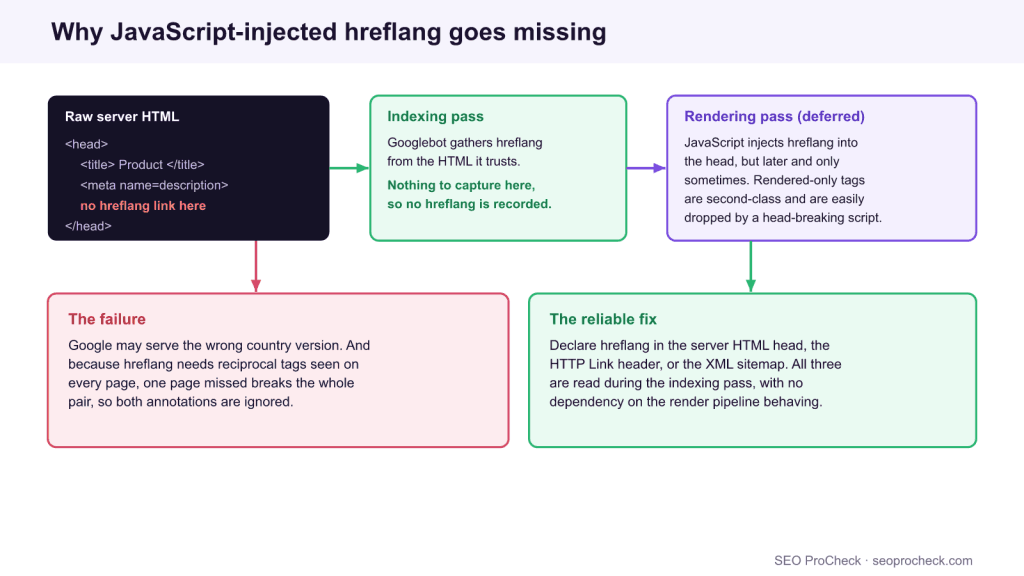
Can JavaScript break hreflang? Yes. If hreflang annotations are injected into the <head> by JavaScript instead of being present in the server-delivered HTML, Google may only see them after rendering, which is deferred, resource-dependent, and easily derailed by anything JS moves or injects into the head before them. The reliable rule: declare hreflang in the raw server HTML head, in HTTP headers, or in the XML sitemap, and never depend on client-side rendering for it.
- hreflang injected by JavaScript is only read during Google’s deferred render pass, so it is easily missed or dropped.
- Declare hreflang in the raw server HTML head, an HTTP
Linkheader, or the XML sitemap: all three are read without rendering. - Compare view-source with the rendered DOM to tell whether your tags are server-side or JavaScript-injected.
- Because hreflang must be reciprocal, one page whose tag is missed invalidates the whole annotation pair.

International SEO presents unique challenges for reaching users across languages and regions. This case study documents successful international expansion strategies that established search visibility in target markets.
International Context
International SEO requirements vary based on target markets, content localization needs, and technical infrastructure. This case study establishes the international scope and specific challenges addressed.
Technical Implementation
International targeting requires proper technical setup: URL structure decisions, hreflang implementation, and Search Console configuration. This case study documents the technical approach that enabled successful international targeting.
Localization Strategy
Beyond technical implementation, international success requires appropriate content localization. This case study covers translation quality, local relevance adaptation, and market-specific content development.
Market Performance
International SEO success is measured by visibility and traffic in target markets. This case study quantifies performance across markets, demonstrating the effectiveness of the international approach.
International SEO case studies help practitioners navigate the complexity of multi-market optimization.
Why This Failure Mode Still Bites
The Search Engine Land case study linked below documented a pattern we still see regularly in audits: a site’s hreflang looks perfect in the browser, every validator run against the rendered page passes, and yet Google keeps serving the wrong country versions, because the annotations only exist after JavaScript runs. Tag managers injecting hreflang, SPA frameworks building the entire <head> client-side, and consent or personalization scripts that rewrite head elements are the usual culprits.
The underlying mechanics haven’t changed since the case study was written, even though Google’s renderer has improved. Hreflang processing happens as part of indexing signals gathered from the HTML Google trusts; rendering happens later, sometimes much later, and rendered-only head elements are second-class citizens. A single script that injects an iframe, an early <body>-like element, or malformed markup into the head can cause everything after it to be treated as body content, silently discarding your rendered-in hreflang. When an annotation is only sometimes seen, hreflang’s reciprocity requirement makes things worse: if page A’s tag is picked up but page B’s return tag isn’t, the pair is invalid and both annotations are ignored.
Diagnostic Walkthrough: Is Your Hreflang Server-Rendered?
This takes fifteen minutes and settles the question definitively.
- View-source vs. rendered DOM. Open a localized page and hit view-source (
Ctrl/Cmd+U), this is the raw server HTML. Search forhreflang. Then open DevTools > Elements (the rendered DOM) and search again. Present in DevTools but absent from view-source = JavaScript-injected. That one comparison is the whole diagnosis in most cases. - Confirm with curl.
curl -s https://example.com/fr/page | grep -i hreflangremoves any browser-extension ambiguity. While you’re there, check response headers too (curl -sI), hreflang may legitimately live in an HTTPLinkheader rather than the HTML. - URL Inspection in Search Console. Inspect the live URL and open the rendered HTML in the “View crawled page” panel. This shows what Google’s own renderer produced. If hreflang is missing even here, your injection is failing for Googlebot specifically (timing, blocked script, or head-breaking markup). If it appears here but not in view-source, you are in the “works only after render” risk zone the case study describes.
- Crawl both ways with Screaming Frog. Run one crawl in default HTML mode and one with JavaScript rendering enabled (Configuration > Spider > Rendering), then compare the hreflang reports. Annotations that only exist in the rendered crawl are client-side injected across the whole site, this turns a one-page spot check into a site-wide inventory. Our Screaming Frog crawl recipes include a ready-made configuration for exactly this comparison, and our broader JavaScript rendering diagnosis guide covers the same technique for other rendered-only tags.
- Check reciprocity on the raw HTML. For a sample cluster (one URL per locale), verify every page lists all its alternates and itself, in the server HTML. A hreflang validator speeds this up, but make sure it fetches raw HTML rather than executing scripts, or it will happily validate the illusion.
Where Hreflang Should Be Declared
Google supports exactly three delivery methods, and all three are read without rendering:
| Method | How | Best for | Watch out for |
|---|---|---|---|
HTML <link> in server-rendered head | <link rel="alternate" hreflang="fr" href="..."> in the raw HTML | Most sites; easiest to spot-check | Head bloat on sites with many locales; must survive any head-rewriting scripts |
HTTP Link header | Server sends Link: <url>; rel="alternate"; hreflang="fr" | Non-HTML assets (PDFs); CDN-level control | Invisible in view-source, audit with curl; header size limits with many locales |
| XML sitemap | <xhtml:link> entries per URL | Large locale matrices; keeps pages lean; fixes hreflang without touching templates | Sitemap must be regenerated on URL changes; reciprocity errors hide in stale files |
JavaScript injection is conspicuously not on that list. Google’s documentation doesn’t forbid it, rendered head tags can be picked up, but it is the only approach whose success depends on the render pipeline behaving perfectly on every crawl. For a site whose international revenue depends on the right version ranking in the right country, that is not a dependency worth keeping. If you can’t move the tags server-side (common with tag-manager-based “fixes”), the sitemap method is the standard escape hatch: it requires no template changes at all.
For the fuller decision framework, including which method scales best by site type, see our guide on where to declare hreflang, and don’t forget the annotation set is only complete with a fallback: our check on missing x-default hreflang explains why that piece matters.
Remediation Priorities
If the walkthrough above shows JS-injected hreflang, fix in this order: (1) move annotations into the server response, template-level for the head method, or generate sitemap hreflang from your locale mapping; (2) remove the JS injection once the server-side version is live, so you don’t ship conflicting signals during render; (3) re-verify with URL Inspection and a raw-HTML crawl; (4) monitor international queries and country-level impressions in Search Console over the following weeks, hreflang corrections show up as the right locale URLs regaining impressions in their own markets. The complete implementation reference lives in our hreflang and international SEO guide.
Frequently Asked Questions
Sometimes, and that is the problem. Rendered head tags can be picked up, but only after deferred rendering, and only if nothing in the rendered head breaks parsing first. Because hreflang requires reciprocal annotations to be seen consistently across every page in a cluster, “sometimes” degrades to “effectively broken” at scale.
Compare view-source (raw server HTML) with DevTools Elements (rendered DOM) on the same page. If hreflang appears only in DevTools, it is JavaScript-injected. Confirm with curl | grep hreflang and with the rendered HTML in Search Console’s URL Inspection tool.
You can, but you shouldn’t treat it as more than a temporary patch. GTM-injected tags exist only after rendering, inherit every risk described above, and add tag-manager timing as a failure mode. If templates can’t be touched, use the XML sitemap method instead, it is fully supported and requires no page changes.
Yes, Google treats the three supported methods as equivalent. Pick one method per URL set and stay consistent; mixing methods across the same cluster makes debugging reciprocity errors much harder.
The usual causes, in order of frequency: the validator tested the rendered page rather than the raw HTML (masking a JS-injection problem), reciprocal return tags are missing on some pages, annotations point at redirected or non-canonical URLs, or there is no x-default to catch unmatched users. Work through the diagnostic walkthrough above before touching the tags themselves.
Google has to recrawl both sides of every annotation pair before it honors them, so expect weeks rather than days on large sites, with high-crawl-frequency pages correcting first. Resubmitting the hreflang sitemap and monitoring country-level impressions in Search Console is the practical way to track progress.
Source: https://searchengineland.com/case-study-javascript-blocking-googles-view-hreflang-259312
Claude Vincent is a technical SEO consultant focused on crawlability, rendering, and AI-search visibility. He writes the field guides and case studies at SEO ProCheck, with a bias toward the durable, unglamorous work that decides whether search engines and AI answer engines can actually read and cite a site.
About SEO ProCheck
Technical SEO consulting and GEO strategy with 20 years of enterprise experience. Case studies, resources, and tools for search and AI visibility.
Work With Me
Technical SEO audits, GEO strategy, site migrations, and international SEO. Hourly consulting for teams who need hands-on support, not just reports.
Subscribe to our newsletter!







Recent Posts
- Can AI Crawlers Actually Read Your Site? I Measured 400 of the Biggest September 5, 2026
- The Pre-Publish Quality Gate for AI-Assisted Content August 6, 2026
- AGENTS.md vs llms.txt vs llms-full.txt: Which Agent File Does What July 18, 2026