

E-E-A-T Optimization Guide: Building Trust and Authority
- September 10, 2024
- E-E-A-T Optimization, Content SEO
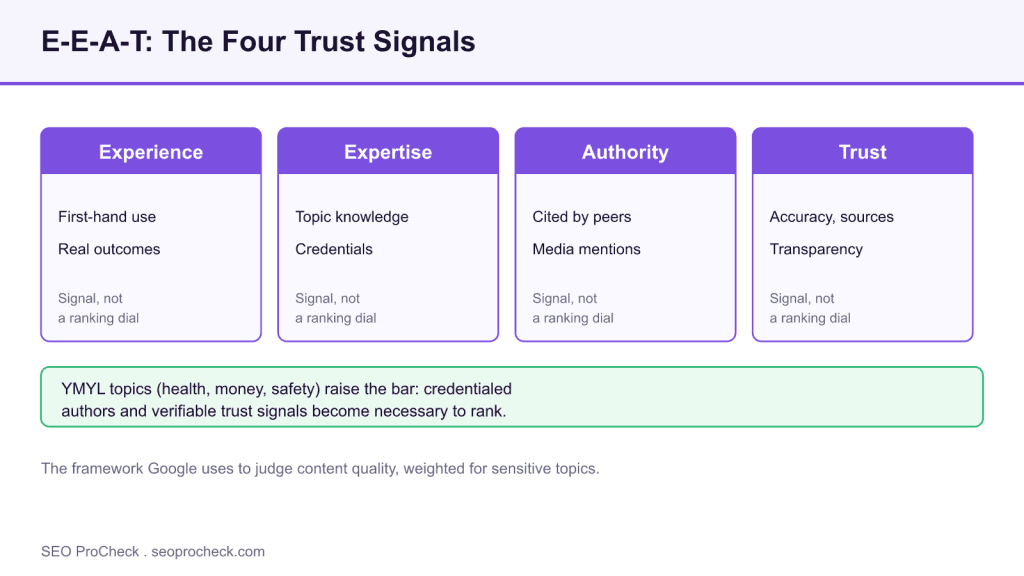
E-E-A-T is the framework Google uses to judge content quality: Experience, Expertise, Authoritativeness, and Trustworthiness. It is not a single ranking dial you can turn, but a set of signals that decide whether your content is trusted enough to rank, and the bar rises sharply for YMYL topics like health and finance.
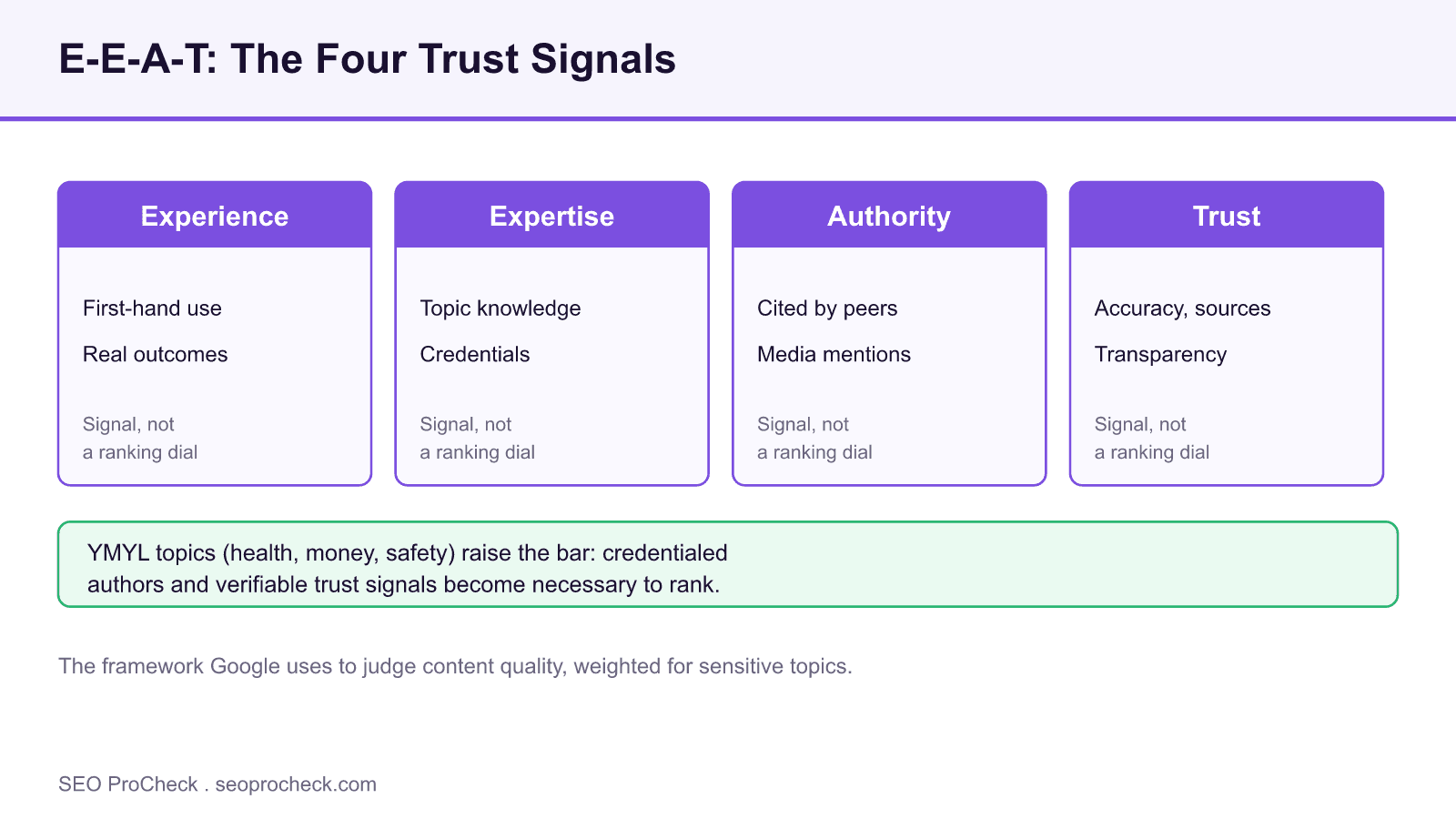
- Experience means first-hand use; Expertise means demonstrable knowledge; Authoritativeness means being cited; Trustworthiness means accuracy and transparency.
- YMYL (Your Money or Your Life) content needs credentialed authors and verifiable sources to compete.
- You prove E-E-A-T on the page with author bios, citations, specifics, and clear sourcing, not with a plugin setting.
- Strong E-E-A-T tends to show up as ranking stability through core updates.
Understanding E-E-A-T Components
Experience refers to first-hand, real-world experience with the topic. A product review from someone who actually used the product demonstrates experience. This addition to the original E-A-T framework emphasizes authentic human insight over purely researched content.
Expertise means having the knowledge or skill in a particular area. For medical topics, expertise might require medical credentials. For DIY topics, practical skill demonstrated through content quality may suffice. Required expertise level varies by topic sensitivity.
Authoritativeness measures recognition as a go-to source. Citations from other authoritative sources, media mentions, and industry recognition build authoritativeness. A site can have expertise without authoritativeness if that expertise isn't widely recognized.
Trustworthiness encompasses accuracy, transparency, and reliability. Factual accuracy, clear attribution of sources, transparent business practices, and consistent quality all contribute to trustworthiness.
Implementing E-E-A-T Signals
Create detailed author pages demonstrating credentials and experience. Include author bylines on content with links to author pages. List relevant qualifications, publications, industry experience, and social proof. For YMYL topics, credentialed authors matter significantly. Consider adding Person schema on author pages so the entity connections are machine readable.
Demonstrate experience through specific examples, case studies, and detailed insights only possible through direct involvement. First-person accounts of using products, implementing strategies, or experiencing outcomes provide experience signals that researched content cannot match.
Build authoritativeness through consistent quality publishing, earning mentions and links from recognized sources, and participating in industry discussions. Authoritativeness develops over time through accumulated recognition, and it compounds with topical authority earned by covering a subject deeply.
Establish trustworthiness through factual accuracy, citing reputable sources, maintaining content freshness, providing clear contact information, and transparent business practices. Address potential trust concerns proactively.
E-E-A-T for YMYL Topics
YMYL (Your Money or Your Life) topics affecting health, finances, safety, or wellbeing require heightened E-E-A-T standards. Medical content should involve medical professionals. Financial advice should come from qualified advisors. Insufficient E-E-A-T for YMYL topics can prevent ranking regardless of other optimization.
Measuring E-E-A-T Impact
E-E-A-T improvements often correlate with algorithm update resilience. Sites with strong E-E-A-T signals typically maintain rankings through core updates while weaker sites see volatility. Track ranking stability through updates as an indirect measure of E-E-A-T strength.
Turning E-E-A-T Into On-Page Proof
The mistake most teams make is treating E-E-A-T as an abstract score. It is not. Every component maps to something a reader or a quality rater can literally see on the page. The table below turns each signal into a concrete artifact you can ship this week and a place to verify it.
| Signal | How to demonstrate it on the page | Where to verify |
|---|---|---|
| Experience | First-hand notes, original photos or screenshots, specific numbers from real use, dates of when you tested | Read the page as a skeptic: could only someone who did this write it? |
| Expertise | Author byline linked to a detailed bio, credentials, prior work, precise and correct terminology | Author page plus Person schema in Rich Results Test |
| Authoritativeness | Citations to primary sources, earned mentions and links, being referenced by peers | Backlink and brand mention reports |
| Trustworthiness | Visible sourcing, contact and About pages, HTTPS, corrections policy, no deceptive layout | Manual audit plus a trust signal review |
A Practical E-E-A-T Checklist
Run this pass on any page that targets a competitive or sensitive query. Attach a real author with a linked bio. Add at least one detail that only direct experience produces. Cite the primary source, not a summary of a summary. State when the page was last reviewed. For YMYL, name the qualified reviewer. Small sites are not locked out of this: focused, honest depth beats a thin page from a bigger brand, and our note on E-E-A-T signals for small sites covers how to punch above your domain weight.
What E-E-A-T Is Not
E-E-A-T is not a meta tag, a schema type, or a number in a plugin. There is no field you fill in. It is the sum of signals Google reasons about from the content, the author, the site, and the wider web. Chasing a score misses the point. Build genuinely trustworthy content and the signals follow.
Frequently Asked Questions
Is E-E-A-T a direct Google ranking factor?
No. Google has said E-E-A-T is not a single ranking signal it measures directly. Instead, its systems use many signals that align with what E-E-A-T describes, so improving real experience, expertise, authority, and trust tends to help how your content is assessed.
What does the extra E in E-E-A-T stand for?
The first E stands for Experience, added to the earlier E-A-T framework. It rewards first-hand, real-world involvement with a topic, such as actually using a product or visiting a place, rather than content assembled only from other sources.
How do I show experience if I am writing about something technical?
Include specifics that only hands-on work produces: exact settings you used, screenshots, the result you got, and where it broke. Concrete detail and honest edge cases signal genuine experience far more than generic overviews do.
Does E-E-A-T matter for every page?
It matters most for YMYL topics that affect health, money, or safety, where the bar is highest. For lighter topics the standard is lower, but clear authorship, accurate facts, and honest sourcing help on any page.
Can a small site rank against big brands on E-E-A-T?
Yes, within a focused niche. Deep, first-hand, well-sourced content on a specific subject can build real topical authority and trust that competes with broad but shallow coverage from larger sites.
How can I measure whether my E-E-A-T is working?
There is no direct score. Track ranking stability through core updates as an indirect signal: pages with strong trust signals tend to hold up while thin pages swing. Pair that with author page performance and earned mentions over time.
Claude Vincent is a technical SEO consultant focused on crawlability, rendering, and AI-search visibility. He writes the field guides and case studies at SEO ProCheck, with a bias toward the durable, unglamorous work that decides whether search engines and AI answer engines can actually read and cite a site.
About SEO ProCheck
Technical SEO consulting and GEO strategy with 20 years of enterprise experience. Case studies, resources, and tools for search and AI visibility.
Work With Me
Technical SEO audits, GEO strategy, site migrations, and international SEO. Hourly consulting for teams who need hands-on support, not just reports.
Subscribe to our newsletter!







Recent Posts
- Can AI Crawlers Actually Read Your Site? I Measured 400 of the Biggest September 5, 2026
- The Pre-Publish Quality Gate for AI-Assisted Content August 6, 2026
- AGENTS.md vs llms.txt vs llms-full.txt: Which Agent File Does What July 18, 2026