

Demonstrating E-E-A-T as a Small Site: Concrete Signals for Experience and Authority Google Can Actually Verify
- July 2, 2025
- Content SEO
AI Summary
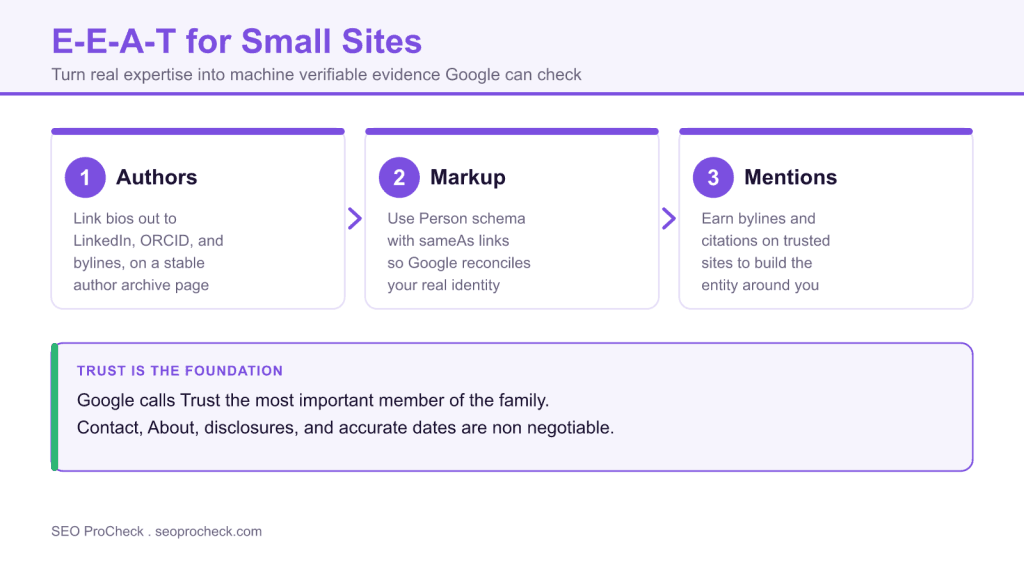
Small sites cannot rely on brand recognition, so the job is to turn real expertise into evidence Google can verify at scale. Every signal should pass one test: can an outside party confirm it without taking your word for it?
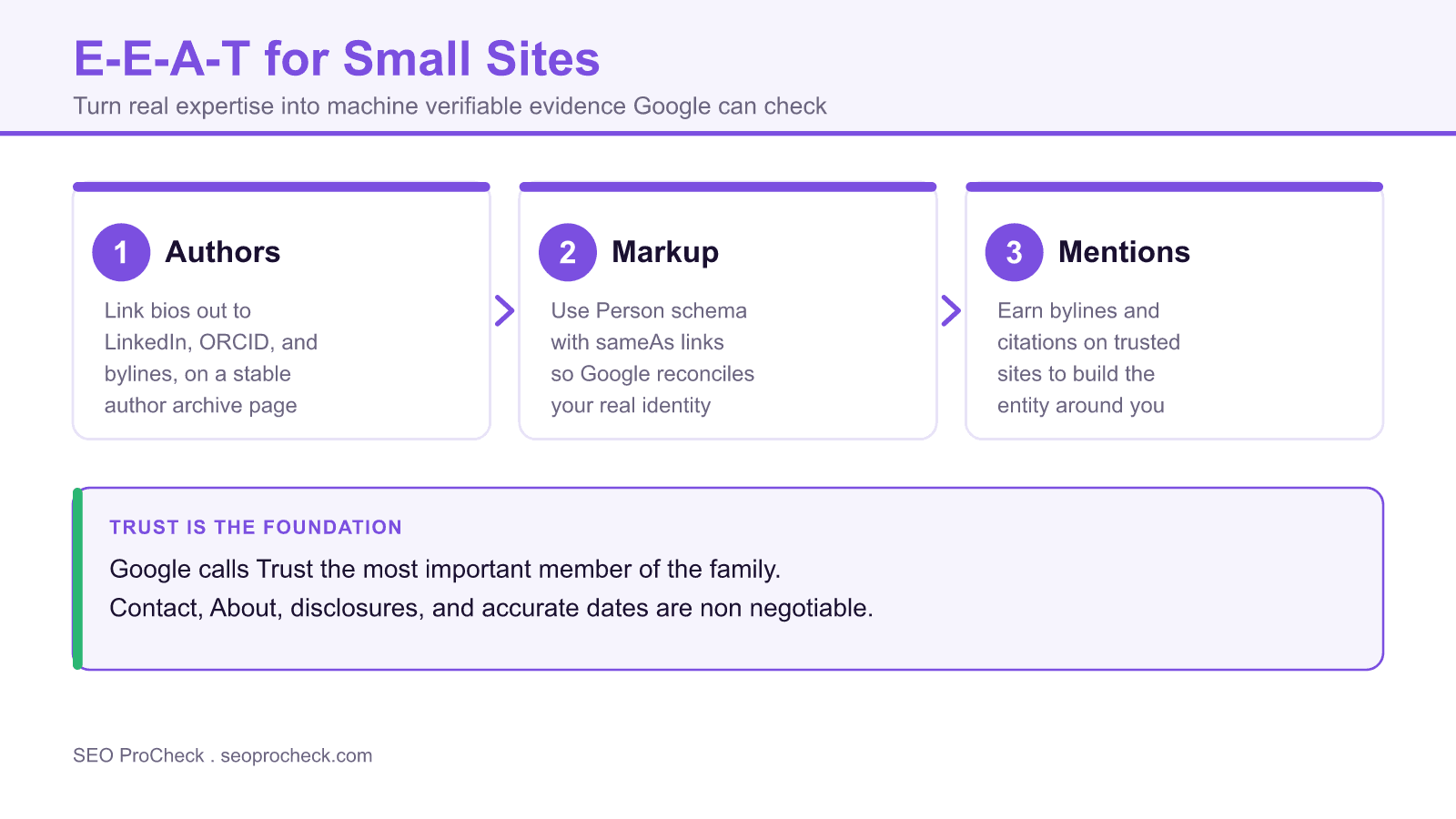
- Build real author entities with bios that link out to independent, checkable proof.
- Use Person schema with sameAs links so Google reconciles your author with a known entity.
- Show first hand experience with original media and specific, non generic detail.
- Trust is the foundation: contact, About, disclosures, and accurate dates are non negotiable.
Google's Quality Rater Guidelines tell raters to assess Experience, Expertise, Authoritativeness, and Trust, but raters don't influence your rankings directly, and Google's systems can't read your mind. They can only weigh signals that exist on your page and across the web. For a small site without brand recognition, the job is to convert real expertise into machine-verifiable evidence. This article skips the platitudes and details the specific E-E-A-T signals that actually move the needle.
What "verifiable" actually means here
Google has repeatedly said there is no single E-E-A-T score. Instead, its ranking systems approximate quality using signals they can detect at scale: links, mentions, entity associations in the Knowledge Graph, structured data, and corroboration across independent sources. The practical implication is blunt, if a human rater couldn't confirm your expertise by clicking around for two minutes, the algorithm almost certainly can't either.
So the test for every signal below is: Can an outside party verify this without taking your word for it? A bio claiming "20 years of experience" is unverifiable. A bio linking to a LinkedIn profile, a conference talk, and three bylined articles on industry sites is.
Author bios that carry real weight
Most small-site bios are useless to Google because they assert credentials instead of evidencing them. Rebuild yours around outbound corroboration:
- Link out to independent proof. Every claim should point somewhere Google already trusts, your LinkedIn, an ORCID or Google Scholar profile, professional licensing registries, a company team page, prior bylines, podcast appearances, or a personal site with its own history.
- Make the author a real, consistent entity. Use the same name, photo, and biography across the web. Inconsistent names ("J. Smith" here, "John A. Smith" there) fragment your entity and weaken Knowledge Graph association.
- Be specific about the basis of expertise. "Certified financial planner who has filed 400+ client returns" beats "finance expert." Specifics are checkable; adjectives aren't.
- Put the bio on a real author archive page at a stable URL (
/author/jane-doe/), not just a byline string. This gives the entity a home you can mark up and link to.
Mark up authorship so machines can parse it
Structured data doesn't grant E-E-A-T, but it removes ambiguity about who wrote what. Use schema.org Person and connect it to your articles:
- On articles, set the
authorproperty to aPersonobject, not a plain string, with aurlpointing to the author page and asameAsarray linking to their authoritative profiles. - On the author page itself, use
ProfilePagemarkup wrapping aPersonwithsameAs,jobTitle,alumniOf, andknowsAbout. - Reinforce the publisher with
Organizationmarkup and a populatedsameAs, so the site itself reads as a defined entity.
A minimal author reference inside Article schema looks like this:
"author": {"@type": "Person", "name": "Jane Doe", "url": "https://example.com/author/jane-doe/", "sameAs": ["https://www.linkedin.com/in/janedoe", "https://orcid.org/0000-0000-0000-0000"]}
The sameAs links are the load-bearing part, they let Google reconcile your author with an entity it can already evaluate elsewhere.
First-hand experience: the "E" most sites fake and Google can spot
The first "E", Experience, is the hardest to invent and therefore the most valuable when genuine. It means demonstrating you actually did the thing, not that you read about it. Concrete signals:
- Original media. Your own photos and video of the product, location, or process, with consistent lighting, hands in frame, real backgrounds, instead of stock or manufacturer imagery. Keep EXIF data intact; it's a small corroborating detail.
- Specific, non-generic detail. Measurements you took, a quirk you only learn by use, a step that the official documentation gets wrong. Review content that could have been written without touching the product reads as such.
- Process artifacts. Test methodology, sample sizes, the rig you used, dates of testing, what you compared against. Show the work.
- Timestamps and updates. A "tested March 2026, retested after the firmware update" note signals ongoing first-hand contact.
This maps directly to Google's product-review guidance, which explicitly rewards evidence of hands-on use and visual proof beyond what the manufacturer supplies.
Citations and outbound links done like a professional
Citing sources doesn't "leak authority", that myth has cost small sites dearly. Authoritative content references authoritative sources. Do it properly:
- Cite primary sources, not aggregators. Link the original study, the standards body, the government dataset, not a blog summarizing it.
- Attribute claims inline where the reader (and a language model parsing the page) can see exactly which assertion the citation supports.
- Be honest about uncertainty. "Evidence is mixed" with two opposing citations reads as more expert than false certainty.
- Don't fabricate statistics. A single invented number that a rater can debunk poisons trust in the whole page. When you lack a hard figure, characterize it generally rather than inventing precision.
Entity associations: getting cited where Google is already looking
Authoritativeness for a small site is largely about being independently associated with your topic across trusted sources. You can't link-build your way to authority alone; you need corroborating mentions:
- Earn bylines on established industry publications. One guest article on a recognized site does more for author authority than fifty pages on your own domain, because it ties your entity to a trusted one.
- Get listed in relevant directories and association registries, professional bodies, certification boards, local business records, that share your name, role, and specialty.
- Pursue unlinked brand and author mentions. Podcasts, panels, quotes in journalist roundups (HARO-style), and forum participation under your real name all build the corroboration graph.
- Maintain a Wikidata entry if you legitimately qualify (notable bylines, published work). Wikidata feeds entity understanding and is something a small site can sometimes earn ethically.
- Keep NAP/profile consistency. Same name, role, and topic focus everywhere reinforces a single strong entity rather than several weak ones.
Trust: the foundation the other three sit on
Google has called Trust the most important member of the family, the rest are meaningless without it. The verifiable trust signals are unglamorous but non-negotiable:
- A real, reachable contact page with a physical address or verifiable method of contact.
- A clear About page explaining who runs the site, its purpose, and its funding or affiliate relationships.
- Disclosed affiliations, sponsored content, affiliate links, and conflicts of interest stated plainly.
- HTTPS, accurate publish and update dates, working corrections policy, and an editorial process page for YMYL topics.
- Genuine third-party reviews and consistent business listings for local or commercial sites.
Common mistakes
- AI-generating bios for fake authors. Synthetic headshots and invented credentials are increasingly detectable and catastrophic to trust when exposed. A single honest author beats a roster of fabricated ones.
- Treating E-E-A-T as a meta tag. There's no tag for it. It's the sum of corroborated evidence, not a switch you flip.
- Stuffing "expert" and "trusted" into copy. Self-applied authority labels are noise. Let the evidence and the citations imply it.
- Hiding authorship to look "brand-like." Anonymous content on a no-name domain is the worst of both worlds, name your authors and tie them to verifiable identities.
- Chasing links while ignoring mentions. Corroboration across independent sources often matters more than raw link counts for establishing a topical entity.
A practical priority order
If you're starting from zero, sequence it: (1) build real author entities with linked-out proof and schema; (2) ensure first-hand evidence and original media on your money pages; (3) fix trust fundamentals, About, contact, disclosures, dates; (4) earn external bylines and mentions to seed entity associations; (5) cite primary sources rigorously throughout. None of this is gameable, which is the point, the strongest E-E-A-T signals are the ones you can't fake, only document.
Want this handled properly on your site?
It is exactly the kind of work an advanced technical SEO audit covers. See how an advanced SEO audit works →
Unverifiable claims versus verifiable evidence
| E-E-A-T area | Unverifiable claim | Verifiable evidence |
|---|---|---|
| Experience | Years of hands-on use | Original photos, intact EXIF, documented test methodology |
| Expertise | Finance expert | Certification number, 400+ filed returns, external bylines |
| Authoritativeness | Industry leader | Guest bylines, independent citations, Wikidata entry |
| Trust | Trusted source | Contact page, disclosures, HTTPS, accurate publish dates |
Frequently asked questions
Can a small site really demonstrate E-E-A-T?
Yes, but only by converting real expertise into evidence an outsider can verify. If a human rater could not confirm your expertise by clicking around for two minutes, the algorithm almost certainly cannot either.
What makes an author bio actually count?
Outbound corroboration. Link every claim to something Google already trusts, such as LinkedIn, ORCID, licensing registries, or prior bylines, and keep the same name, photo, and biography consistent across the web.
Does citing other sources leak authority?
No, that is a myth that has cost small sites dearly. Authoritative content references authoritative sources. Cite primary sources, attribute claims inline, and be honest about uncertainty.
How important is schema for E-E-A-T?
Structured data does not grant E-E-A-T, but it removes ambiguity about who wrote what. Use Person schema with a sameAs array so Google can reconcile your author with an entity it already evaluates elsewhere.
What is the single most important trust signal?
There is no one signal, but Trust as a whole is the foundation. A reachable contact page, a clear About page, disclosed affiliations, HTTPS, and accurate dates are all non negotiable basics.
Take this with you
The assistant links open with a question about this page already written. Nothing is sent until you press enter.
Claude Vincent is a technical SEO consultant focused on crawlability, rendering, and AI-search visibility. He writes the field guides and case studies at SEO ProCheck, with a bias toward the durable, unglamorous work that decides whether search engines and AI answer engines can actually read and cite a site.
About SEO ProCheck
Technical SEO consulting and GEO strategy with 20 years of enterprise experience. Case studies, resources, and tools for search and AI visibility.
Work With Me
Technical SEO audits, GEO strategy, site migrations, and international SEO. Hourly consulting for teams who need hands-on support, not just reports.
Subscribe to our newsletter!








Recent Posts
- Most Top Sites Never Say Who They Are in Structured Data October 14, 2026
- Homepage Titles Are Mostly Too Short, Not Too Long October 8, 2026
- Who Actually Serves an llms.txt? 184 Top Sites Measured September 29, 2026