AI Summary
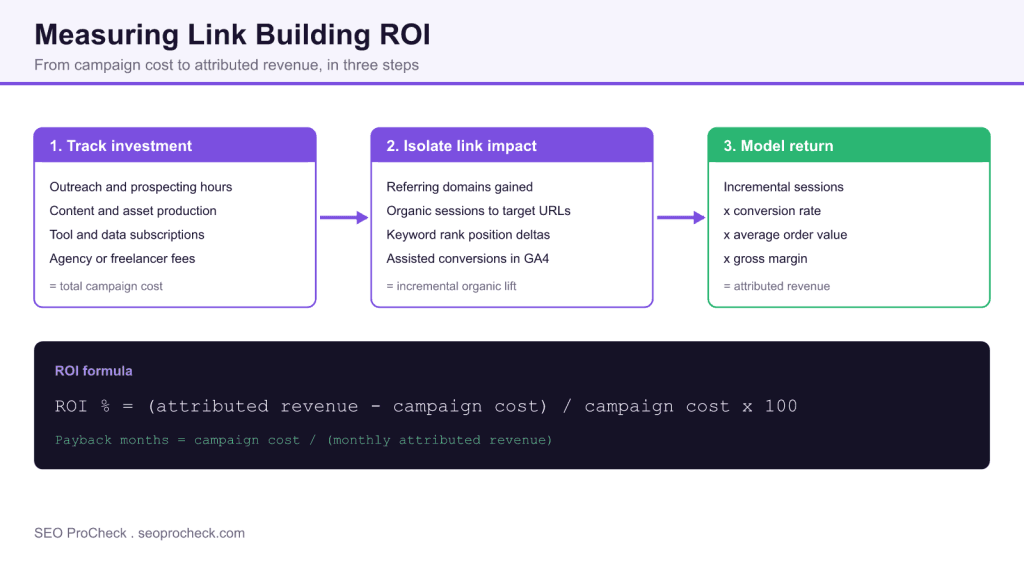
Link building ROI is the attributed organic revenue an earned link campaign generates, minus its fully loaded cost, divided by that cost. You measure it by logging every input, isolating the lift on the exact pages that received links, and modeling incremental sessions through your conversion rate, order value, and margin.
- ROI percent equals (attributed revenue minus campaign cost) divided by campaign cost, times 100.
- Track link value on target URL cohorts, not sitewide totals, so other SEO work does not contaminate the read.
- Use a holdback set of comparable pages to separate link impact from algorithm and on page changes.
- Judge campaigns on a rolling six to nine month window because equity compounds slowly.
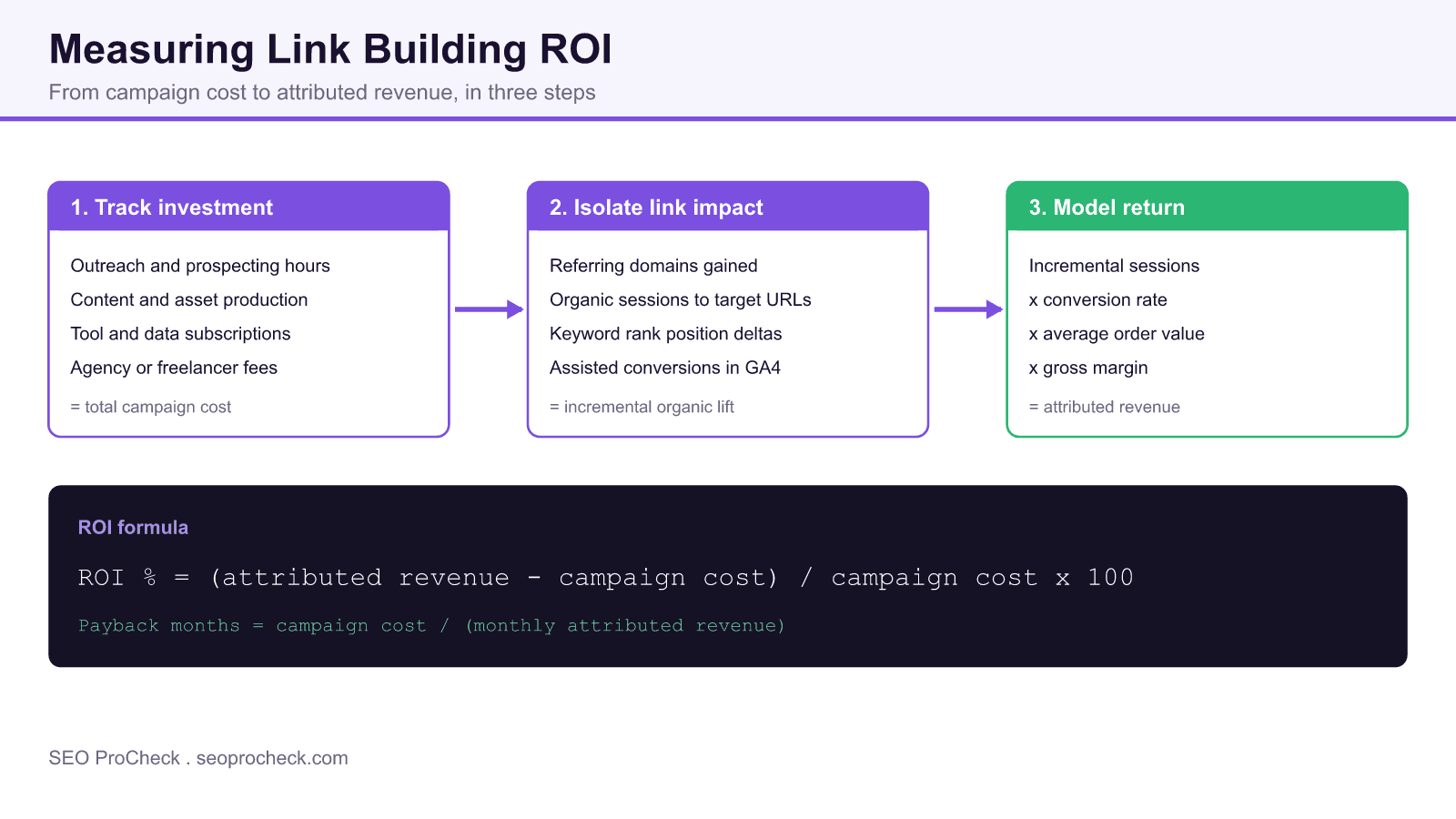
Most link building reports stop at a vanity number: domains earned, average Domain Rating, links live this quarter. None of those tell a CFO whether the budget returned more than it cost. Measuring link building ROI means connecting the money that went in to the organic revenue that came out, and doing it in a way that survives scrutiny. This walkthrough shows the exact inputs to log, how to isolate a link's contribution from everything else moving on the site, and the formulas that turn rankings into a defensible return figure.
Why link ROI resists simple math
Links do not convert visitors directly. They pass equity that lifts rankings on target pages, which lifts impressions and clicks, which eventually lifts conversions. Every step in that chain is delayed and shared with other variables: a core update, a title rewrite, seasonality, or a competitor dropping out. If you attribute all downstream revenue to the link you overstate ROI; if you attribute none you cannot justify the budget. The workable middle is to measure lift at the page level, on a defined cohort, against a comparison group, over a window long enough for equity to settle.
Step 1: Log the fully loaded cost
Underpricing the campaign is the most common way teams fake a good ROI. Capture every input, including internal time at a blended hourly rate, not just the invoices you paid outside vendors.
| Cost line | How to capture it | Example monthly |
|---|---|---|
| Prospecting and outreach hours | Time logged in your PM tool at a blended rate | 40 hrs at 60 = 2,400 |
| Content and linkable assets | Writer, designer, and data costs per asset | 1,800 |
| Tools and data | Prorated share of outreach, index, and rank tools | 350 |
| Agency or freelancer fees | Retainer or per placement invoices | 2,000 |
| Total campaign cost | Sum of the above | 6,550 |
The example figures above are illustrative placeholders, not survey data. Replace them with your own actuals pulled from your time tracker and accounts payable so the denominator in the ROI formula is honest.
Step 2: Isolate the link's contribution
Do not read sitewide organic traffic and credit it to the campaign. Build a cohort of the exact URLs that received links and measure only those. In GA4, create a comparison or an exploration filtered to a custom segment where Landing page matches your target URLs, then watch Sessions and Key events for that segment against the prior period. A useful GA4 exploration setup:
| Field | Setting |
|---|---|
| Dimension | Landing page + query string |
| Segment | Session source/medium contains organic |
| Filter | Landing page matches regex of target URLs |
| Metrics | Sessions, Engaged sessions, Key events, Session key event rate |
| Comparison | 90 days before first placement vs 90 days after |
Pair that with a rank tracker scoped to the target keywords and annotate each placement date. To separate link impact from the rest of your SEO program, keep a holdback set: comparable pages of similar intent and starting position that you deliberately do not link build. If your target cohort climbs while the holdback stays flat, the delta is a reasonable proxy for link contribution.
Step 3: Model the return and apply the formula
Once you have incremental organic sessions on the target cohort, convert them to money with your own funnel numbers:
attributed revenue = incremental sessions x conversion rate x average order value x gross margin
ROI percent = (attributed revenue minus campaign cost) / campaign cost x 100
Then compute payback months as campaign cost divided by monthly attributed revenue. A campaign that returns its cost inside twelve months and shortens its payback each quarter is compounding correctly, because the links keep passing equity long after you stop paying for them. Report the trailing figure monthly rather than declaring victory on day one.
Metrics that belong on the report
| Metric | What it proves | Source |
|---|---|---|
| Referring domains gained | Campaign output only | Backlink tool |
| Target keyword rank delta | Ranking movement on linked pages | Rank tracker |
| Incremental organic sessions | Traffic lift on the cohort | GA4 segment |
| Assisted and last click conversions | Revenue contribution | GA4 Key events |
| Payback months | Speed of return | Cost / monthly revenue |
Traps that inflate or hide real ROI
Crediting sitewide traffic to a handful of links overstates ROI wildly; always scope to the cohort. Ignoring internal time understates cost and makes weak campaigns look efficient. Measuring too early reads noise, since equity has not settled. Counting nofollow and referral driven conversions at zero hides genuine value you can see directly in analytics. And declaring one number forever misses that link ROI is a trailing figure that keeps improving, which is usually the strongest argument for continued budget.
If earned links point at pages that later get suppressed for weak content, the equity is wasted, so confirm your targets can rank on their own merits before you invest, and if rankings have collapsed for other reasons work through a link based penalty recovery process first. Aim link equity at pages that will not trip a thin content penalty, and see the full link building resources for prospecting and outreach workflows that feed this measurement model.
Set up measurement before the first outreach email
Retrofitting attribution after a campaign is how teams end up guessing. Before a single link goes live, freeze a baseline: export current rankings for the target keywords, snapshot the target URL cohort traffic for the trailing ninety days, and record the referring domain counts pointing at each target. Create the GA4 exploration and the rank tracker project up front so the comparison window starts clean. Add calendar annotations for every planned publish and placement date, because lining placements up against ranking movement is what lets you defend causation later. Decide the holdback pages in advance too, since choosing them after you see results invites bias. With the baseline locked and the cohort defined, the ROI number you report at month three, six, and nine is a measurement rather than a story, and that is the difference between a link budget that gets renewed and one that gets cut.
Frequently asked questions
How do you actually calculate link building ROI?
Sum every cost that went into the campaign (outreach time, content, tools, fees), then estimate the incremental organic revenue the earned links produced. ROI percent equals attributed revenue minus campaign cost, divided by campaign cost, times 100. Track it monthly because link equity compounds over quarters, not days.
What is a realistic timeframe to see return from links?
Most earned links need one to three months to be crawled, evaluated, and reflected in rankings, and another one to two quarters before ranking gains convert into stable revenue. Judge a campaign on a rolling six to nine month window rather than week to week. Set that expectation with stakeholders before the campaign starts.
Which metrics prove a link created value versus just existing?
A raw referring domain count proves the link exists, not that it moved anything. Value shows up as rank position gains on the target URL keywords, more organic sessions landing on that URL, and assisted or last click conversions attributed to organic in GA4. Pair a rank tracker with a target URL cohort in analytics.
How do you isolate link impact from other SEO work?
Use a holdback set: choose comparable pages you do not build links to and compare their trajectory against your link targets over the same period. Segment analytics by the exact landing URLs that received links so on page changes elsewhere do not contaminate the read. Annotate the build dates so you can line them up against ranking movement.
Should you value nofollow and unlinked brand mentions?
Yes, at a discount. Nofollow and UGC links can still drive referral traffic and conversions you can measure directly in analytics, so credit that revenue even if you assume zero ranking equity. Unlinked mentions build entity signals and often precede editorial links, so log them as pipeline rather than ignore them.
What is a good ROI benchmark for a link campaign?
There is no universal number because it depends on your margin and average order value, but a healthy program returns more than the fully loaded cost within twelve months and improves after that as links keep passing equity. Compute payback months as campaign cost divided by monthly attributed revenue and track whether it shortens over time.
Claude Vincent is a technical SEO consultant focused on crawlability, rendering, and AI-search visibility. He writes the field guides and case studies at SEO ProCheck, with a bias toward the durable, unglamorous work that decides whether search engines and AI answer engines can actually read and cite a site.
About SEO ProCheck
Technical SEO consulting and GEO strategy with 20 years of enterprise experience. Case studies, resources, and tools for search and AI visibility.
Work With Me
Technical SEO audits, GEO strategy, site migrations, and international SEO. Hourly consulting for teams who need hands-on support, not just reports.
Subscribe to our newsletter!