

AI Summary
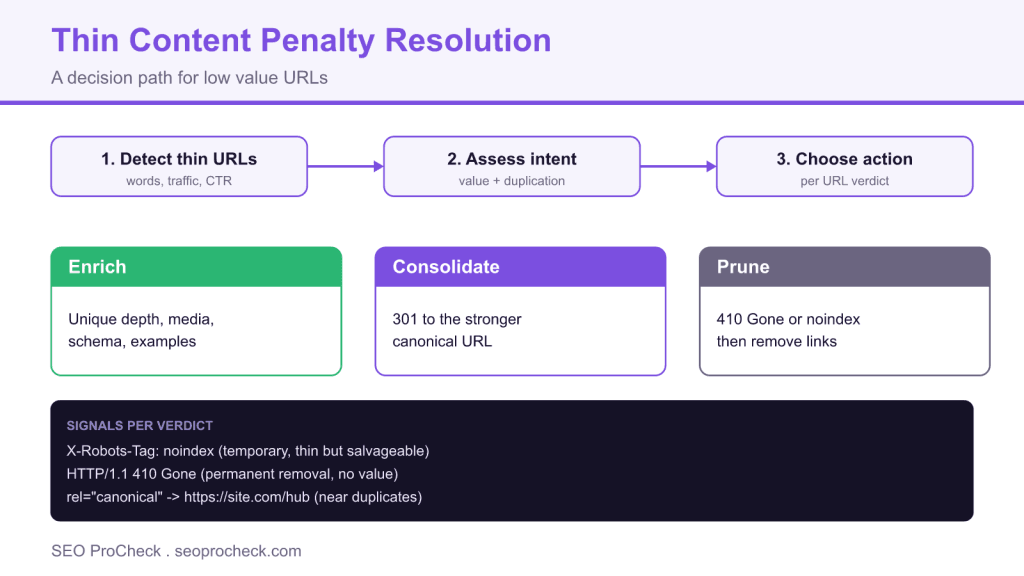
Thin content penalty resolution means auditing low value URLs, then deciding per page whether to enrich, consolidate, or remove them so the pattern of unhelpful pages stops dragging down the whole domain. Work URL by URL: enrich pages that serve real intent, 301 near duplicates into one strong canonical, and return 410 or apply noindex to pages that will never earn their keep.
- Thin content is a site pattern problem, so a domain wide audit beats fixing pages one at a time in isolation.
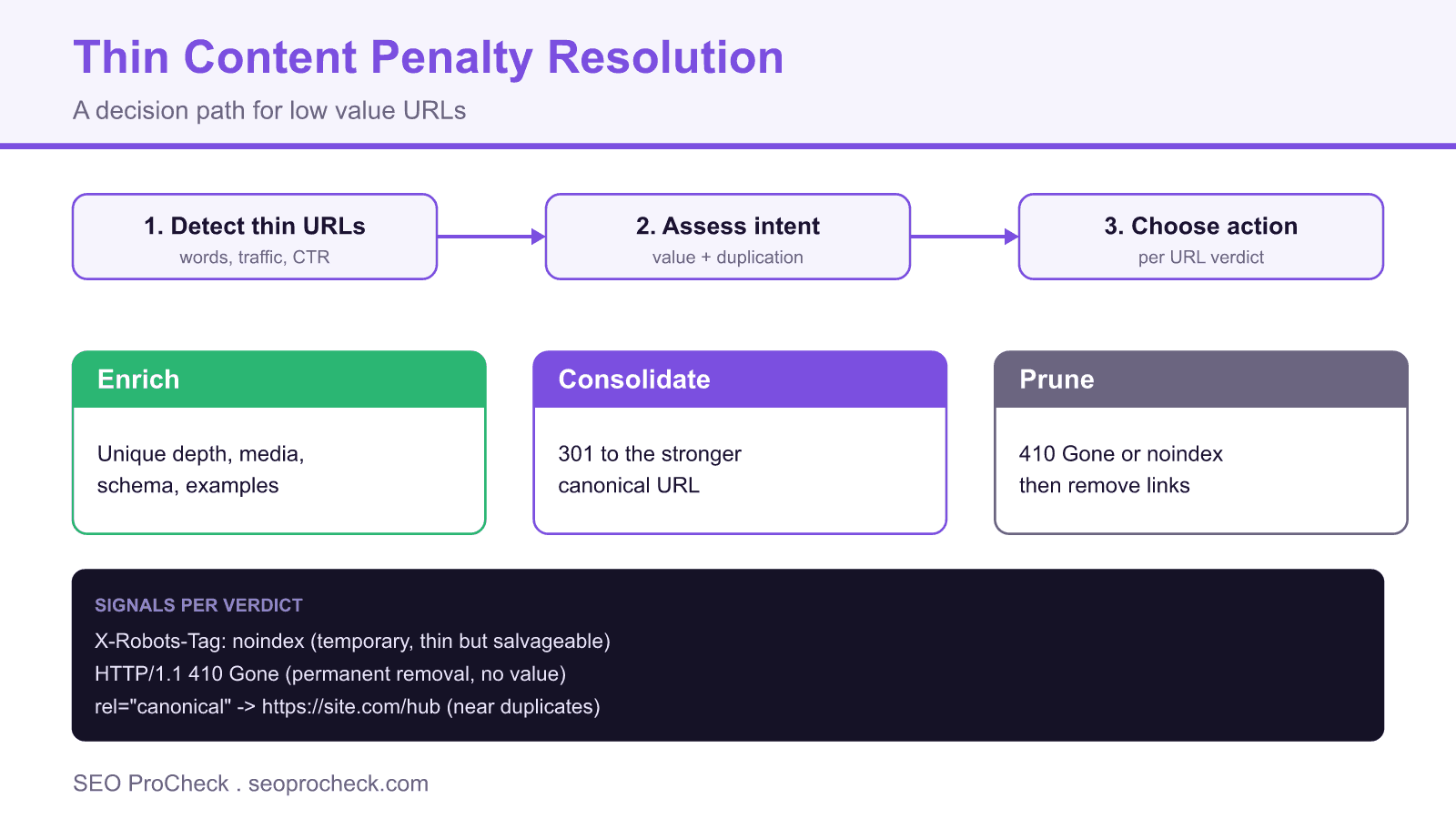
- Every flagged URL gets one of three verdicts: enrich, consolidate with a 301, or prune with a 410 or noindex.
- Recovery from a Helpful Content style demotion or a core update is gradual and confirmed at the next broad assessment, not overnight.
- Measure with the GSC Pages report and impressions per URL, not with word count alone.
What "thin content" actually means
Thin content is not simply a low word count. Google evaluates whether a page provides substantial, original value for the query it targets. A 350 word answer that fully resolves a narrow question is not thin, while a 1,500 word page of restated boilerplate, doorway variations, scraped manufacturer copy, or auto generated filler is. The problem compounds at the site level: when a large share of indexed URLs are unhelpful, classifier style systems such as the Helpful Content signals and broad core updates can suppress rankings across the whole domain, including your genuinely strong pages. That is why resolution is a portfolio exercise, not a single page edit.
Step 1: build the inventory
Start from a full crawl and layer in performance data so every decision is evidence based. A practical stack is a Screaming Frog crawl exported to CSV, joined against the Google Search Console Pages report and a Google Analytics 4 landing page export. The columns that matter most:
- Word count and text ratio from the crawl (the
Internal > HTMLexport). - Impressions and clicks over the last 90 days per URL from Search Console.
- Sessions and engaged sessions from GA4.
- Inlinks so you know how much internal equity each URL already receives.
Flag candidates where impressions sit near zero for 90 days, engaged sessions are negligible, and the page duplicates the intent of a stronger URL. Do not trust word count on its own.
Step 2: assign one verdict per URL
Sort every flagged URL into exactly one of three buckets. The matrix below is the working rule set.
| Verdict | When it applies | Action | Signal returned |
|---|---|---|---|
| Enrich | Page serves real intent but is shallow or incomplete | Add original depth, media, data, examples, schema | Keep indexable, resubmit |
| Consolidate | Multiple near duplicate pages compete for one intent | Merge into the strongest URL | 301 plus a canonical to the survivor |
| Prune | No intent, no links, no traffic, no future value | Remove and clean internal links | 410 Gone or noindex |
A useful default: if a page could be rewritten to be genuinely useful within your resources, enrich it. If its purpose is already covered elsewhere, consolidate. If it exists only because a template or import created it, prune.
Step 3: apply the technical signals correctly
Each verdict has a precise technical implementation. Getting the status code and directive right is what makes recovery stick.
# Consolidate: permanent redirect + canonical on the survivor
HTTP/1.1 301 Moved Permanently
Location: https://example.com/guides/olive-oil-grades

# On the survivor page <head>
<link rel="canonical" href="https://example.com/guides/olive-oil-grades">

# Prune, temporary hold while you decide (keeps the URL live)
X-Robots-Tag: noindex, follow

# Prune, permanent removal (page is gone for good)
HTTP/1.1 410 Gone
Use noindex, follow when a page might return or still passes link value onward, and reserve 410 Gone for permanent deletions so crawlers drop the URL faster than a soft 404. Never mix signals: a page that is noindex and also canonicalised elsewhere and also redirected sends conflicting instructions that delay processing. For pruning at scale, also remove or update the internal links that point at the dead URLs, and drop them from your XML sitemap so you are not still advertising pages you just removed. If you are unsure whether removal is causing new soft errors, cross check against discovered currently not indexed patterns in Search Console.
Step 4: rebuild internal signals and confirm recovery
After the verdicts are live, the site still needs to route authority to the pages you kept. Thin content pruning often exposes missing internal links, so add contextual links from strong hubs to the enriched survivors. Watch for index bloat at the same time, since bloat and thin content are usually the same underlying problem viewed from two angles. Recovery after a Helpful Content style demotion or a broad core update is not instant. Improvements are typically reassessed at the next broad rollout, which is why teams that watched the May 2026 core update saw movement weeks after their cleanup, not the day of the push. Track impressions and clicks per URL in the GSC Pages report and compare the enriched cohort against the pruned cohort so you can attribute the change.
Worked example
Suppose an ecommerce blog has 240 tag archive pages, each listing one or two posts with no description. They earn 0 clicks and near zero impressions, and they duplicate category intent. Verdict: prune. Apply noindex, follow to keep link equity flowing, remove them from the sitemap, and after two crawl cycles confirm they have dropped from the index. Meanwhile, twelve genuinely useful buying guides are 400 words each and rank on page two. Verdict: enrich. Expand each with original testing notes, a comparison table, and FAQ schema. Within one to two core assessments the enriched guides typically move up while the removed archives stop diluting the site.
Frequently asked questions
Is there really a specific thin content penalty?
There is no single named penalty for most sites. Thin content is handled by broad algorithmic systems such as the Helpful Content signals and core updates that assess site quality as a whole, plus manual actions in rare severe cases. The practical effect is the same: a site heavy with unhelpful pages gets demoted, so the fix is to raise or remove those pages.
Should I delete thin pages or noindex them?
Return 410 Gone when a page is permanently removed and has no lasting value, because crawlers drop it faster. Use noindex when the page might return, still passes internal link value, or you want to keep the URL live while you improve it. Do not apply both signals to the same URL at once.
How long does recovery take?
Recovery is gradual. Enriched pages can improve within a few weeks of recrawl, but sitewide demotions tied to core updates are usually reassessed at the next broad update, which can be weeks or months later. Consistent cleanup between updates is what compounds.
Does word count determine whether a page is thin?
No. A short page that fully answers a narrow query is fine, while a long page of restated filler is thin. Judge value against the query the page targets, not the character count.
Will consolidating pages with 301 redirects lose rankings?
Merging near duplicates into one authoritative URL usually strengthens rankings because you stop splitting relevance and links across competing pages. Keep the 301 in place permanently and point a canonical at the survivor so the signals stay consistent.
How do I find thin pages at scale?
Crawl the site with a tool such as Screaming Frog, export word count and inlinks, then join that against the Search Console Pages report and GA4 landing pages. Flag URLs with near zero impressions and engagement that duplicate stronger pages, and review that shortlist manually before assigning verdicts.
Take this with you
The assistant links open with a question about this page already written. Nothing is sent until you press enter.
Claude Vincent is a technical SEO consultant focused on crawlability, rendering, and AI-search visibility. He writes the field guides and case studies at SEO ProCheck, with a bias toward the durable, unglamorous work that decides whether search engines and AI answer engines can actually read and cite a site.
About SEO ProCheck
Technical SEO consulting and GEO strategy with 20 years of enterprise experience. Case studies, resources, and tools for search and AI visibility.
Work With Me
Technical SEO audits, GEO strategy, site migrations, and international SEO. Hourly consulting for teams who need hands-on support, not just reports.
Subscribe to our newsletter!








Recent Posts
- Most Top Sites Never Say Who They Are in Structured Data October 14, 2026
- Homepage Titles Are Mostly Too Short, Not Too Long October 8, 2026
- Who Actually Serves an llms.txt? 184 Top Sites Measured September 29, 2026