

AI Summary
A service area business has no storefront customers visit, so its SEO strategy hides the address in Google Business Profile, defines the cities served, and earns relevance through genuine per city landing pages, consistent citations, local reviews, and areaServed schema. Because proximity is a weaker lever without a visible address, distinct local content and trust signals do the heavy lifting.
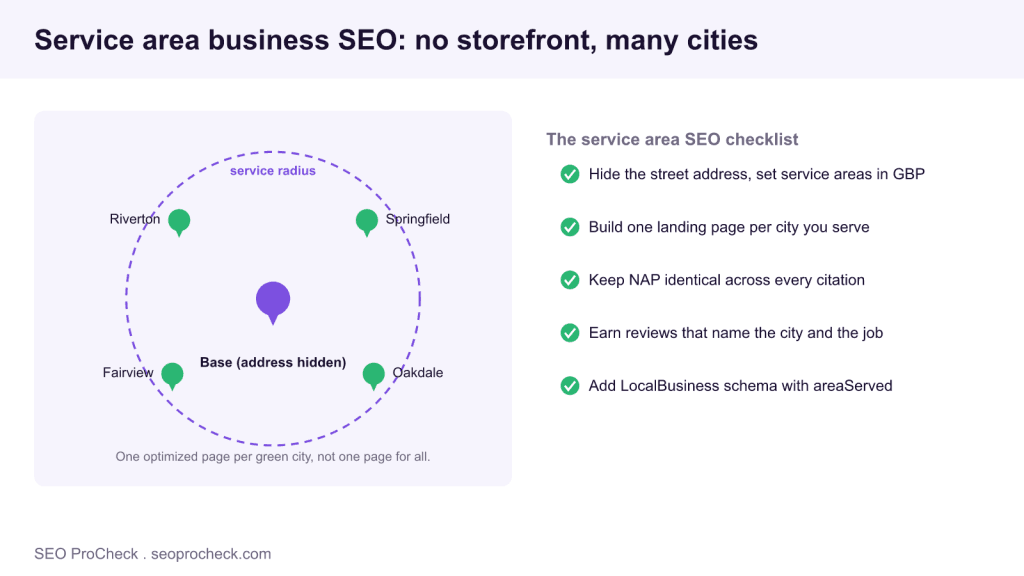
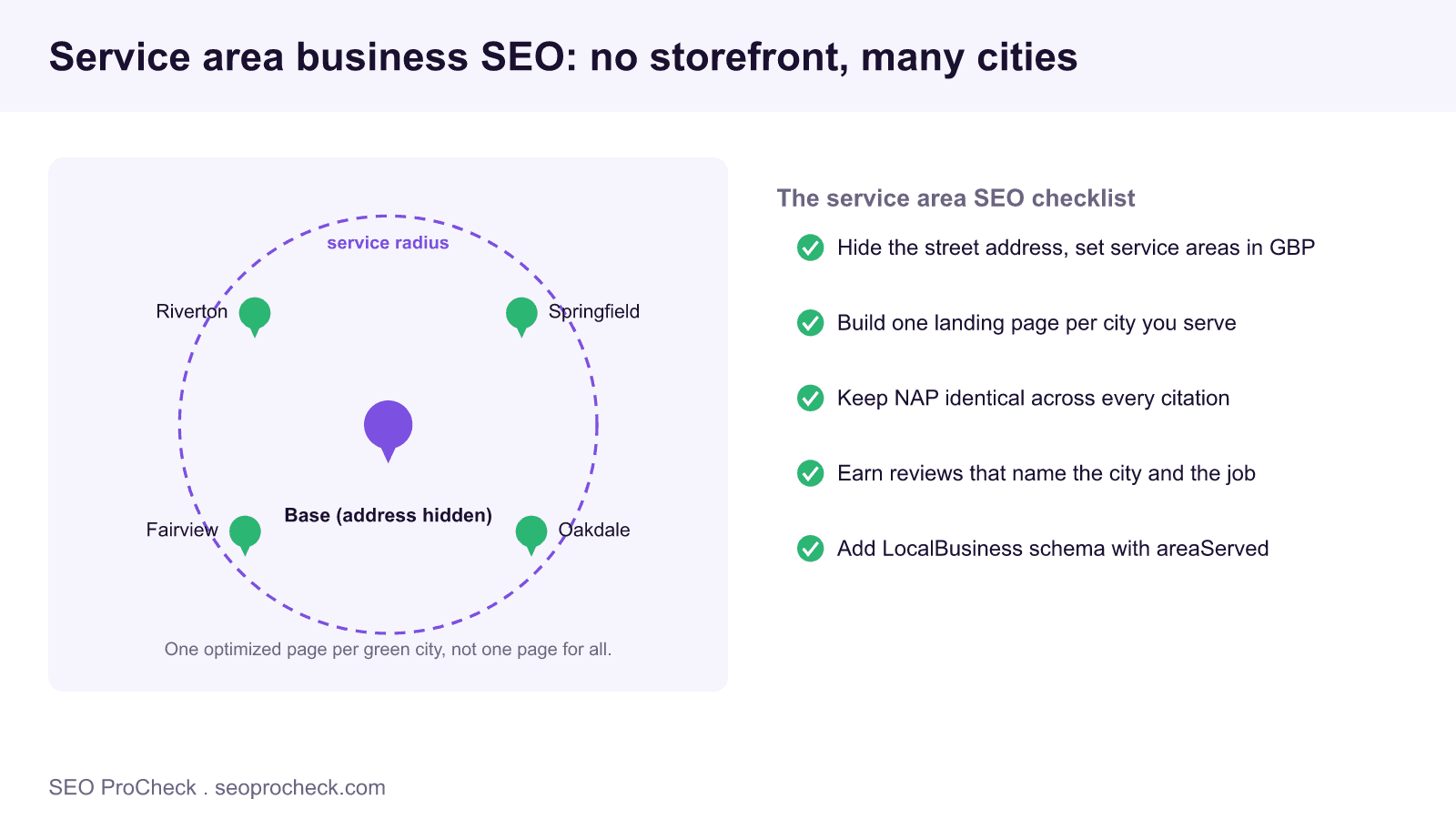
- Hide the street address and set service areas in Google Business Profile.
- Build one substantive landing page per city you genuinely serve.
- Keep name, phone, and location data identical across every citation.
- Use LocalBusiness schema with areaServed and no public street address.
A service area business faces a local SEO problem that storefronts do not. It wants to rank in a dozen towns, but it has no public address in any of them, so the proximity signal that carries a shop to the top of the map is largely unavailable. Winning here means replacing the missing proximity signal with two things Google can measure: precise relevance for each city you serve, and consistent trust signals that prove the business is real. This guide lays out how to do both without stepping on the doorway page rules that get aggressive local sites penalized.
Set up Google Business Profile the SAB way
The foundation is your Google Business Profile. Mark the business as a service area business, hide the street address, and define your service areas by city or region rather than by radius where the interface allows it, since named areas map cleanly to the pages you will build. Do not display a home address you never serve customers at, because that is a common cause of profile suspension. If you run a hybrid model with a genuine public counter and field service, you can show the address and add service areas on top of it. Fill every field, add real photos of jobs and vehicles, and keep hours accurate.
Understand how ranking changes without an address
Local ranking blends relevance, distance, and prominence. For a storefront, distance to the searcher does a lot of work. For a SAB with a hidden address, that distance lever is softened, so relevance and prominence have to compensate. In practice that means your city pages, your citations, and your reviews carry more weight than they would for a shop. The table below contrasts the two models so you can set expectations with a client or a stakeholder.
| Signal | Storefront business | Service area business |
|---|---|---|
| Address in GBP | Visible, verified | Hidden, service areas listed |
| Map pin ranking | Anchored to the address | Weaker near the base, driven by relevance |
| Best content unit | Store or location page | City or service plus city page |
| Proximity factor | Very strong | Present but softened, relevance matters more |
| Schema type | LocalBusiness with address | LocalBusiness with areaServed, no public address |
Build one real page per city, not a template farm
The single most abused tactic in service area SEO is the city page farm: fifty pages that are identical except for a swapped town name. Google treats those as doorway pages and devalues or penalizes them. Do the opposite. Build a page only for a city you genuinely serve, and give each one distinct substance: examples of jobs completed there, local considerations such as older housing stock or hard water, area specific pricing factors, named neighborhoods, and real photos. A smaller set of substantive city pages beats a large set of thin ones every time. For the structural mechanics of these pages, see our guide to local landing pages.
Keep citations and NAP airtight
With no visible address to anchor on, your name and phone number become the primary identity signals, so they must be identical everywhere: your site, Google Business Profile, and every directory or citation. Pick one canonical format for the business name and one phone number and never vary them. Audit your existing citations, fix conflicts, and remove duplicate listings, because fragmented data quietly caps how confidently Google can rank you across your service area.
Turn reviews into local relevance
Reviews are among the strongest local ranking factors, and for a SAB they double as area relevance signals. A steady flow of recent reviews that naturally name the city and describe the job gives Google evidence you actually operate in those places. Ask happy customers to mention where the work happened and what you did, and never script or pay for the content of a review. Respond to every review, which reinforces prominence and shows the profile is actively managed.
Mark it up with the right schema
Add structured data that matches your public presentation. Use the most specific LocalBusiness subtype for your trade and populate areaServed with the cities you cover. Crucially, do not publish a street address in schema that you have hidden in Google Business Profile, since your markup should mirror what the public sees.
{
  "@context": "https://schema.org",
  "@type": "Plumber",
  "name": "Rivertown Rapid Plumbing",
  "telephone": "+1-555-0142",
  "url": "https://example.com/",
  "areaServed": [
    { "@type": "City", "name": "Springfield" },
    { "@type": "City", "name": "Riverton" },
    { "@type": "City", "name": "Oakdale" }
  ],
  "openingHoursSpecification": {
    "@type": "OpeningHoursSpecification",
    "dayOfWeek": ["Monday","Tuesday","Wednesday","Thursday","Friday"],
    "opens": "08:00",
    "closes": "18:00"
  }
}
Place this in the head or body of your homepage or primary service page, and let each city page reinforce it with its own locally focused content rather than duplicating the full block.
Related reading
Service area SEO sits alongside the rest of your local program. Continue with our guide to building local landing pages that avoid doorway page problems, our companion piece on geo modified keyword strategy, and the wider local SEO glossary.
Frequently asked questions
What is a service area business in Google terms?
A service area business, or SAB, is one that serves customers at their location rather than at a storefront they visit, such as a plumber, mobile mechanic, cleaner, or locksmith. In Google Business Profile you mark it as a SAB by hiding the street address and defining the cities or regions you serve. Hybrid businesses with both a shopfront and field service can show an address and service areas together.
Should I hide my address on Google Business Profile?
If customers never come to your premises, yes. Google requires SABs to hide the address and list service areas instead, and showing a home address you do not serve customers at can trigger a suspension. If you have a genuine public storefront, keep the address visible and add service areas on top.
Can I create a landing page for every city I want to rank in?
You can create a page for each city you genuinely serve, but each page must offer real, distinct value: local specifics, jobs completed there, local pricing factors, and genuine detail. Spinning up dozens of near identical templated pages that differ only by the city name is doorway page behavior that Google devalues or penalizes. Build pages for the cities that matter and make them substantive.
How important is NAP consistency for a service area business?
It is foundational. Your business name, phone, and the way you present your location must be identical across Google, your site, and every citation. Because a SAB has no visible address to anchor on, inconsistent name and phone data is even more damaging than for a storefront, since it fragments the trust signals Google uses to understand the entity.
Do reviews help a service area business rank?
Strongly. Review quantity, recency, and content are major local ranking factors, and reviews that naturally name the city and the job done give Google relevance signals for those areas. Ask satisfied customers to mention where the work happened and what you did, without scripting or incentivizing the content of the review.
What schema should a service area business use?
Use LocalBusiness or the most specific subtype such as Plumber or HVACBusiness, and populate areaServed with the cities or regions you cover. Include name, telephone, url, and openingHours, but do not publish a street address you have hidden in Google Business Profile, since your structured data should match your public presentation.
Claude Vincent is a technical SEO consultant focused on crawlability, rendering, and AI-search visibility. He writes the field guides and case studies at SEO ProCheck, with a bias toward the durable, unglamorous work that decides whether search engines and AI answer engines can actually read and cite a site.
About SEO ProCheck
Technical SEO consulting and GEO strategy with 20 years of enterprise experience. Case studies, resources, and tools for search and AI visibility.
Work With Me
Technical SEO audits, GEO strategy, site migrations, and international SEO. Hourly consulting for teams who need hands-on support, not just reports.
Subscribe to our newsletter!







Recent Posts
- Can AI Crawlers Actually Read Your Site? I Measured 400 of the Biggest September 5, 2026
- The Pre-Publish Quality Gate for AI-Assisted Content August 6, 2026
- AGENTS.md vs llms.txt vs llms-full.txt: Which Agent File Does What July 18, 2026