

AI Search Quality Rater Guidelines
- January 20, 2025
- GEO (Generative Engine Optimization), AI and Search
AI Summary
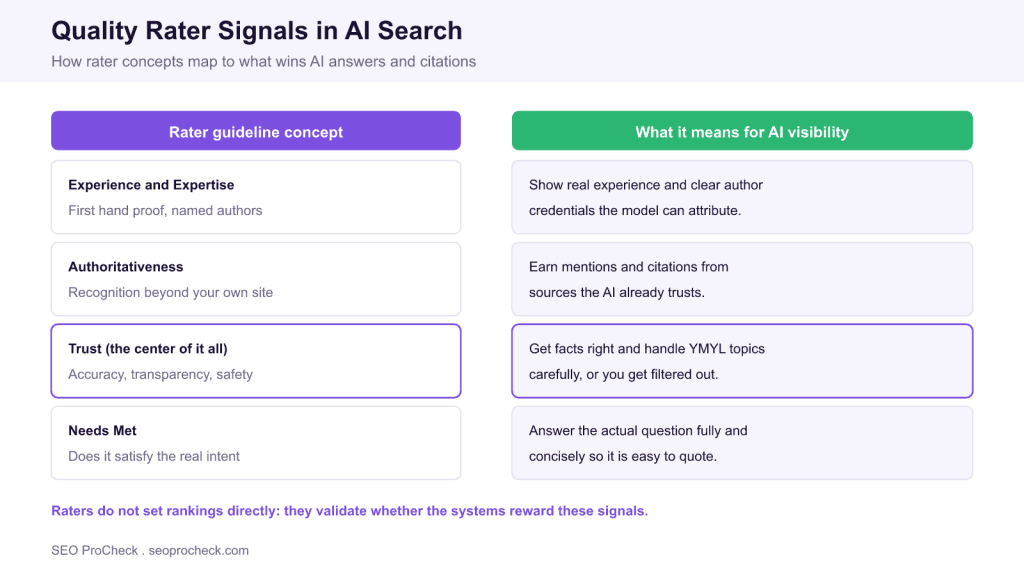
Google's Search Quality Rater Guidelines are the human evaluation manual that describes what a helpful, trustworthy result looks like, and the same concepts, E-E-A-T, Needs Met and careful YMYL handling, describe what earns a place in AI answers. Raters do not set your rankings directly, but they calibrate the systems that do, so writing to satisfy those signals is the most durable way to be visible in AI search.
- Quality raters score sample results to train and validate ranking systems, not to rank your pages one by one.
- Trust is the center of E-E-A-T: accuracy, transparency and safe handling of sensitive topics come first.
- Needs Met rewards content that fully and concisely answers the real intent, which is exactly what AI answers quote.
- YMYL topics face a higher bar, so citations and expert authorship matter most on health, finance and safety pages.
What the Quality Rater Guidelines Are
The Search Quality Rater Guidelines are a public manual Google gives to thousands of trained human raters who score sample search results. Crucially, those scores do not directly move any individual page up or down. Instead, raters provide the ground truth that Google uses to train, test and validate its ranking systems, including the systems behind AI Overviews and other generative answers. That is why the guidelines are the clearest window into what search rewards: they spell out, in plain language, the qualities the algorithms are being tuned to approximate. For the core definitions, keep the quality rater guidelines glossary entry handy, and use the fuller strategy walkthrough when you brief a team.
Two rating dimensions do most of the work. Page Quality asks how trustworthy and useful a page is on its own terms, and Needs Met asks how well a result satisfies the specific query. An AI answer is, in effect, a machine trying to produce a high Needs Met response using high Page Quality sources, so if you optimise for those two ideas you are optimising for the same target the model is chasing.
Trust Sits at the Center of E-E-A-T
E-E-A-T stands for Experience, Expertise, Authoritativeness and Trust, and the guidelines are explicit that Trust is the most important member of the group. A page can be written by a credentialed expert and still fail if it is inaccurate, deceptive, or unsafe. Experience covers first hand involvement with the topic, expertise covers depth and correctness, and authoritativeness covers recognition from outside your own site. Read the complete E-E-A-T guide for the full framework, then apply it with the AI lens below.
For AI visibility, these signals matter because generative systems prefer sources they can attribute and defend. A clearly authored page with verifiable facts and outside recognition is easier for a model to cite with confidence than an anonymous page making unsupported claims. Show who wrote the content and why they are qualified, link your claims to primary sources, and keep your facts consistent everywhere your brand appears.
Needs Met and the AI Answer
The Needs Met scale rewards results that fully satisfy the intent behind a query with the least friction. This translates cleanly into AI search: an answer engine wants a passage it can lift that resolves the question completely and concisely. Structure pages so the direct answer appears near the top, then support it with the detail, examples and caveats a careful reader needs. Clear headings, short declarative sentences, and a well formed summary give a model an easy passage to quote and attribute back to you.
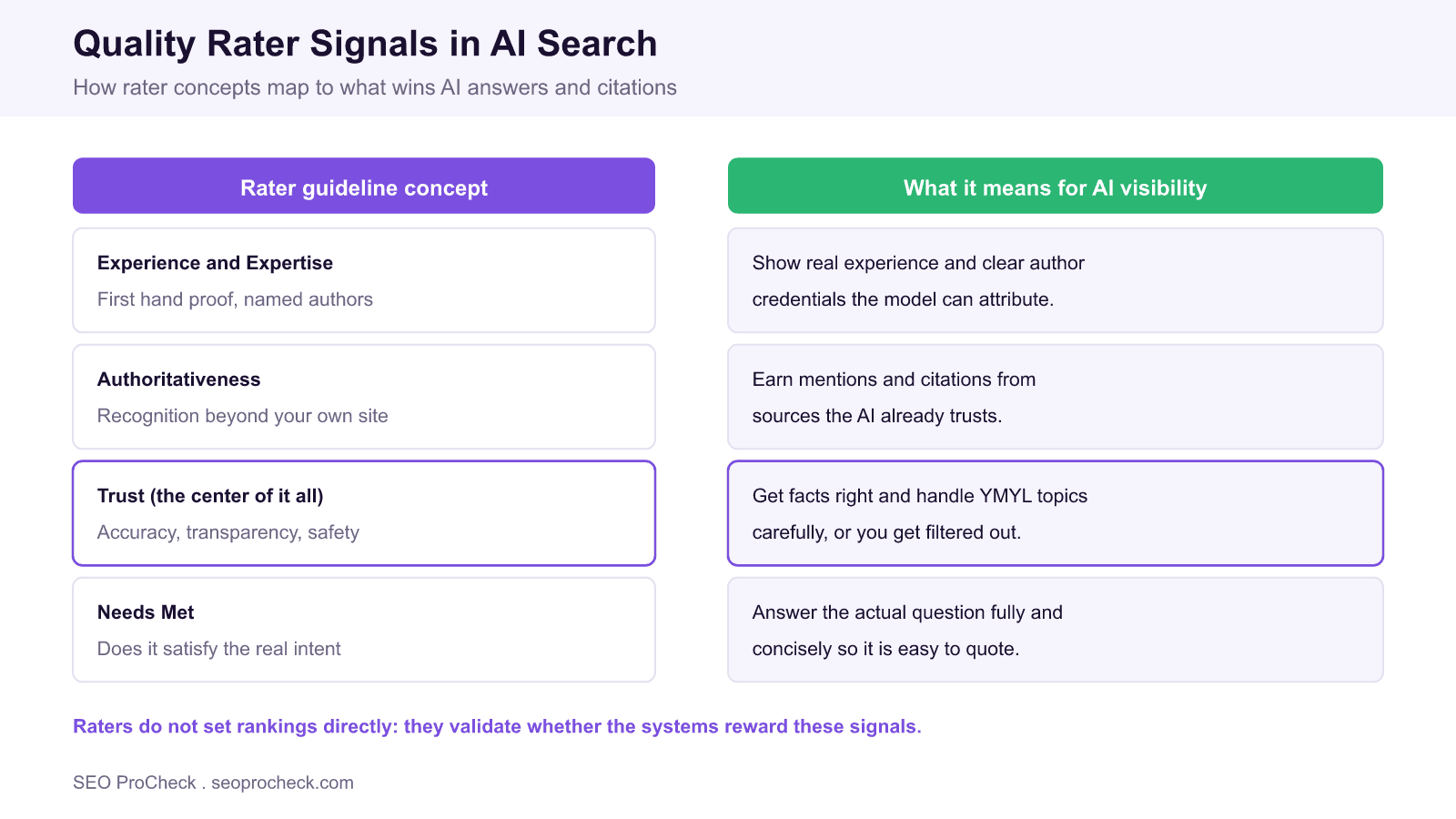
The mapping below turns each rater concept into a concrete action. Treat it as an editorial checklist rather than a scoring formula, because raters judge holistically and so, increasingly, do the systems they train.
| Guideline concept | What raters look for | Practical action for AI visibility |
|---|---|---|
| Experience | First hand use or involvement with the topic | Include original examples, results and named authors |
| Expertise | Depth and correctness for the subject | Cover the topic completely and cite primary sources |
| Authoritativeness | Recognition beyond your own site | Earn mentions and links from trusted publications |
| Trust | Accuracy, transparency, safety, honest intent | Get facts right, show who is responsible, handle YMYL with care |
| Needs Met | How well the result satisfies the query | Answer the actual intent fully, near the top, in quotable form |
| Page Quality | Purpose, main content, reputation | Ship substantial main content on a reputable, well maintained site |
YMYL Raises the Bar
Your Money or Your Life topics, those that can affect health, finances, safety or major life decisions, are held to the strictest standard in the guidelines, and AI systems mirror that caution. On YMYL subjects a model is far more likely to lean on recognised authorities and to hedge or omit claims it cannot support. If you publish in these areas, invest in genuine expert authorship, transparent sourcing, clear dates, and visible accountability such as author bios and an identifiable publisher. Thin or anonymous YMYL content is the most likely to be filtered out of an AI answer entirely.
How to Apply This for AI Search Visibility
Put the guidelines to work with a short, repeatable routine. Lead every important page with a direct answer to its core question. Attach a real author with relevant credentials, and support factual claims with links to primary sources. Keep entity and brand facts consistent across your site and third party profiles so the model sees one coherent story. Build outside recognition through earned mentions rather than manufactured links. And on YMYL topics, raise the rigor: dates, citations, expert review, and clear accountability. None of this chases a secret ranking factor; it satisfies the same published criteria raters use, which is why it holds up as the systems change.
Common Ways Pages Lose Trust
It helps to know the failure modes the guidelines call out, because avoiding them is often faster than chasing new signals. The most common trust killers are: no identifiable author or publisher on content that clearly needs one, factual claims with no sourcing, outdated information presented as current, deceptive design that hides the main content behind ads or interstitials, and unsupported superlatives on YMYL topics. Each of these gives a rater, and by extension a generative system, a reason to distrust or discard the page.
Audit your important pages against that list before you add anything new. Confirm each page names who is responsible, dates its claims, sources its facts, and puts substantial main content front and center. Fixing these basics usually lifts both classic rankings and AI citation odds more than any single advanced tactic, because it removes the exact red flags the guidelines are written to detect.
What's Changed Since the Guidelines Added Experience
Google added the extra E for Experience to E-A-T in late 2022 and has continued to refine the guidelines since, sharpening the emphasis on Trust as the deciding factor. The rise of AI Overviews has not replaced these criteria; it has raised their stakes, because a generative system compresses many sources into a single answer and favours the ones it can trust and attribute. The practical takeaway is stable: write demonstrably experienced, accurate, well sourced content that fully meets the need, and you align with both the rater guidelines and the AI systems they help train.
Frequently Asked Questions
Do quality raters directly control my Google rankings?
No. Raters score sample results to give Google labelled data for training and evaluating its ranking systems. Their individual scores do not push a specific page up or down. Their aggregate judgments shape the systems that ultimately decide rankings and AI answers, which is why the published criteria are worth following.
How do the quality rater guidelines apply to AI Overviews?
AI Overviews and similar features are built and validated using the same notions of Page Quality, Needs Met and E-E-A-T. A generative answer is effectively an attempt to produce a high Needs Met response from trustworthy sources, so content that scores well against the guidelines is more likely to be cited. The guidelines are the clearest public description of what these systems aim for.
What does E-E-A-T stand for and which part matters most?
E-E-A-T stands for Experience, Expertise, Authoritativeness and Trust. The guidelines state that Trust is the most important element, because a page that is inaccurate, deceptive or unsafe fails regardless of how expert its author is. Experience, expertise and authoritativeness all feed into establishing that trust.
What is a YMYL page and why does it face a higher bar?
YMYL stands for Your Money or Your Life, covering topics that can affect health, finances, safety or major decisions. Because errors on these pages can cause real harm, the guidelines demand higher trust, expertise and accountability. AI systems are correspondingly more cautious and lean on recognised authorities when answering YMYL questions.
How can I make my content more likely to be cited in AI answers?
Lead with a direct, accurate answer to the page's core question, attach a qualified named author, and support claims with primary sources. Keep your facts consistent across the web and earn recognition from trusted publications. This satisfies the Needs Met and E-E-A-T criteria that generative systems are trained to reward.
Where can I read the actual quality rater guidelines?
Google publishes the Search Quality Rater Guidelines as a free PDF that it updates periodically. It is long but readable, and the sections on Page Quality, Needs Met and E-E-A-T are the most useful for content teams. Pair it with a practical strategy summary so you can turn the concepts into an editorial checklist.
Claude Vincent is a technical SEO consultant focused on crawlability, rendering, and AI-search visibility. He writes the field guides and case studies at SEO ProCheck, with a bias toward the durable, unglamorous work that decides whether search engines and AI answer engines can actually read and cite a site.
About SEO ProCheck
Technical SEO consulting and GEO strategy with 20 years of enterprise experience. Case studies, resources, and tools for search and AI visibility.
Work With Me
Technical SEO audits, GEO strategy, site migrations, and international SEO. Hourly consulting for teams who need hands-on support, not just reports.
Subscribe to our newsletter!







Recent Posts
- Finding a Competitor's Sitemap, and Turning It Into a Change Log September 15, 2026
- AI Crawler User Agents: The Current Names, and Which Ones Sites Actually Block September 9, 2026
- Can AI Crawlers Actually Read Your Site? I Measured 400 of the Biggest September 5, 2026