

AI Summary
Technical debt affects technical SEO by turning fixes that should take a day into projects that take a quarter, and by charging continuous interest in crawl budget, index quality and page speed. It rarely produces a ranking penalty. It produces a site where the right recommendations are agreed to and never shipped.
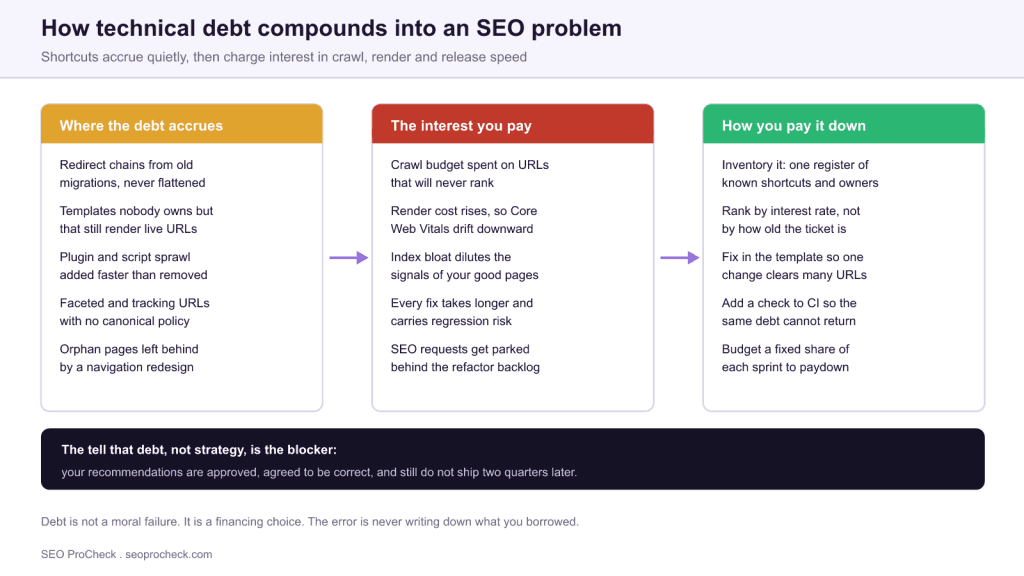
- Debt accrues in redirect chains, unowned templates, parameter sprawl and orphan pages left by redesigns.
- The interest is paid in crawl waste, index bloat, rising render cost and slower, riskier releases.
- Prioritize by interest rate, meaning cost per unit time, not by how old the ticket is.
- Fix at template level and add a check to continuous integration so the same debt cannot return.
The clearest sign that technical debt, rather than strategy, is your constraint is this: your recommendations are approved, everyone agrees they are correct, and two quarters later they still have not shipped. Nothing was rejected. The work simply could not be done at an acceptable cost, because doing it meant touching a template nobody owns, in a codebase where the last person who understood the routing left.
Debt is not a moral failure, and the framing matters for how you deal with it. Borrowing to ship on time is often the right call. The error is not writing down what was borrowed, so that a year later nobody can distinguish a deliberate shortcut from a bug, and the interest goes on being paid by whoever inherits the system.
Where the debt accrues
Technical debt relevant to SEO tends to collect in five places. None of them will appear in an audit report labelled as debt, which is part of why they persist.
- Redirect chains from old migrations. Each migration adds a hop rather than rewriting the rules, because rewriting means auditing what the previous team did. Three migrations later you have chains several hops deep that nobody dares flatten.
- Templates nobody owns. A campaign template from four years ago still renders live URLs. No team claims it, so it is excluded from every refactor, and it quietly emits outdated markup on pages that are still indexed.
- Plugin and script sprawl. Scripts get added faster than they get removed because removal requires proving nothing depends on them. The render path grows monotonically.
- Parameter and faceted URLs with no canonical policy. Filtering was shipped without a decision about which combinations should be indexable, and the URL space is now combinatorially large.
- Orphan pages from navigation redesigns. The new navigation launched and the pages the old one linked to are still live, still indexed, and no longer reachable by following links.
Write these into a register with an owner and an estimated cost. An undocumented shortcut is indistinguishable from a defect, and defects get argued about instead of scheduled.
Crawlability Essentials
Crawl is where technical debt charges its most measurable interest, because a crawler has a finite budget for your site and debt spends it on URLs that will never rank.
Parameter sprawl is the largest contributor on most sites. Faceted navigation without an indexation policy generates a URL for every combination of filters, and a crawler will happily work through them. The result is a site where the majority of crawl activity goes to URLs the business does not care about, while genuinely new pages wait to be discovered. Background on how the budget is allocated is in crawl budget explained.
Redirect chains are the second. Every hop is a request, and a crawler that follows several hops to reach content is spending several times the budget for one page. Chains also degrade quietly: a chain that works today breaks entirely the day one middle hop is retired, and the failure surfaces as a 404 on a URL nobody remembers linking to. Flattening is covered in redirect chains and loops.
The reason both persist is the same. Fixing them requires understanding a rule set written by people who have left, and the safe looking option is always to add one more rule on top.
Indexation Optimization
Debt damages index quality through accumulation rather than through any single error. Old templates, abandoned campaign pages, near duplicate location or variant pages and orphaned articles all stay indexable because removing them requires a decision nobody is incentivized to make.
The cost is dilution. When several URLs address the same topic, internal links and external links spread across them, and none of them consolidates enough signal to compete. The site can appear to have strong coverage while performing worse than a smaller, tighter version of itself would. Diagnosing this properly is covered in the duplicate content guide.
There is a second order effect worth naming. Once a site has thousands of low value indexable URLs, every report becomes harder to read. The Page indexing report fills with categories that are mostly noise, and the genuine signal, a template that started returning the wrong canonical last week, is buried. Debt does not only cost performance, it costs observability, and that is what makes it compound.
Performance and Experience
Render debt accumulates the way script tags do: one at a time, each individually defensible. Analytics, then a tag manager, then a consent tool, then a personalization script, then a chat widget. No single addition justifies a refactor, and the aggregate is a page that takes seconds to become interactive.
This is also where debt becomes hardest to reverse, because removing a script means proving that nothing depends on it. That proof is expensive and unglamorous, so the default is to leave it, which is precisely the mechanism by which the render path only ever grows.
Client side rendering deserves a specific warning. A framework chosen for developer velocity moves the cost of building the page onto the client and onto the crawler. It can work well, but it needs deliberate maintenance of the rendering strategy, and rendering strategy is exactly the kind of thing that gets set once and never revisited. Diagnosis is covered in JavaScript rendering SEO diagnosis.
The debt register
Make the debt visible before trying to prioritize it. This table is a workable starting structure.
| Debt | Interest you pay | How to spot it | Paydown |
|---|---|---|---|
| Redirect chains | Crawl budget per hop, latency for users, silent breakage when a hop retires | Crawl export filtered to redirect hop count above one | Rewrite rules to point at final destinations |
| Unowned templates | Outdated markup on live indexed URLs, excluded from every refactor | Group crawl export by template and look for ones with no current owner | Assign an owner or retire the template |
| Script and plugin sprawl | Render cost, Core Web Vitals drift, third party failure risk | Compare the request waterfall against a list of scripts anyone can justify | Remove one per cycle, measure after each |
| Parameter and facet URLs | Crawl waste at large scale, index bloat | Log analysis grouped by parameter, plus crawl volume by URL pattern | Define an indexation policy, then enforce it in the template |
| Orphan pages | Indexed URLs with no internal support, invisible to your own navigation | Set difference between sitemap or log URLs and the link crawl | Link them properly or consolidate and redirect |
| Near duplicate pages | Signal dilution, unpredictable canonical selection | Content hashing or near duplicate clustering across the crawl | Consolidate to one URL and redirect the rest |
Paying it down
Four practices separate teams that reduce debt from teams that only complain about it.
- Prioritize by interest rate, not by age. The right question is what this debt costs per unit time, and how much it raises the cost of future work. An ancient ticket that costs nothing can stay ancient. A recent shortcut that blocks every subsequent change is urgent.
- Fix at template level. One template change can clear tens of thousands of URLs. Per URL fixes are a way of paying interest while feeling productive.
- Add a check to continuous integration. A test asserting that the canonical is self referencing, or that a removed URL returns 404, costs an hour and retires that class of problem permanently. This is the difference between paying debt down and paying it repeatedly.
- Budget a fixed share of every cycle. Debt work loses every one off prioritization contest against new features, which is why the only durable approach is a standing allocation rather than a quarterly argument.
One framing point that changes how these requests land. SEO tickets compete poorly against features. Infrastructure tickets do not. Removing 40,000 crawlable URLs is a database load and cost story before it is an SEO story, and flattening redirect chains reduces latency for real users. The work is the same, and the engineering team can act on the second version.
FAQ
It is the accumulated cost of past shortcuts in the codebase, infrastructure and URL structure that now makes SEO work slower, riskier or impossible. A redirect chain left from a migration, a template nobody owns, and a parameter scheme with no canonical policy are all technical debt, and all of them charge interest.
Rarely as a direct penalty. It hurts by consuming crawl budget on URLs that will never rank, by diluting signals across near duplicate pages, by raising render cost until Core Web Vitals drift, and by making every fix slow enough that improvements stop shipping. The damage is cumulative rather than sudden.
Translate it into their units. An SEO ticket competes badly against a feature, but a request framed as removing 40,000 crawlable URLs that generate database load, or flattening redirect chains that add latency to real user requests, is a request about infrastructure cost and reliability.
Both, in a fixed ratio rather than by argument each quarter. Reserve a standing share of each cycle for paydown. Debt work always loses a one off prioritization contest against new work, so the only reliable way to fund it is to stop having the contest.
Whatever is blocking indexation of pages you want indexed, since no other work can produce value while that is in place. After that, prioritize by interest rate: how much the debt costs per unit time, and how much it increases the cost of future work.
Add a check to continuous integration for the specific failure, so the build catches it rather than a person catching it a quarter later. A test that asserts the canonical is self referencing, or that a removed URL returns 404, costs an hour to write and permanently retires the problem.
Source: https://www.onely.com/blog/how-technical-debt-affects-technical-seo/
Take this with you
The assistant links open with a question about this page already written. Nothing is sent until you press enter.
Claude Vincent is a technical SEO consultant focused on crawlability, rendering, and AI-search visibility. He writes the field guides and case studies at SEO ProCheck, with a bias toward the durable, unglamorous work that decides whether search engines and AI answer engines can actually read and cite a site.
About SEO ProCheck
Technical SEO consulting and GEO strategy with 20 years of enterprise experience. Case studies, resources, and tools for search and AI visibility.
Work With Me
Technical SEO audits, GEO strategy, site migrations, and international SEO. Hourly consulting for teams who need hands-on support, not just reports.
Subscribe to our newsletter!








Recent Posts
- Most Top Sites Never Say Who They Are in Structured Data October 14, 2026
- Homepage Titles Are Mostly Too Short, Not Too Long October 8, 2026
- Who Actually Serves an llms.txt? 184 Top Sites Measured September 29, 2026