

AI Summary
Semrush is an all in one search marketing platform covering organic research, paid intelligence, rank tracking, site auditing, and content tooling under one login. Its strength is breadth across the whole search channel, and its trap is sprawl plus modeled metrics that are easy to misread as fact.
- Position Tracking and Site Audit are the two modules that compound in value, so start there and ignore the rest until you need it.
- Authority Score is a proprietary 0 to 100 index, not a Google signal, and it is not comparable to the Ahrefs DR number.
- Traffic Analytics figures are modeled from clickstream panels, useful for relative comparison, unreliable as absolute counts.
- Connect Search Console and GA4 so the modeled numbers sit next to measured ones.
Semrush is an all-in-one search marketing platform: organic research, paid search intelligence, rank tracking, site auditing, and content tooling under one login. You use it when your work spans more than pure SEO, it's the tool that tries to cover the whole search channel rather than one discipline deeply.
Breadth is the product, and the trade-off
Where Ahrefs grew out of a link index, Semrush grew out of competitive keyword intelligence, its original party trick was showing you any domain's organic and paid keywords. It has since bolted on dozens of modules: Position Tracking, Site Audit, Keyword Magic, Topic Research, Listing Management, social schedulers, even PR tooling. The result is genuinely useful breadth and genuinely real sprawl. Most subscribers use a fraction of the platform, and the interface makes you feel it, finding the report you want is sometimes half the job.
Apply the same vendor-claim discipline here as anywhere else. Semrush's keyword database size is a marketing number nobody independently audits. Traffic Analytics figures are modeled from clickstream panels and can be way off for individual sites, fine for comparing two competitors' order of magnitude, reckless to quote as fact. And Authority Score (AS), Semrush's 0 to 100 domain metric, is exactly what Ahrefs' DR is: a proprietary, non-Google number that compresses links, traffic estimates, and spam signals into one digit. Google uses none of it. AS and DR aren't even comparable to each other, same scale, different math, so never mix them in one report column.
What Semrush does well, by job
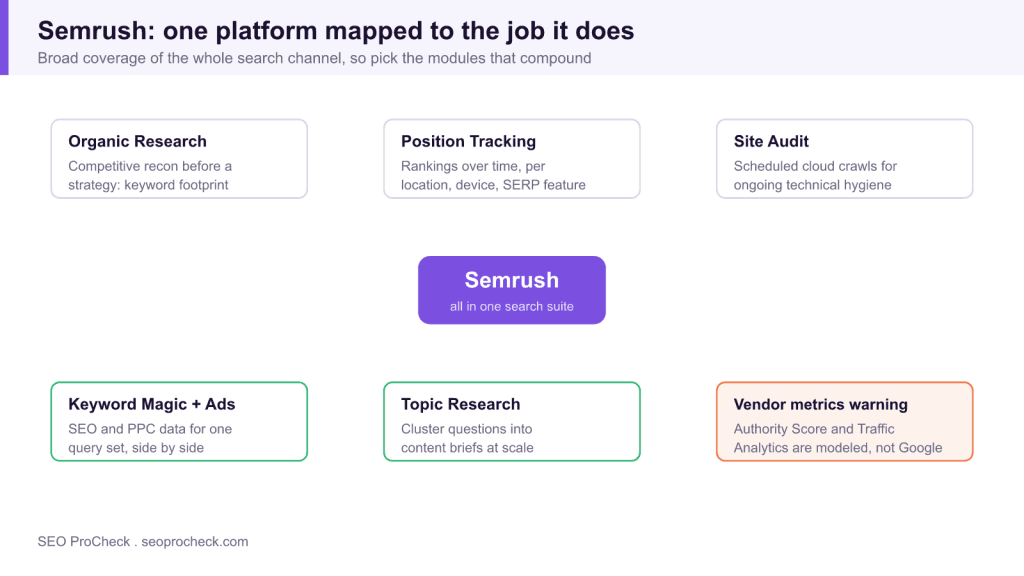
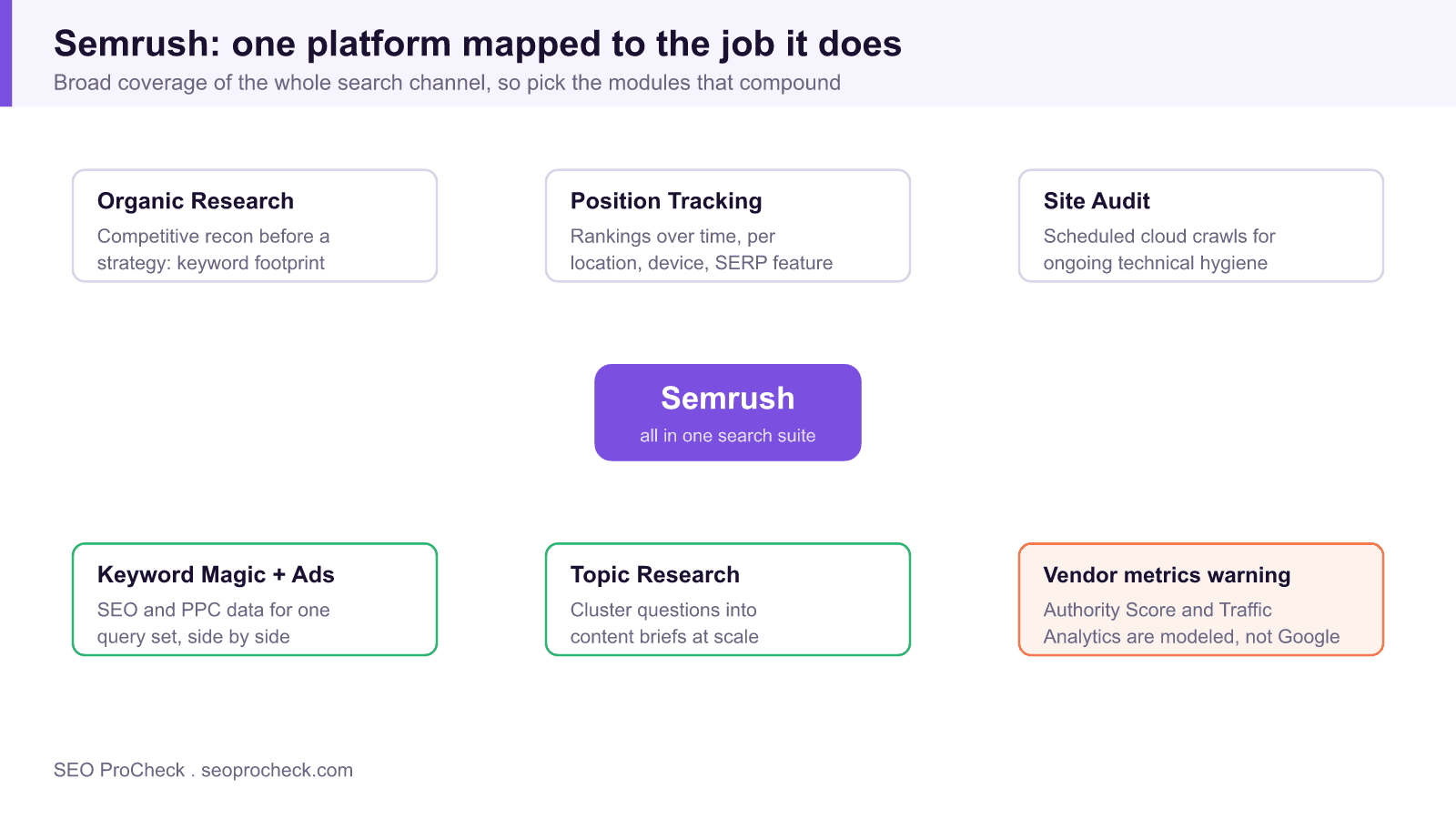
Rather than mirror a feature list, here's how the platform maps to actual work:
| The job | Semrush module | Why it's good | Watch out for |
|---|---|---|---|
| Competitive recon before a strategy | Organic Research + Keyword Gap | Fast read on any domain's keyword footprint, trends, and top pages; the original strength of the product | Rankings snapshot lags reality by days-to-weeks; "traffic" columns are modeled, not measured |
| Watching rankings over time | Position Tracking | Highly configurable: per-location, per-device, SERP features, share of voice; among the best implementations of rank tracking anywhere | Every reading is still a sample from fixed conditions; local businesses must set city-level targets or the data is fiction |
| Ongoing technical hygiene | Site Audit | Scheduled cloud crawls, decent issue explanations, thematic reports (crawlability, HTTPS, Core Web Vitals) | Issue counts inflate with warnings that don't matter; a desktop crawler gives you more control when you need to dig |
| Integrated SEO + PPC planning | Keyword Magic + Advertising Research | Seeing organic and paid data for the same query set in one place, this is where Semrush beats SEO-only tools outright | Volume and CPC are estimates layered on Google Ads buckets; treat as ranges |
| Content briefs at scale | Topic Research + SEO Writing Assistant | Quick clustering of questions and subtopics for writers | Optimization scores encourage box-ticking prose; a "10/10" SEO score has never made a mediocre article rank |
How to set it up without drowning
- Create one Project per site and resist enabling every module. Position Tracking and Site Audit are the two that compound in value over time, start there.
- Configure Position Tracking properly: real target locations, mobile and desktop, competitors added, SERP features on. The Position Tracking setup guide walks through it step by step.
- Schedule Site Audit weekly, then triage by crawlability errors first, ignore the notices tab until errors are boring.
- Run Keyword Gap quarterly against your two closest SERP competitors and feed the output into your content planning, filtered hard for relevance.
- Connect Search Console and GA4 so modeled numbers sit next to real ones, the fastest way to learn how far off the estimates run for your site.
Common mistakes (and fixes)
- Reporting Authority Score to clients as "our authority." It's a vendor index, not a Google measure, and it moves when Semrush changes the formula. Fix: report referring domains, rankings, and clicks; mention AS only as a rough competitive gauge.
- Quoting Traffic Analytics numbers as actual traffic. Panel-based estimates for mid-size sites can miss badly. Fix: use them for relative comparison between competitors, flag them as estimates, and never contradict a site's real analytics with them.
- Tracking national rankings for a local business. A plumber in Newark does not have a US-wide ranking in any meaningful sense. Fix: set city or zip-level tracking locations.
- Letting Site Audit scores drive priorities. The health score weights things your stack may not care about. Fix: triage issues by actual crawl/index impact, not by what moves the gauge.
- Paying for Semrush and Ahrefs while using one badly. Fix: read the feature-by-feature comparison, pick the one matching your workload, master it.
FAQ
Is Authority Score comparable to Ahrefs' DR?
No. Both are 0 to 100, which tempts people to compare them, but they're computed differently from different indexes. A site can be DR 55 and AS 40. Pick one vendor's metric for internal triage and stay consistent, and keep both out of KPI dashboards.
How accurate is Semrush's search volume?
It's modeled from clickstream data calibrated against Google Ads ranges, good for relative size ("this term is ~10x bigger than that one"), unreliable as an absolute monthly count. The longer explanation is in how SEO tools estimate search volume.
Semrush or Ahrefs for backlinks?
Semrush's link index has improved a lot, but most practitioners still reach for Ahrefs when the job is link analysis or prospecting. If backlinks are a side dish for you, Semrush's index is plenty.
Is the free tier usable?
For occasional lookups, barely, ten queries a day and one project with tight limits. It works as an extended trial, not as a working tier.
Do I need it if I have Search Console?
They answer different questions. Search Console tells you how your site performs in Google. Semrush tells you what everyone else is doing and lets you sample rankings under controlled conditions. Competitive work needs the second; pure monitoring of a small site often doesn't.
Take this with you
The assistant links open with a question about this page already written. Nothing is sent until you press enter.
Claude Vincent is a technical SEO consultant focused on crawlability, rendering, and AI-search visibility. He writes the field guides and case studies at SEO ProCheck, with a bias toward the durable, unglamorous work that decides whether search engines and AI answer engines can actually read and cite a site.
About SEO ProCheck
Technical SEO consulting and GEO strategy with 20 years of enterprise experience. Case studies, resources, and tools for search and AI visibility.
Work With Me
Technical SEO audits, GEO strategy, site migrations, and international SEO. Hourly consulting for teams who need hands-on support, not just reports.
Subscribe to our newsletter!








Recent Posts
- Most Top Sites Never Say Who They Are in Structured Data October 14, 2026
- Homepage Titles Are Mostly Too Short, Not Too Long October 8, 2026
- Who Actually Serves an llms.txt? 184 Top Sites Measured September 29, 2026