

AI Summary
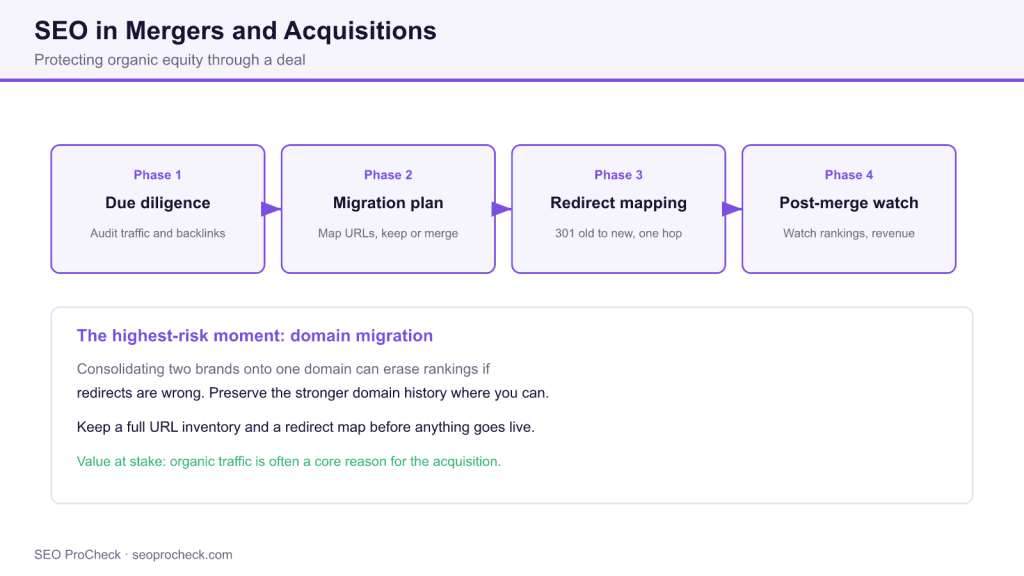
In a merger or acquisition, SEO protects the organic traffic that is often part of what the buyer is paying for. The work runs in four phases: due diligence on both properties, a migration plan that decides which URLs to keep or consolidate, careful 301 redirect mapping, and post merge monitoring to catch losses early.
- Organic traffic and backlink equity are assets that should be valued during due diligence.
- Domain migration is the single highest risk moment; a wrong redirect map can erase rankings.
- Preserve the stronger domain history and map every legacy URL to its best new destination.
- Redirects should be single hop 301s, never chains, and monitored for weeks after launch.
The Role of SEO in Mergers and Acquisitions provides valuable insights for SEO practitioners. This resource examines approaches and considerations that can improve organic search performance.
Key Concepts
Understanding the fundamental principles behind this topic helps inform strategic decisions. Whether optimizing for traditional search or emerging AI platforms, foundational concepts remain relevant. This resource covers the essential knowledge practitioners need.
Implementation Considerations
Moving from concept to execution requires understanding practical constraints and opportunities. Different situations call for different approaches. This resource provides guidance for applying concepts in real-world contexts.
Measuring Impact
SEO efforts require measurement to demonstrate value and guide optimization. Identifying appropriate metrics, establishing baselines, and tracking progress enables data-driven improvement. This resource addresses how to evaluate success.
This resource contributes to the knowledge base SEO practitioners need for effective optimization in an evolving search landscape.
Source: https://ahrefs.com/blog/seo-for-mergers-acquisitions
Practitioner commentary: where deals gain or lose organic value
When two companies combine, their websites usually do too, and that is where SEO earns its seat at the table. If the acquisition thesis includes an audience, a content library, or a backlink profile, then organic traffic is part of the asset being bought, and it can evaporate during a botched migration. The discipline here is unglamorous: inventory everything, decide what survives, and move it without breaking the signals that made it rank.
Due diligence is the phase teams skip and later regret. Before signing, you want a clear read on each property: organic traffic trends, the backlink profile and its quality, any history of manual actions or algorithmic suppression, and how much of the traffic sits on a handful of pages versus spread across the site. A target whose rankings are propped up by a thin set of aging links is worth less than its traffic chart suggests, and that belongs in the valuation conversation, not in a surprise three months after close.
The four phases and their deliverables
| Phase | Core work | Key deliverable |
|---|---|---|
| Due diligence | Audit traffic, backlinks, penalties on both sites | A risk and value memo per property |
| Migration plan | Decide keep, consolidate, or retire each URL | A URL inventory with decisions |
| Redirect mapping | Map each legacy URL to one new URL | A one hop 301 redirect map |
| Post merge watch | Monitor rankings, indexation, and revenue | A dashboard with alerts and a rollback plan |
The migration is the moment of maximum risk
Consolidating two brands onto one domain concentrates authority, which is often the right call, but it is also where rankings die if the redirect map is wrong. Every legacy URL that had value should 301 to the closest equivalent on the surviving domain, in a single hop, with no redirect chains that dilute signals and waste crawl budget. Preserve the stronger domain history where the business allows it, because a domain with years of trust and links is not something you recreate quickly. Keep a full inventory before anything goes live so nothing that ranked quietly gets dropped in the reshuffle. The way authority flows through the new structure is worth planning against our internal linking guide, and consolidating overlapping pages helps avoid the index bloat that two merged catalogs often create.
What's changed since this article
The mechanics of a migration have stayed remarkably stable: 301s, a clean map, patience while Google reprocesses. What has shifted is the reporting picture around it. With AI Overviews folded into Search Console and click through rates softening on informational queries, post merge monitoring has to separate a migration loss from an ambient answer engine loss, which again argues for tracking a matched set of stable pages as a baseline. The other change is speed of scrutiny: brand mentions and entity signals propagate faster now, so keeping the acquired brand consistent across the web during a transition, or redirecting it deliberately, matters more than it used to. For related strategy reading, see the general SEO articles.
Frequently asked questions
Why does SEO matter in a merger or acquisition?
Because organic traffic and backlink equity are often part of what the buyer is paying for. A poorly executed website migration can erase that traffic, so SEO protects value that would otherwise be lost during integration.
What SEO due diligence should happen before a deal closes?
Audit each property for organic traffic trends, backlink quality, any manual actions or algorithmic suppression, and how concentrated the traffic is. The findings inform valuation and surface risks before they become post close surprises.
What is the riskiest SEO step in an acquisition?
Domain migration, especially consolidating two brands onto one domain. If legacy URLs are not mapped correctly to their new equivalents with single hop 301 redirects, rankings and traffic can drop sharply.
Should we keep both domains or consolidate to one?
It depends on brand strategy and the relative authority of each domain. Consolidating concentrates link equity but must be done with a complete redirect map; keeping both can preserve distinct audiences at the cost of maintaining two properties.
How long should we monitor SEO after a merger?
Monitor closely for at least a few months, since Google needs time to reprocess redirects and reassign signals. Watch rankings, indexation, and revenue, and keep a rollback plan ready in case a migration decision needs reversing.
How do we tell a migration loss from a normal traffic dip?
Track a matched set of stable pages as a baseline. If those move the same way, the change is ambient, for example an algorithm update or AI Overviews. If only migrated URLs drop, the redirect map or consolidation is the likely cause.
Take this with you
The assistant links open with a question about this page already written. Nothing is sent until you press enter.
Claude Vincent is a technical SEO consultant focused on crawlability, rendering, and AI-search visibility. He writes the field guides and case studies at SEO ProCheck, with a bias toward the durable, unglamorous work that decides whether search engines and AI answer engines can actually read and cite a site.
About SEO ProCheck
Technical SEO consulting and GEO strategy with 20 years of enterprise experience. Case studies, resources, and tools for search and AI visibility.
Work With Me
Technical SEO audits, GEO strategy, site migrations, and international SEO. Hourly consulting for teams who need hands-on support, not just reports.
Subscribe to our newsletter!








Recent Posts
- Most Top Sites Never Say Who They Are in Structured Data October 14, 2026
- Homepage Titles Are Mostly Too Short, Not Too Long October 8, 2026
- Who Actually Serves an llms.txt? 184 Top Sites Measured September 29, 2026