

AI Summary
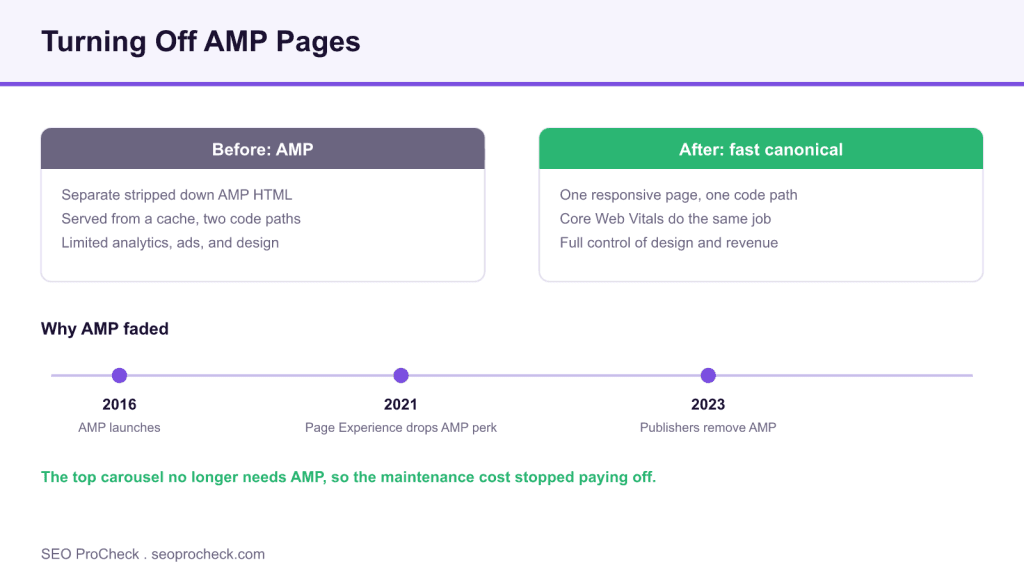
Search Engine Land announced it was turning off AMP because modern responsive pages and Core Web Vitals now deliver the speed AMP once provided, without the cost of maintaining a second codebase. After Google's 2021 Page Experience update removed the AMP requirement for the Top Stories carousel, AMP lost its main SEO advantage.
- AMP was a separate, stripped down HTML version served from a Google cache.
- The 2021 Page Experience update dropped AMP as a Top Stories requirement.
- Core Web Vitals let a normal responsive page hit the same speed targets.
- Removing AMP cut a second code path, freeing design, analytics, and ad control.
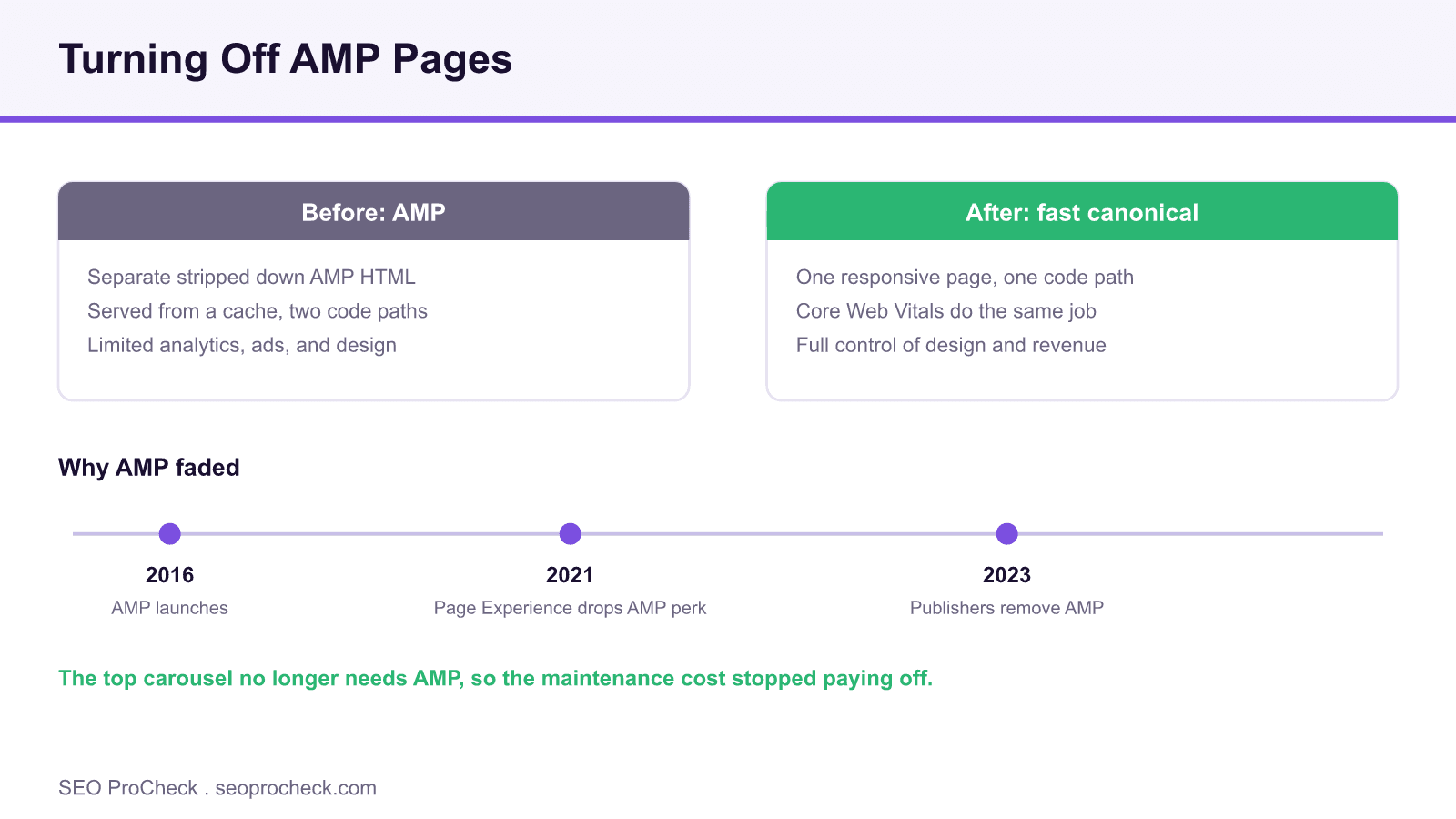
We’re turning off AMP pages at Search Engine Land provides valuable insights for SEO practitioners. This resource examines approaches and considerations that can improve organic search performance.
What AMP was and why it mattered
Accelerated Mobile Pages, or AMP, was an open framework for building very fast, stripped down mobile pages. AMP restricted the HTML, CSS, and JavaScript you could use and served pages from a Google cache, which made them load almost instantly. For years, AMP was also the ticket into the Top Stories carousel for news publishers.
That combination of speed and carousel access is why so many publishers adopted AMP despite the extra work of maintaining an AMP version alongside their normal pages.
Why Search Engine Land turned it off
Search Engine Land explained that AMP no longer earned its keep. Google's Page Experience update in 2021 removed AMP as a requirement for Top Stories, so the biggest reason to maintain it disappeared. At the same time, Core Web Vitals gave every site a clear, measurable speed target that a well built responsive page can meet without AMP.
Maintaining AMP meant maintaining a second codebase with its own limits on design, analytics, and advertising. Once the carousel perk was gone and a normal page could hit the same speed, that second code path was pure cost, so turning AMP off simplified the stack and returned full control of the page.
How to remove AMP safely
Removing AMP is straightforward if you sequence it carefully. Redirect each AMP URL to its canonical page with a 301, remove the amphtml link from your canonical pages, and update or resubmit your sitemaps so Google recrawls the canonical versions.
Then watch the results. Monitor Interaction to Next Paint and the other Core Web Vitals to confirm the responsive page is fast, and keep your canonical pages quick with the basics covered in our guide to speeding up WordPress. Because the canonical page now carries all the traffic, make sure it renders well for crawlers, a topic we cover in server versus client rendering for crawlers.
Do you still need AMP?
For most sites, no. If your responsive pages pass Core Web Vitals and you are not relying on AMP for a specific integration, the maintenance cost usually outweighs the benefit. AMP still exists and can be used, but it is now optional rather than a competitive necessity.
The practical takeaway from Search Engine Land's decision is that the industry moved on: invest in a single fast responsive experience rather than a parallel AMP build.
| Concern | AMP era | Post AMP responsive |
|---|---|---|
| Speed | Fast via cache and limited code | Fast via Core Web Vitals work |
| Top Stories | AMP once required | Open to non AMP since 2021 |
| Codebase | Two versions to maintain | One responsive version |
| Design and ads | Constrained by AMP rules | Full control |
| Analytics | Limited and split | Standard, unified |
What has changed since
- Google's 2021 Page Experience update removed AMP as a Top Stories requirement, ending its biggest SEO advantage.
- Core Web Vitals, including Interaction to Next Paint, now define the speed bar that a responsive page can meet without AMP.
- Many major publishers, Search Engine Land among them, have retired AMP to simplify their stack and reclaim design and revenue control.
Key Concepts
Understanding the fundamental principles behind this topic helps inform strategic decisions. Whether optimizing for traditional search or emerging AI platforms, foundational concepts remain relevant. This resource covers the essential knowledge practitioners need.
Implementation Considerations
Moving from concept to execution requires understanding practical constraints and opportunities. Different situations call for different approaches. This resource provides guidance for applying concepts in real-world contexts.
Measuring Impact
SEO efforts require measurement to demonstrate value and guide optimization. Identifying appropriate metrics, establishing baselines, and tracking progress enables data-driven improvement. This resource addresses how to evaluate success.
This resource contributes to the knowledge base SEO practitioners need for effective optimization in an evolving search landscape.
Source: https://searchengineland.com/why-were-turning-off-amp-pages-at-search-engine-land-376228
Frequently asked questions
Why did Search Engine Land turn off AMP?
Because AMP stopped paying for itself. Google's 2021 Page Experience update removed the AMP requirement for Top Stories, and Core Web Vitals let a responsive page hit the same speed, so maintaining a second AMP codebase became pure cost.
Is AMP still a ranking factor?
AMP itself was never a direct ranking factor, and it is no longer required for the Top Stories carousel. What matters now is page experience and Core Web Vitals, which you can meet with a fast responsive page whether or not it uses AMP.
Do I need AMP in 2025?
For most sites, no. If your responsive pages pass Core Web Vitals, AMP usually adds maintenance cost without a matching benefit. AMP remains available and optional, but it is no longer a competitive necessity for search visibility.
How do I remove AMP without hurting SEO?
Redirect each AMP URL to its canonical page with a 301, remove the amphtml link from canonical pages, and update your sitemaps. Then monitor Core Web Vitals and indexing to confirm the responsive pages are fast and being crawled correctly.
Will removing AMP slow down my pages?
Not if your responsive pages are built well. AMP was a shortcut to speed, but a properly optimized page can meet the same Core Web Vitals targets. Focus on efficient code, image optimization, and caching to keep pages fast.
What replaced AMP for fast mobile pages?
Core Web Vitals and modern responsive development replaced AMP as the standard for fast mobile experiences. Instead of a separate AMP version, teams now optimize a single responsive page to meet Google's page experience metrics.
Claude Vincent is a technical SEO consultant focused on crawlability, rendering, and AI-search visibility. He writes the field guides and case studies at SEO ProCheck, with a bias toward the durable, unglamorous work that decides whether search engines and AI answer engines can actually read and cite a site.
About SEO ProCheck
Technical SEO consulting and GEO strategy with 20 years of enterprise experience. Case studies, resources, and tools for search and AI visibility.
Work With Me
Technical SEO audits, GEO strategy, site migrations, and international SEO. Hourly consulting for teams who need hands-on support, not just reports.
Subscribe to our newsletter!







Recent Posts
- Can AI Crawlers Actually Read Your Site? I Measured 400 of the Biggest September 5, 2026
- The Pre-Publish Quality Gate for AI-Assisted Content August 6, 2026
- AGENTS.md vs llms.txt vs llms-full.txt: Which Agent File Does What July 18, 2026