

How To Update Older and Outdated Content To Maintain High Search Rankings (Case Study)
- April 17, 2016
- Content
AI Summary
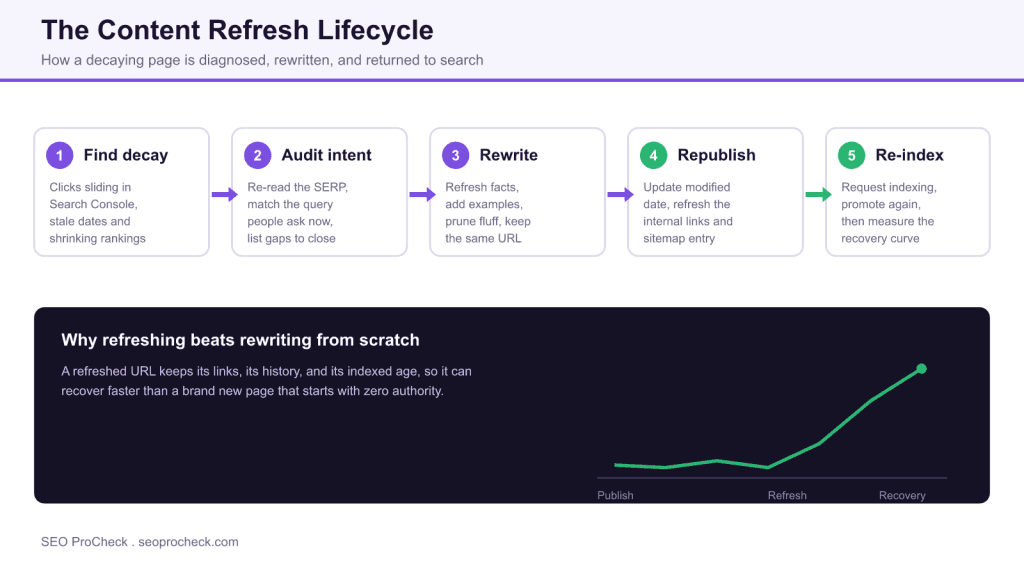
Updating older content means rewriting a page that already ranks, on its existing URL, so it keeps its links and indexed history while the content is brought back to current standards. Done on a schedule, refreshing recovers lost clicks faster than publishing a brand new page, because a known URL is re-crawled and re-scored sooner.
- Find decaying pages in Search Console: sort the Pages report by falling clicks over the last 6 months.
- Refresh on the same URL. Changing the slug throws away link equity and forces a fresh indexing cycle.
- Rewrite for the query people ask today, add worked examples, prune filler, and update the visible date.
- After publishing, request indexing so the page is re-crawled in days rather than weeks.
Content-driven SEO success requires strategic approaches to creation, optimization, and management. This case study demonstrates how content strategy directly drives organic growth when aligned with user needs and search behavior.
How to spot content that is losing rankings
Content decay is rarely sudden. A page that ranked in position 3 slips to 6, then to 11, and the clicks quietly drain away while the URL still looks fine. The fastest way to surface these pages is Google Search Console. Open the Performance report, set the date range to compare the last 3 months against the previous 3 months, then add a filter on the Pages tab and sort by the largest click decline. Any URL that has lost a meaningful share of its clicks while impressions hold steady is a refresh candidate: the demand is still there, but your page has stopped matching it.
Cross-reference that list against three signals before you act. First, the visible publish or modified date: pages that read as dated to a human read as dated to a ranking system too. Second, the current top results for the target query, because intent drifts and a guide written for one question can be outranked once searchers start asking a slightly different one. Third, the internal link count, since orphaned or lightly linked pages recover slowly no matter how good the rewrite is.
Content Strategy Framework
Effective content strategy begins with understanding target audiences, their questions, and the competitive content landscape. This case study outlines the strategic framework that guided content decisions, from topic selection to format choices.
In practice the framework for a refresh is narrower than for a new piece: the topic is already chosen and already validated by the traffic it once earned. The decision is not what to write, it is what has gone stale. Group the gaps into three buckets, factual (numbers, product names, screenshots that no longer match reality), structural (headings that no longer map to how people search), and competitive (subtopics the current top pages cover that yours does not). That triage keeps the rewrite focused instead of turning into an open-ended new draft.
Content Development Process
Moving from strategy to published content requires efficient processes for research, creation, and optimization. This case study documents workflows, quality standards, and production approaches that enabled consistent, high-quality output.
For refreshes, the single most important rule is to keep the same URL. Rewriting in place preserves the backlinks, the internal links, and the crawl history that already point at the page. If you publish the rewrite at a new slug and delete the old one, you throw all of that away and hand the ranking system a page it has never scored. When a URL genuinely must change, map a 301 redirect from the old address to the new one so the accumulated authority follows.
Optimization and Distribution
Published content requires ongoing optimization based on performance data. This case study covers how content was refined post-publication, how internal linking supported content performance, and how distribution amplified content reach.
A repeatable refresh workflow
Turn the ideas above into a checklist so the work is repeatable across a whole library rather than a one-off rescue. The version below is the one this case study effectively follows, expressed as concrete steps a practitioner can run on any decaying URL.
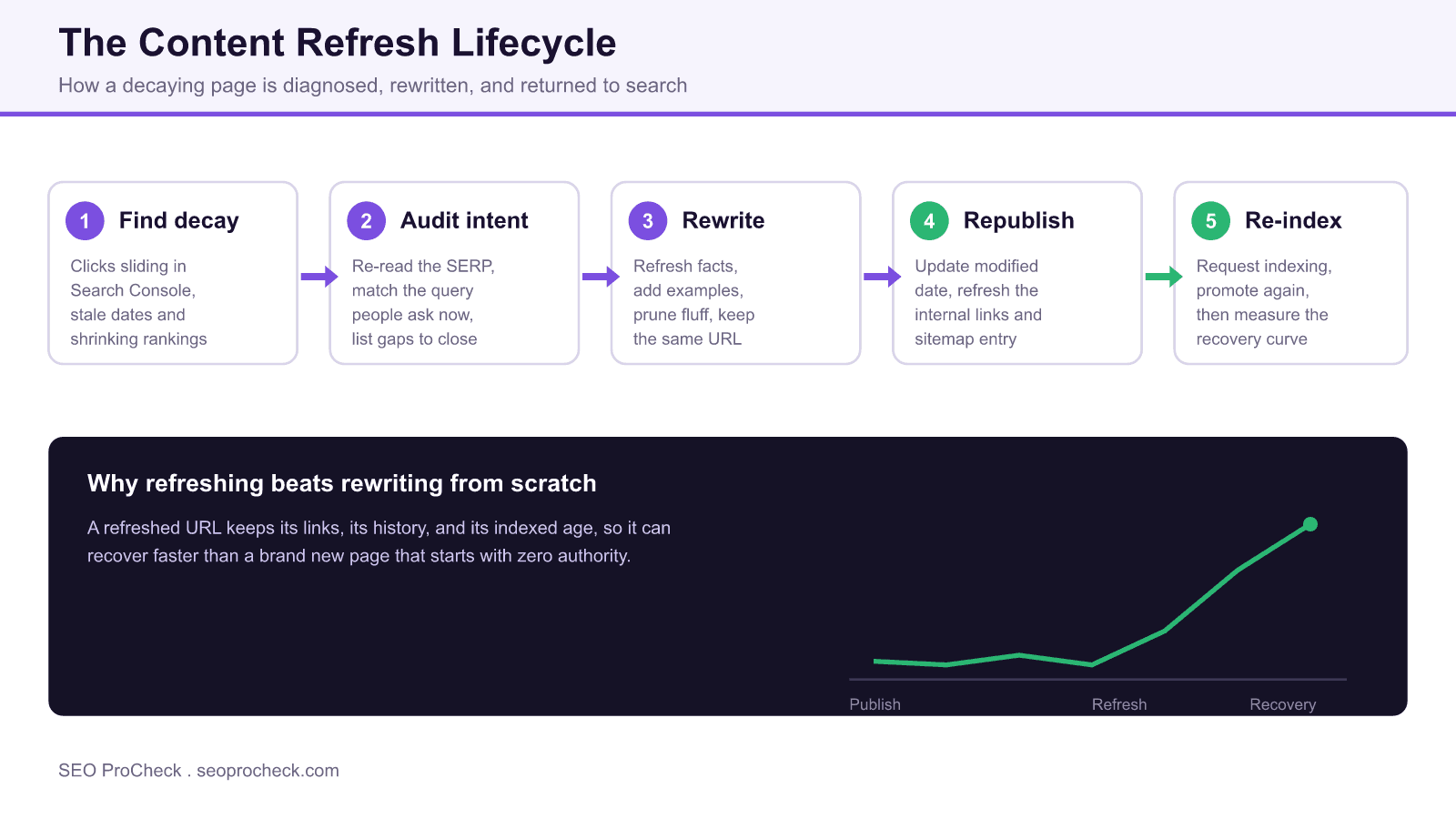
- Diagnose: confirm the click decline in Search Console and record the target query and current position.
- Re-read the SERP: open the current top five results and list every subtopic they cover that your page omits.
- Rewrite in place: update facts, add or replace examples, tighten the introduction, and cut sentences that pad without informing.
- Refresh the supporting signals: update the modified date, add two or three internal links from strong related pages, and confirm the URL is still in your sitemap.
- Re-index: submit the URL for indexing so it is re-crawled quickly, then note the date so you can measure recovery against it.
Refresh, rewrite, or leave it: a decision table
| Situation | Signal | Action | Keep the URL? |
|---|---|---|---|
| Clicks falling, impressions steady | Demand exists, page is stale | Refresh in place | Yes |
| Clicks and impressions both gone | Query no longer searched | Consolidate or retire | Redirect to best match |
| Two pages target one query | Self-competition, thin twins | Merge into one stronger page | Redirect the weaker URL |
| Page still ranks well | Healthy, on-trend | Leave it, monitor | Yes |
| Facts outdated, rankings intact | Trust risk, not yet a decline | Light factual refresh | Yes |
Results and Attribution
Measuring content ROI requires connecting content efforts to business outcomes. This case study demonstrates the traffic, engagement, and business results achieved through strategic content investment. Attribution methodology helps validate content strategy effectiveness.
To attribute a refresh cleanly, mark the republish date as an annotation and compare the 28 days before against the 28 days after for that specific URL, not the whole site. Watch clicks, average position, and the number of distinct queries the page ranks for, because a good refresh often widens the query footprint even before it lifts the headline term. Hold the comparison to the same weekday mix so a weekend does not distort the read.
What has changed since
The core mechanics of refreshing content have held up, but two things have shifted. First, AI Overviews and AI Mode now pull sentences directly from pages, which rewards content that answers the question in the first paragraph in plain, quotable language rather than burying the answer. Second, freshness signals are read more holistically: updating only the visible date without changing the substance is transparent to modern systems and can erode trust rather than build it. Refresh the content, then let the date reflect real work.
Content SEO case studies help practitioners build cases for content investment with documented results.
Source: https://www.gsqi.com/marketing-blog/updating-older-killer-content/
Frequently asked questions
How often should I update older content?
Review your top pages at least twice a year and refresh any that show a sustained click decline in Search Console. High-velocity topics such as software or pricing may need quarterly attention, while evergreen explainers can go longer between refreshes.
Should I change the URL when I update a page?
No. Keep the same URL so the page retains its backlinks, internal links, and indexed history. If the URL must change for a genuine reason, add a 301 redirect from the old address to the new one so the authority follows.
Does just changing the publish date help rankings?
Not on its own. Changing the date without changing the content is transparent to modern ranking systems and can reduce trust. Update the substance first, then let the modified date reflect the real work you did.
How do I find which pages are decaying?
In Search Console, open the Performance report, compare the last 3 months with the previous 3 months, then sort the Pages tab by the largest click decline while impressions stay flat. Those URLs still have demand but have stopped matching it.
How long until a refreshed page recovers?
Once you request indexing, the page is usually re-crawled within days, and ranking movement typically follows over the next few weeks. Because the URL keeps its history, recovery is normally faster than launching a new page from zero.
Is refreshing content better than writing new articles?
For pages that already rank and then slipped, refreshing is usually the higher return, because you build on existing authority. New articles are better for genuinely new topics where you have no existing page to improve.
Related reading on SEO ProCheck:
Claude Vincent is a technical SEO consultant focused on crawlability, rendering, and AI-search visibility. He writes the field guides and case studies at SEO ProCheck, with a bias toward the durable, unglamorous work that decides whether search engines and AI answer engines can actually read and cite a site.
About SEO ProCheck
Technical SEO consulting and GEO strategy with 20 years of enterprise experience. Case studies, resources, and tools for search and AI visibility.
Work With Me
Technical SEO audits, GEO strategy, site migrations, and international SEO. Hourly consulting for teams who need hands-on support, not just reports.
Subscribe to our newsletter!







Recent Posts
- Can AI Crawlers Actually Read Your Site? I Measured 400 of the Biggest September 5, 2026
- The Pre-Publish Quality Gate for AI-Assisted Content August 6, 2026
- AGENTS.md vs llms.txt vs llms-full.txt: Which Agent File Does What July 18, 2026