

AI Summary
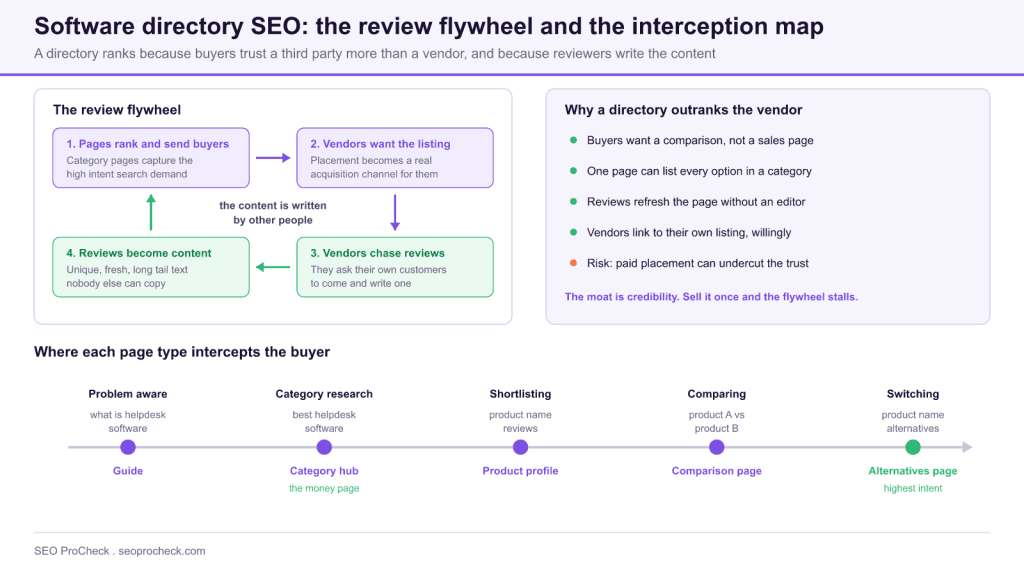
A software directory wins organic search for two structural reasons: buyers researching a purchase prefer a third party comparison to a vendor's own sales page, and the reviews that make each page unique are written by other people. That turns content production into a flywheel rather than a cost line.
- The category hub ("best X software") is the money page; everything else feeds it.
- Vendors recruit their own customers to leave reviews, so content scales with vendor incentive, not headcount.
- Aggregated ratings about third party products are not self serving, so review structured data is legitimately available.
- The moat is credibility. Paid placement that overrides merit is the fastest way to break it.

This case study documents a successful organic growth strategy, demonstrating how strategic SEO implementation drives measurable business results. The approach provides actionable insights for practitioners facing similar challenges.
Challenge and Context
Every successful SEO initiative begins with understanding the starting position and objectives. This case study reveals the initial challenges, competitive landscape, and business goals that shaped the strategy. Understanding context helps practitioners assess applicability to their own situations.
Strategic Approach
The methodology employed combined technical optimization, content strategy, and authority building in a coordinated approach. Key decisions around prioritization, resource allocation, and tactical execution provide a template for similar initiatives. The strategy balanced quick wins with sustainable long-term growth.
Implementation Details
Moving from strategy to execution required specific technical implementations, content creation processes, and measurement frameworks. This case study documents the practical steps taken, tools used, and workflows developed. These implementation details help practitioners translate strategy into action.
Results and Analysis
The outcomes demonstrate the effectiveness of the approach through measurable metrics: traffic growth, ranking improvements, and business impact. Analysis of what worked best and what could have been done differently provides learning value beyond the raw results.
This case study contributes to the evidence base for effective SEO strategy, helping practitioners learn from documented successes.
What a "traffic value" figure actually measures
Before the strategy, a note on the metric in the title, because it is routinely misread. Traffic value is a third party tool estimate of what the site's organic traffic would cost to buy through paid search. Tools compute it roughly as: for each ranking keyword, estimated clicks at that position multiplied by the advertising cost per click for that keyword, summed across the keyword set.
That makes it a useful scale indicator and a poor revenue proxy. It is not money the business earns. It is sensitive to which keyword database the tool uses, it assumes you would actually bid on every term at the quoted price, and it inflates dramatically in categories with expensive clicks. Software categories have some of the highest costs per click anywhere, so a directory in that space posts enormous traffic value numbers relative to its actual revenue. Read the figure as "this site occupies commercially valuable search real estate", never as a profit and loss line.
The flywheel: why the content writes itself
Most content operations are limited by how fast they can produce credible material. A review directory removes that constraint by making somebody else's incentive do the work.
- Category pages rank and send qualified buyers to vendors. A page for "best helpdesk software" intercepts people actively choosing a tool.
- Vendors notice that placement drives real pipeline. A directory listing becomes an acquisition channel worth managing.
- Vendors campaign for reviews. They email their own customers asking them to leave one, because ratings and review counts affect placement and buyer confidence.
- Those reviews become unique, fresh, long tail content on the directory's pages. Nobody can copy them, and they arrive continuously without an editorial budget.
Loop back to step one, stronger. The critical property is that the marginal cost of content approaches zero while its defensibility stays high. That is a fundamentally different economic position from a publisher writing its own reviews.
The page architecture and what each layer is for
| Page type | Query pattern | Buyer stage | What makes it rank | Scale |
|---|---|---|---|---|
| Category hub | best {category} software | Choosing a category | Breadth of options plus aggregate ratings | Hundreds. The money pages |
| Product profile | {product} reviews, {product} pricing | Shortlisting | Volume and recency of genuine reviews | Tens of thousands |
| Comparison | {a} vs {b} | Down to two options | Structured attribute deltas, a clear verdict | Selective, demand led only |
| Alternatives | {product} alternatives | Actively switching | Honest reasons to leave, credible substitutes | One per major product |
| Segment cut | best {category} for {segment} | Category with a constraint | Genuinely different criteria, not a reorder | Only where demand is proven |
The discipline point is in the last two rows. Comparison and segment pages are combinatorial: every product pairs with every other, every category multiplies by every segment. Generating that space exhaustively produces tens of thousands of near identical pages and invites the duplicate handling problems that sink large templated sites. Build only the cells with demonstrated search demand, which is a keyword research exercise before it is an engineering one.
Review structured data: what is actually allowed
This is where directories have a real and legitimate advantage that vendors do not. Google's structured data guidance prohibits self serving review markup, meaning ratings about an entity published by that same entity. A software vendor cannot mark up reviews of its own product for rich results. A third party directory publishing user reviews about other companies' products is not self serving, so the markup is available to it.
Practical implementation notes:
- Mark up product profiles with
SoftwareApplicationorProductcarrying anaggregateRating, plus individualReviewitems withauthoranddatePublished. - The rating shown in markup must be visible on the page. Marking up a score the user cannot see is a violation and gets manual actions.
ratingValue,bestRating,worstRatingandreviewCountshould reconcile exactly with what the page displays.- Do not put
aggregateRatingon a category hub as though the list itself had a rating. Rate the products, not the page. - Review snippets are only supported for a defined set of schema types, so verify the type you are using is eligible before building it.
Our review schema reference covers required properties and the eligibility rules in full.
The trust problem, which is also the SEO problem
Every directory faces the same tension. Revenue comes from vendors, credibility comes from buyers, and vendors would like to buy their way up the list. Give in far enough and the category pages stop reflecting merit, buyers notice, engagement decays, and the rankings that made the placement valuable go with them.
The defensive practices are not complicated, but they have to be real:
- Label paid placement unambiguously. Sponsored positions marked as sponsored, and outbound commercial links carrying
rel="sponsored". Undisclosed paid ranking is both a trust failure and a link scheme. - Verify reviewers. Require proof of actual use. Incentivised and fabricated reviews are explicitly targeted by search spam policies, and a directory that gets a reputation for them loses the only asset it has.
- Publish the ranking methodology. State how positions are determined. If the ordering is influenced by commercial relationships, say so on the page.
- Keep negative reviews. A directory where nothing scores badly is not a directory, and buyers detect this immediately.
The technical constraints at directory scale
Tens of thousands of product profiles plus category and comparison pages create the familiar large site problems. Three deserve specific attention here.
Thin profiles. A listing for a product with two reviews and a copied vendor description is a candidate for "Crawled, currently not indexed". Consider gating indexation on a minimum content threshold, for example a review count floor, and letting profiles graduate into the index as they accumulate substance rather than publishing every listing indexable on day one.
Filter and sort explosion. Category pages invite filtering by price, platform, company size and rating, in any combination. That space is unbounded and almost entirely duplicative. Promote only the filter combinations with proven search demand into indexable static URLs and keep the rest out of the crawl, as described in our faceted navigation guide.
Link distribution. Category hubs earn the external links; product profiles need internal ones to be crawled at all. Link from hubs to profiles, from profiles to their category and to related products, and keep profiles within a few clicks of the home page. Our internal linking guide covers depth and equity flow at this scale.
FAQ
Because they match the intent better. Someone searching "best helpdesk software" wants to compare options, and a vendor page can only argue for one. A directory lists every option, carries independent ratings, and is perceived as a neutral source, which is what a buyer in the research stage is looking for.
It is a third party tool's estimate of what the site's organic traffic would cost to buy through paid search, calculated from estimated clicks per ranking keyword multiplied by that keyword's advertising cost per click. It measures the commercial value of the search real estate a site occupies. It is not revenue, and it runs high in categories with expensive clicks such as software.
Yes. Google prohibits self serving review markup, meaning ratings about an entity published by that same entity, which is why a vendor cannot mark up reviews of its own product. A directory publishing user reviews about other companies' products is not self serving, so aggregate rating markup is available to it provided the ratings are genuinely visible on the page.
The category hub targeting "best {category} software". It captures buyers at the moment they are choosing, it attracts the external links, and it is where vendors want placement, which is what powers the review flywheel. Product profiles carry the long tail volume, but the category page is the commercial engine.
Verify that reviewers actually used the product, publish a clear policy on incentivised reviews, and moderate for fabricated submissions. Search spam policies explicitly target fake and manipulated reviews, and beyond the ranking risk, a directory whose ratings are not trusted has lost the only asset it owns. Keeping negative reviews visible is part of the same discipline.
Not from day one. A profile with a copied vendor description and almost no reviews is thin, and publishing thousands of them invites indexing problems across the whole template. Set a substance threshold, such as a minimum review count, and let profiles become indexable as they accumulate real content rather than shipping the entire catalogue at once.
Claude Vincent is a technical SEO consultant focused on crawlability, rendering, and AI-search visibility. He writes the field guides and case studies at SEO ProCheck, with a bias toward the durable, unglamorous work that decides whether search engines and AI answer engines can actually read and cite a site.
About SEO ProCheck
Technical SEO consulting and GEO strategy with 20 years of enterprise experience. Case studies, resources, and tools for search and AI visibility.
Work With Me
Technical SEO audits, GEO strategy, site migrations, and international SEO. Hourly consulting for teams who need hands-on support, not just reports.
Subscribe to our newsletter!






Recent Posts
- Can AI Crawlers Actually Read Your Site? I Measured 400 of the Biggest September 5, 2026
- The Pre-Publish Quality Gate for AI-Assisted Content August 6, 2026
- AGENTS.md vs llms.txt vs llms-full.txt: Which Agent File Does What July 18, 2026