

AI Summary
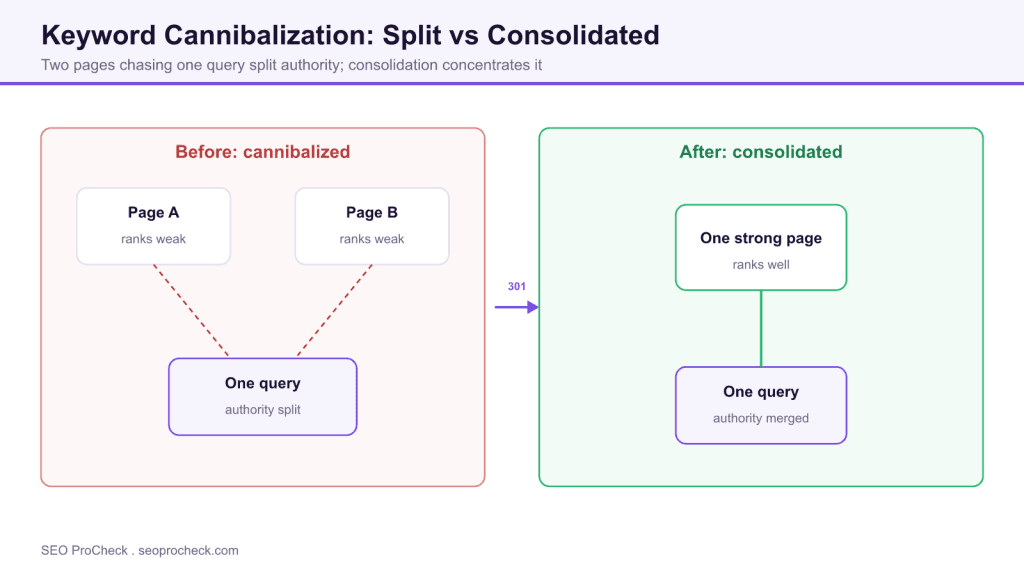
Keyword cannibalization happens when several of your own pages compete for the same query, splitting clicks, links, and ranking signals so none ranks as well as one focused page could. Fix it by consolidating the weaker pages into the strongest with 301 redirects, or by differentiating them to serve genuinely distinct intents.
- Diagnose it with a Search Console query where several URLs swap in and out and none holds a strong position.
- Confirm intent overlap: two pages for the same intent is cannibalization, two pages for distinct intents is healthy coverage.
- Consolidate with 301 redirects to the strongest URL, then repoint internal links to it.
- Prevent it with a keyword map that assigns one primary URL per target query.
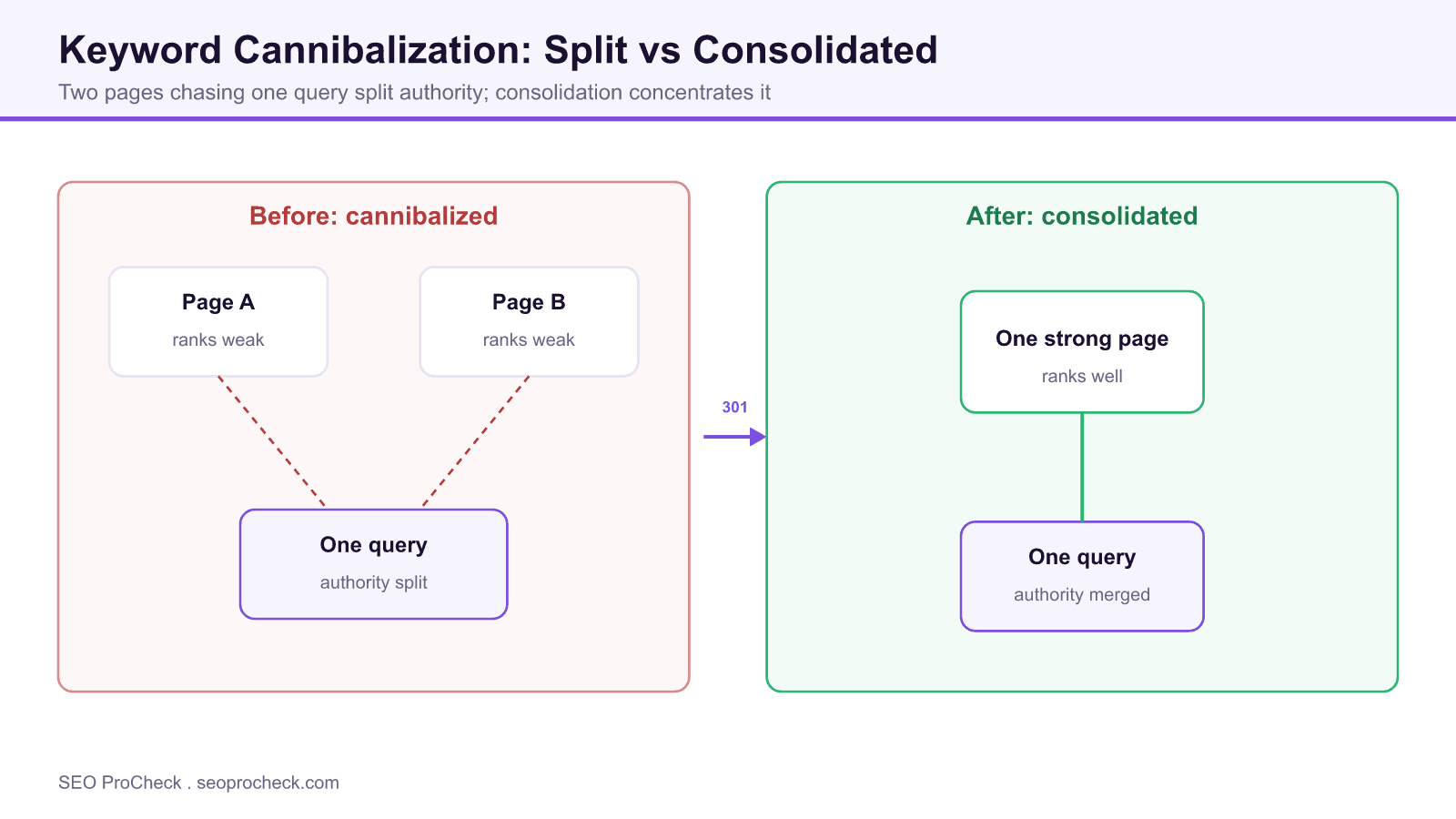
Research into keyword cannibalization examined how multiple pages targeting similar keywords affect rankings and what solutions prove most effective. The study analyzed ranking patterns before and after cannibalization resolution.
Identifying Cannibalization
Cannibalization detection focused on pages with significant ranking overlap where neither achieved strong positions. Common indicators included ranking fluctuations where different pages appeared for the same query, neither page ranking in top positions despite topical relevance, and impression data showing multiple pages for identical queries.
Impact on Rankings
True cannibalization cases showed measurable ranking suppression compared to sites with clear topical targeting. Link equity and authority signals split across multiple pages rather than concentrating on the strongest candidate. However, the study noted that multiple pages ranking for related but distinct intents is not cannibalization and can be beneficial.
Resolution Strategies
Consolidation through redirecting weaker pages to the strongest candidate showed consistent ranking improvements. Content differentiation to target distinct intents also proved effective where consolidation wasn't appropriate. Internal linking adjustments to clarify primary pages for specific topics helped search engines understand intended targeting.
Prevention Approaches
Content planning with clear keyword mapping prevented cannibalization. Regular audits identifying overlap allowed early intervention. Clear internal linking structures signaling page relationships helped Google understand content hierarchy and targeting intentions.
Source: Multiple keyword cannibalization studies compiled
How to detect cannibalization in Search Console
Open the Performance report, click into a target query, then add the Pages dimension. If two or more URLs collect impressions for the same query and each ranks in a mediocre position, you likely have cannibalization. A quick confirmation is a site:yourdomain.com "target phrase" search: if several near identical pages surface, they are competing with each other.
Confirm it is truly cannibalization
Overlap alone is not a problem. The test is intent. If both pages try to satisfy the same searcher need, they cannibalize. If one targets "keyword research tools" and another targets "how to do keyword research", they serve different intents and can both rank. Only consolidate when the pages genuinely compete for the same job.
Resolution playbook
Pick the fix that matches the situation rather than defaulting to deletion:
- Consolidate: merge the weaker page into the strongest and 301 redirect the old URL. Best when the pages are near duplicates.
- Differentiate: rewrite each page around a distinct intent and adjust titles and headings. Best when both intents deserve coverage.
- Canonicalize: keep both live for users but set
rel="canonical"from the secondary to the primary. Best when a page must exist for navigation but should not compete in search. - Repoint internal links: whichever fix you choose, update internal anchors to point at the page you want to rank.
When you use noindex or canonical directives as part of the fix, verify the exact syntax against the meta robots and X-Robots-Tag reference so the signal you send is the one you intend.
Which fix to use, and when
| Situation | Recommended fix | Why |
|---|---|---|
| Two near duplicate pages, one clearly stronger | 301 redirect the weaker to the stronger | Merges links and signals onto one URL |
| Both pages serve distinct intents | Differentiate titles, headings, and content | Preserves valid coverage for two needs |
| Secondary page needed for users but not search | rel=canonical to the primary | Keeps the page live while consolidating signals |
| Temporary overlap during a migration | Fix internal links and monitor | Often resolves once signals settle |
Prevention: keep a keyword map
Cannibalization is cheaper to prevent than to unwind. Maintain a simple keyword map that assigns exactly one primary URL to each target query before you brief new content. Run a quarterly overlap audit so you catch competing pages early, while a redirect is still low risk. Clear internal linking that consistently points a topic at its owner page reinforces the mapping for both users and crawlers.
This discipline is part of the same portfolio thinking that lets the largest publishers scale content without turning their own pages into competitors.
What has changed since these studies
The mechanics of cannibalization are stable, but the cost of leaving many weak, overlapping pages live has risen. Google's helpful content signals and site level quality assessments since 2023 mean a cluster of thin, competing pages can drag on a whole section, not just the individual URLs. Consolidating decisively is more valuable now than it was when these studies were first compiled.
Frequently Asked Questions
What is keyword cannibalization?
Keyword cannibalization is when two or more pages on the same site compete for the same query, splitting clicks, links, and ranking signals. The result is that none of the pages ranks as well as a single focused page could.
How do I find cannibalization?
In Search Console, open a target query and add the Pages dimension to see whether several URLs collect impressions for it. A site: search for the exact phrase is a fast confirmation that near duplicate pages are competing.
Is it always bad to rank two pages for one keyword?
No. If the two pages serve genuinely distinct intents, both can rank and that is healthy coverage. It is only a problem when both pages chase the same searcher need and end up splitting signals.
Should I use a 301 redirect or a canonical tag?
Use a 301 redirect when you are retiring the weaker page and want to merge it into the stronger one. Use a canonical when the secondary page must stay live for users but should not compete in search.
How do I prevent cannibalization?
Keep a keyword map that assigns one primary URL per target query before you create content, audit for overlap each quarter, and use internal links that consistently point a topic at its owner page.
Does fixing cannibalization improve rankings?
Often yes. Consolidating link equity and relevance onto one strong page frequently lifts it above where either competing page ranked, and it can unlock featured snippets the weaker pages were too diluted to win.
Take this with you
The assistant links open with a question about this page already written. Nothing is sent until you press enter.
Claude Vincent is a technical SEO consultant focused on crawlability, rendering, and AI-search visibility. He writes the field guides and case studies at SEO ProCheck, with a bias toward the durable, unglamorous work that decides whether search engines and AI answer engines can actually read and cite a site.
About SEO ProCheck
Technical SEO consulting and GEO strategy with 20 years of enterprise experience. Case studies, resources, and tools for search and AI visibility.
Work With Me
Technical SEO audits, GEO strategy, site migrations, and international SEO. Hourly consulting for teams who need hands-on support, not just reports.
Subscribe to our newsletter!








Recent Posts
- Most Top Sites Never Say Who They Are in Structured Data October 14, 2026
- Homepage Titles Are Mostly Too Short, Not Too Long October 8, 2026
- Who Actually Serves an llms.txt? 184 Top Sites Measured September 29, 2026