AI Summary
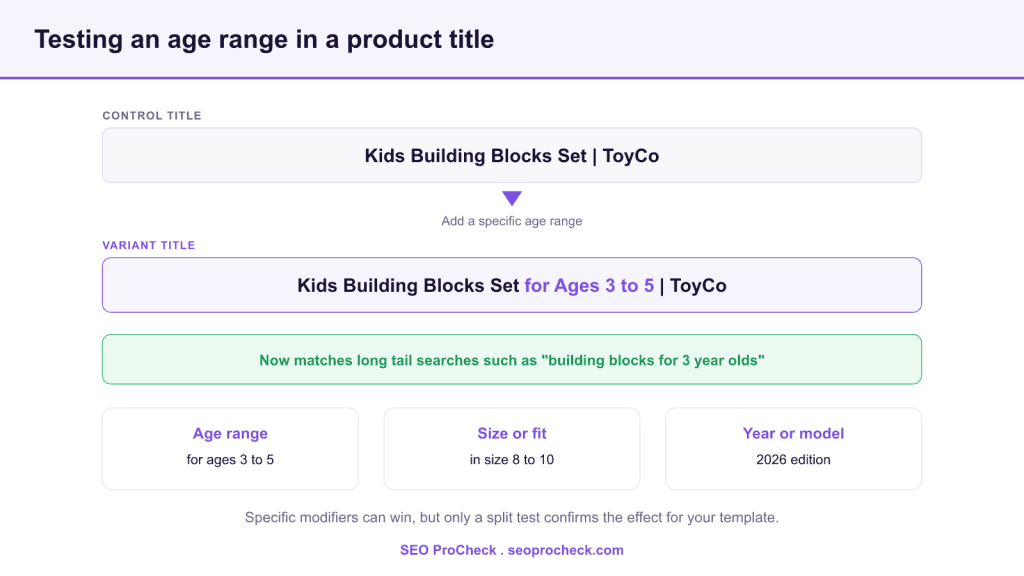
Adding an age range such as for ages 3 to 5 to a product or category title can win traffic by matching the specific way people search, but the effect depends on your catalog and query patterns. Because it varies, the dependable answer comes from a controlled SEO split test rather than a rule of thumb, which is the method the source experiment used.
- A specific modifier like an age range can match long tail queries such as toys for 3 year olds.
- It works best where searchers really use that attribute, mainly kids, apparel, and gift categories.
- The cost is title length and the risk of near duplicate titles across a template, so test before rolling out.
- Run a split test on a set of similar pages, change only the title, and compare organic sessions.
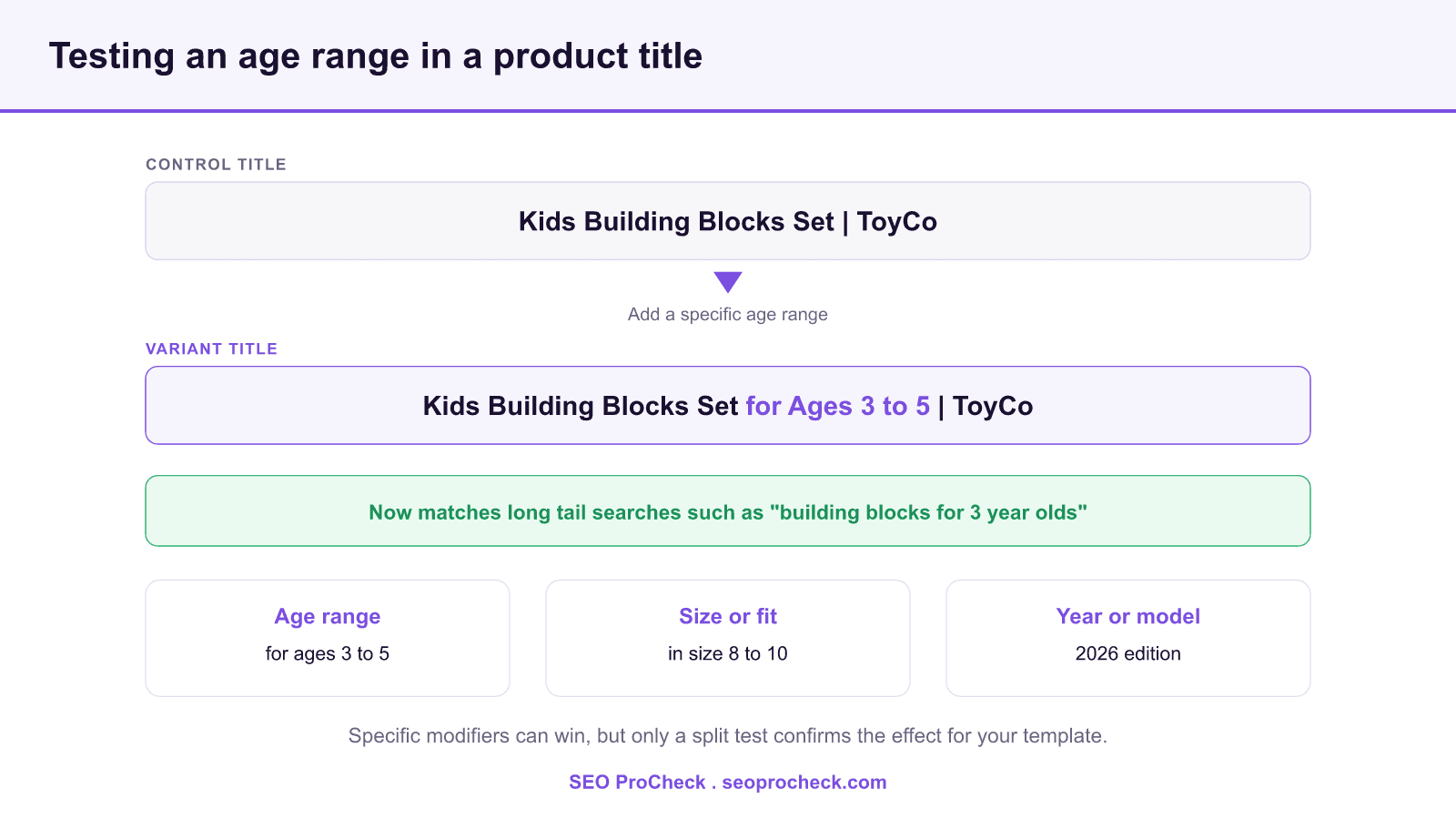
The linked experiment tests a precise question: does adding an age range to titles increase organic traffic? This page explains why a specificity modifier can help, where it tends to work, and how to run and read the test on your own pages. The source keeps the measured numbers; here you get the reasoning and the method so you can judge whether the idea fits your catalog.
Why a specific modifier can win traffic
People often search with the exact attribute that matters to them. A parent does not search for building blocks, they search for building blocks for a 3 year old. When your title contains the same specific qualifier, it matches that intent more closely, which can lift both relevance for long tail queries and click through rate, because the result reads as an exact fit. An age range is one of a family of specificity modifiers, alongside size or fit ranges, model years, quantities, and use cases. Each adds precision that can capture the searcher who knows exactly what they want.
Where age ranges tend to help, and where they do not
- Strong fit: toys, childrens clothing and shoes, books, and gifts, where buyers routinely filter by age.
- Weak fit: categories where age is irrelevant to the purchase, where the modifier just adds length and clutter.
- Watch for duplication: if a whole template gets the same range, titles can become near duplicates that do not distinguish pages.
- Mind the truncation: the range pushes your primary term right, so keep the core keyword near the front.
How to run the split test
Treat this as an SEO split test on a page group, not a user facing A/B test, because a URL has one version for the crawler. The process:
- Choose a template with enough comparable pages to reach significance, for example a childrens product category.
- Randomly split the pages into a control set and a variant set so they are balanced.
- Add the age range to the variant titles only, in a consistent, readable position, and change nothing else.
- Run both groups across a full cycle of weeks, then compare organic sessions or clicks, modelling the variant against the expected performance of the control.
- Report a confidence interval and act only on a statistically significant result.
Specificity modifiers worth testing
| Modifier | Example | Best fit categories |
|---|---|---|
| Age range | for ages 3 to 5 | Toys, kids books, gifts |
| Size or fit | in size 8 to 10 | Apparel, footwear |
| Model year | 2026 edition | Electronics, vehicles, guides |
| Quantity | pack of 12 | Consumables, supplies |
| Use case | for small kitchens | Home, tools, appliances |
Reading the result and what has changed
If the variant shows a significant lift, roll the modifier out to the template and test the next candidate. If it is flat, revert to the cleaner title. If it is negative, the range likely pushed the keyword too far or created duplicate titles, so remove it. Keep in mind that Google rewrites displayed titles when it judges its own version better, so a modifier you add may not always be shown. That makes measured testing more reliable than assumption. For related guidance, see our checks on titles and meta descriptions that duplicate each other and pages with multiple title tags, plus our note on pogosticking, which can erase a click through gain if the page does not match the promise in the title.
Frequently asked questions
They can, especially in categories where buyers search by age such as toys, kids clothing, and gifts, because the title matches long tail queries like toys for 3 year olds. The effect varies by catalog, so a split test is the reliable way to decide.
Keep your primary keyword near the front and add the age range after it, for example Kids Building Blocks Set for Ages 3 to 5. This preserves relevance while still matching the specific query, and it reduces the chance the core term is truncated.
It can. A modifier uses part of the roughly 60 character budget, so watch for truncation and for the keyword being pushed right. If the range costs you the visible keyword, the click through gain may not be worth it, which a test will show.
Beyond age ranges, test size or fit ranges, model years, quantities like pack of 12, and use case phrases such as for small kitchens. Each adds specificity that can match how people actually search in the right category.
It can hurt if the same range is applied across a template and creates near duplicate titles, or if it pushes the primary keyword out of view. A controlled split test flags a negative result so you can revert before rolling it out.
Split a group of comparable pages into control and variant sets, add the age range to the variant titles only, keep everything else the same, and compare organic sessions over a full set of weekly cycles. Act only if the result is statistically significant.
Case study summary and source
This SEO case study documents a successful optimization initiative, providing actionable insights for practitioners. The documented approach demonstrates how strategic SEO implementation drives measurable results.
Initial Situation
Understanding the starting point is essential context for evaluating any case study. This documentation covers the initial challenges, competitive position, and business objectives that shaped the SEO strategy.
Strategy and Approach
The strategic approach combined multiple SEO disciplines to address identified opportunities. Key decisions around prioritization and resource allocation provide a template for similar initiatives.
Implementation
Moving from strategy to execution required specific technical implementations, content development, and process changes. This case study documents the practical steps that translated strategy into action.
Results and Learnings
The outcomes demonstrate effectiveness through measurable improvements in rankings, traffic, and business metrics. Analysis of successes and challenges provides learning value for practitioners.
Case studies like this contribute to the SEO knowledge base, helping practitioners learn from documented real-world experiences.
Claude Vincent is a technical SEO consultant focused on crawlability, rendering, and AI-search visibility. He writes the field guides and case studies at SEO ProCheck, with a bias toward the durable, unglamorous work that decides whether search engines and AI answer engines can actually read and cite a site.
About SEO ProCheck
Technical SEO consulting and GEO strategy with 20 years of enterprise experience. Case studies, resources, and tools for search and AI visibility.
Work With Me
Technical SEO audits, GEO strategy, site migrations, and international SEO. Hourly consulting for teams who need hands-on support, not just reports.
Subscribe to our newsletter!