• Articles
    &Evergreen
    • Articles
      • Algorithm Updates
      • Analytics & Measurement
      • CMS and Platforms
      • Content Strategy
      • E-commerce SEO
      • General
      • Industry Guides
      • Keyword Research
      • Link Building
      • Local SEO
      • Mobile SEO
      • On-Page SEO
      • SEO Tools
    • Evergreen
      • AI and Search
        • AEO (Answer Engine Optimization)
        • AI Overviews and SGE
        • GEO (Generative Engine Optimization)
        • LLM Citation Optimization
      • Content SEO
        • Content Architecture
        • E-E-A-T Optimization
        • Internal Linking Strategy
      • Python and Automation
      • Technical SEO
        • Core Web Vitals and Performance
        • Crawlability and Indexation
        • International SEO and Hreflang
        • Log File Analysis
        • Schema and Structured Data
        • Site Architecture
        • Site Migrations
  • Case Studies
    & Researches
    • Case Studies
      • Content
      • Crawling and Indexing
      • Growth
      • International SEO
      • JavaScript SEO
      • Metadata
      • Migrations
      • Website Architecture
      • Web Performance
    • Research
      • AI Search
      • Cross-Industry
      • E-commerce
      • Enterprise
      • Local and Listings
      • Publisher
  • Free Tools
    & Resources
    • Free SEO Tools
      • Content Analysis
      • Developer Utilities
      • GEO & AI Visibility
      • Local SEO
      • Schema & Structured Data
      • Social & Meta
      • Technical SEO
    • Executive Briefings
      • What SEO Actually Is
      • Why SEO Takes Time
      • Technical vs Content SEO
      • What AI Search Changes
      • Is Your SEO Working?
      • Case Studies
      • Is It Worth It?
      • Hiring an Agency
      • SEO vs Paid
      • Resourcing SEO
    • Best Practices
      • Accessibility
      • AMP
      • Content & GEO
      • Duplicates
      • HTML Structure
      • hrefLang
      • Images
      • Indexation
      • Links
      • Mobile
      • On-Page SEO
      • Organic & Analytics
      • Performance
      • Redirections
      • Robots.txt
      • Security
      • Structured Data
      • Technical GEO
      • URLs
      • XML Sitemaps
    • FAQ
      • AI & Search FAQ
      • Technical SEO FAQ
      • Content SEO FAQ
      • Off-Page SEO FAQ
      • Local SEO FAQ
      • E-commerce SEO FAQ
      • Tools and Analytics FAQ
    • Glossary
      • Glossary | Algorithms
      • Glossary | Analytics
      • Glossary | Business
      • Glossary | Content SEO
      • Glossary | E-commerce
      • Glossary | Emerging
      • Glossary | GEO & AI SEO
      • Glossary | International SEO
      • Glossary | Link Building
      • Glossary | Local SEO
      • Glossary | Search Behavior
      • Glossary | Technical SEO
      • Glossary | Tools
  • Free Tools Hub
  • About
    Me
    • Consulting
      • Advanced SEO Audit
      • GEO & AI SEO
      • Performance & Indexation
      • Site Migrations
      • International SEO
    • Portfolio
    • Contact
    • Tools & Resources
    • Browser Extensions
  • Articles
    &Evergreen
    • Articles
      • Algorithm Updates
      • Analytics & Measurement
      • CMS and Platforms
      • Content Strategy
      • E-commerce SEO
      • General
      • Industry Guides
      • Keyword Research
      • Link Building
      • Local SEO
      • Mobile SEO
      • On-Page SEO
      • SEO Tools
    • Evergreen
      • AI and Search
        • AEO (Answer Engine Optimization)
        • AI Overviews and SGE
        • GEO (Generative Engine Optimization)
        • LLM Citation Optimization
      • Content SEO
        • Content Architecture
        • E-E-A-T Optimization
        • Internal Linking Strategy
      • Python and Automation
      • Technical SEO
        • Core Web Vitals and Performance
        • Crawlability and Indexation
        • International SEO and Hreflang
        • Log File Analysis
        • Schema and Structured Data
        • Site Architecture
        • Site Migrations
  • Case Studies
    & Researches
    • Case Studies
      • Content
      • Crawling and Indexing
      • Growth
      • International SEO
      • JavaScript SEO
      • Metadata
      • Migrations
      • Website Architecture
      • Web Performance
    • Research
      • AI Search
      • Cross-Industry
      • E-commerce
      • Enterprise
      • Local and Listings
      • Publisher
  • Free Tools
    & Resources
    • Free SEO Tools
      • Content Analysis
      • Developer Utilities
      • GEO & AI Visibility
      • Local SEO
      • Schema & Structured Data
      • Social & Meta
      • Technical SEO
    • Executive Briefings
      • What SEO Actually Is
      • Why SEO Takes Time
      • Technical vs Content SEO
      • What AI Search Changes
      • Is Your SEO Working?
      • Case Studies
      • Is It Worth It?
      • Hiring an Agency
      • SEO vs Paid
      • Resourcing SEO
    • Best Practices
      • Accessibility
      • AMP
      • Content & GEO
      • Duplicates
      • HTML Structure
      • hrefLang
      • Images
      • Indexation
      • Links
      • Mobile
      • On-Page SEO
      • Organic & Analytics
      • Performance
      • Redirections
      • Robots.txt
      • Security
      • Structured Data
      • Technical GEO
      • URLs
      • XML Sitemaps
    • FAQ
      • AI & Search FAQ
      • Technical SEO FAQ
      • Content SEO FAQ
      • Off-Page SEO FAQ
      • Local SEO FAQ
      • E-commerce SEO FAQ
      • Tools and Analytics FAQ
    • Glossary
      • Glossary | Algorithms
      • Glossary | Analytics
      • Glossary | Business
      • Glossary | Content SEO
      • Glossary | E-commerce
      • Glossary | Emerging
      • Glossary | GEO & AI SEO
      • Glossary | International SEO
      • Glossary | Link Building
      • Glossary | Local SEO
      • Glossary | Search Behavior
      • Glossary | Technical SEO
      • Glossary | Tools
  • Free Tools Hub
  • About
    Me
    • Consulting
      • Advanced SEO Audit
      • GEO & AI SEO
      • Performance & Indexation
      • Site Migrations
      • International SEO
    • Portfolio
    • Contact
    • Tools & Resources
    • Browser Extensions
consulting services
Home / Metadata / SEO Title Tag Optimization at Etsy: Experimental Design and Causal Inference

SEO Title Tag Optimization at Etsy: Experimental Design and Causal Inference

  • November 25, 2016
  • Metadata
No Comments
Seo title tag optimization at etsy: experimental design and causal inference

AI Summary

You cannot A/B test a title tag the way you test a button, because Google sees one version of a URL, not one per visitor. This case study documents how a large marketplace measured title tag changes properly: split comparable pages into a control group and a variant group, change only the variant, and read the causal lift with a difference in differences model that cancels out seasonality and algorithm noise.

  • The unit of an SEO experiment is the page, not the user.
  • A matched control group absorbs seasonality, trends, and core updates.
  • Difference in differences isolates the title effect from everything else moving at once.
  • Without a control, a before and after chart cannot prove the title caused the change.
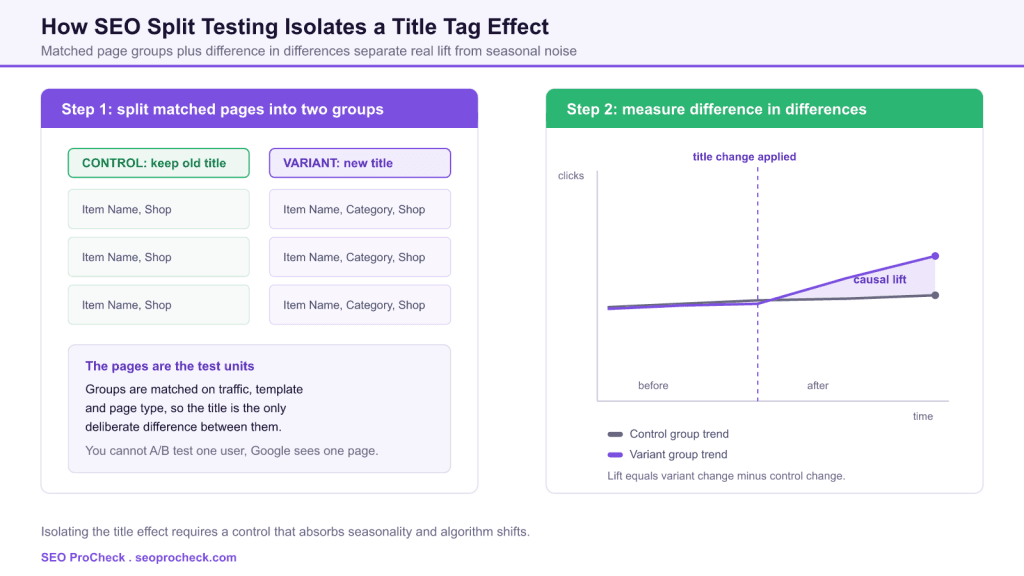
Diagram of an seo title tag split test with matched pages divided into control and variant groups and a difference in differences chart showing the causal lift after the new title is applied.
An SEO title tag split test compares matched control and variant page groups, then reads the causal lift as the gap between their trends.

Rewriting title tags is one of the highest leverage changes in SEO, and also one of the easiest to fool yourself about. Traffic moves for a dozen reasons at once, so a title change followed by a rankings bump proves nothing on its own. This case study documents a disciplined answer to that problem: treat the title change as a controlled experiment, with a proper control group and a causal model, so the measured lift can be trusted.

Why classic A/B testing does not work for SEO

A conversion rate test randomizes people. Half of your visitors see version A, half see version B, and because the two audiences are otherwise identical you can attribute any difference to the design. SEO breaks that model. Googlebot crawls one version of a URL, ranks it, and sends every searcher to the same page. You cannot show Google a randomized mix of titles for the same URL, and you cannot split searchers before they ever reach you. The lever you can pull is which pages get the new treatment.

The unit of the experiment is the page

The workable design randomizes at the page level. Take a large set of similar pages, product listings, category pages, or templated detail pages, and split them into two matched groups. One group, the control, keeps the current title. The other, the variant, gets the new title formula. Because both groups are drawn from the same template and traffic profile, the title is the only deliberate difference between them, which is exactly the condition that lets you reason about cause.

Matching matters. If the variant group happens to hold your highest traffic pages, its numbers will look better no matter what the title says. Good tests balance the groups on pre-period traffic, page type, and seasonality exposure before a single title changes.

Difference in differences: reading the causal lift

Once the change is live, you do not simply compare the variant group before and after. You compare how the variant moved against how the control moved over the same window. That is the difference in differences method. The control group captures everything that affects both groups at once: seasonal demand, a core update, tracking changes, a site wide template tweak. Subtract the control trend from the variant trend and what remains is the part attributable to the title.

Experiment designHow it handles seasonality and updatesMain limitation
Single page before and afterIt does not, any external change is baked into the resultCannot separate the title from anything else that moved
Matched control group, difference in differencesThe control absorbs shared trends, so they cancel outNeeds enough comparable pages to build a stable control
Randomized page level split testRandomization balances known and unknown factors across groupsRequires a large templated page set and test tooling

Statistical significance still applies. A handful of pages produces a noisy estimate that can flip week to week, so tests need enough pages and enough time for the signal to separate from the variance. The wider the natural swing in your clicks, the larger the sample you need before a lift is believable.

What teams actually change in a title

The method is only useful if the treatment is well defined. Common title tag hypotheses worth testing include the position of the brand name, whether a category or attribute is appended, adding a modifier such as a year or a price cue, front loading the primary keyword, and trimming length so the title is not truncated in the results. Each of these is a clean, isolatable variable, which is what makes it a good candidate for a controlled test rather than a guess.

Pitfalls that quietly invalidate an SEO title test

  • A contaminated control. If a site wide change touches the control pages too, they no longer represent the counterfactual.
  • Cannibalization. When variant and control pages compete for the same queries, improving one can depress the other and hide the true effect.
  • Too small a sample. Few pages or a short window leaves the estimate dominated by noise.
  • Seasonality mismatch. Groups exposed to different seasonal demand will diverge for reasons that have nothing to do with the title.
  • Reading rank instead of clicks. Average position is volatile and query dependent, so clicks and impressions from Search Console are usually the sturdier outcome.

The same experimentation logic recurs across technical SEO. See how a controlled comparison is used in SEO split testing on React product pages, and how a timed test measured indexing speed in the JavaScript indexing drag race.

This SEO case study documents a successful optimization initiative, providing actionable insights for practitioners. The documented approach demonstrates how strategic SEO implementation drives measurable results.

Initial Situation

Understanding the starting point is essential context for evaluating any case study. This documentation covers the initial challenges, competitive position, and business objectives that shaped the SEO strategy.

Strategy and Approach

The strategic approach combined multiple SEO disciplines to address identified opportunities. Key decisions around prioritization and resource allocation provide a template for similar initiatives.

Implementation

Moving from strategy to execution required specific technical implementations, content development, and process changes. This case study documents the practical steps that translated strategy into action.

Results and Learnings

The outcomes demonstrate effectiveness through measurable improvements in rankings, traffic, and business metrics. Analysis of successes and challenges provides learning value for practitioners.

Case studies like this contribute to the SEO knowledge base, helping practitioners learn from documented real-world experiences.

Source: https://codeascraft.com/2016/10/25/seo-title-tag-optimization/

FAQ

Can you A/B test title tags the way you test a landing page?

Not directly. Google crawls and ranks one version of a URL and sends every searcher to it, so you cannot randomize visitors. SEO tests randomize at the page level instead, splitting a set of similar pages into a control group and a variant group.

What is difference in differences in an SEO test?

It is a method that compares how the variant group changed against how the control group changed over the same period. Subtracting the control trend removes seasonality, core updates, and other shared movement, leaving the portion of the change attributable to the title.

Why do I need a control group if I already have before and after data?

Because a before and after chart cannot tell you what would have happened anyway. Traffic shifts for many reasons at once, and only a comparable control that experienced those same forces lets you separate the title effect from the background.

How many pages do I need for a reliable title tag test?

Enough that the natural week to week variance in clicks is small relative to the lift you expect. There is no single number, but a handful of pages is almost always too few, and templated page sets in the hundreds or thousands give the sturdiest estimates.

Should I measure rankings or clicks?

Clicks and impressions from Search Console are usually more reliable than average position, which is volatile and varies by query and location. Title changes affect both how you rank and how often people click, and clicks capture that combined effect.

What most often ruins an SEO title tag experiment?

A contaminated control that was also changed, cannibalization between variant and control pages, too small a sample, and seasonality that hits the groups unevenly. Each of these lets an outside force masquerade as a title effect.

  • Claude Vincent

Claude Vincent is a technical SEO consultant focused on crawlability, rendering, and AI-search visibility. He writes the field guides and case studies at SEO ProCheck, with a bias toward the durable, unglamorous work that decides whether search engines and AI answer engines can actually read and cite a site.

  • Enterprise, Marketplaces, Title Tags

About SEO ProCheck

Technical SEO consulting and GEO strategy with 20 years of enterprise experience. Case studies, resources, and tools for search and AI visibility.

Learn more about me

Work With Me

Technical SEO audits, GEO strategy, site migrations, and international SEO. Hourly consulting for teams who need hands-on support, not just reports.

Contact now

Subscribe to our newsletter!

More from our blog


Diagram of the agent-readable file stack showing AGENTS.md in the code repository read by coding agents, llms.txt and llms-full.txt at the website root read by answer engines, and robots.txt plus RSL as the access and licensing layer beneath both.

AGENTS.md vs llms.txt vs llms-full.txt: Which Agent File Does What

AGENTS.md, llms.txt and llms-full.txt look alike but serve different readers. What each…
Continue reading

Profound vs Semrush and Ahrefs: What an AI-Search Tool Actually Replaces (and What It Doesn't)

Profound vs Semrush and Ahrefs don't measure the same thing. A practitioner's…
Continue reading
SEO is the foundation everything is built on; AEO (be the answer) and GEO (get cited) are what it makes possible

SEO vs AEO vs GEO: What Each One Means and How They Actually Differ

SEO, AEO, and GEO are three different jobs: rank in search results,…
Continue reading
Google May 2026 Core Update: What We Learned After the Dust Settled

Google May 2026 Core Update: What We Learned After the Dust Settled

The May 2026 Core Update rolled out from May 21 to June…
Continue reading
Pogosticking: The Click Pattern That Quietly Decides Who Ranks

Pogosticking: The Click Pattern That Quietly Decides Who Ranks

Pogosticking is when a searcher clicks your result, bounces back to Google,…
Continue reading
Interaction to Next Paint (INP): The Complete Guide

Interaction to Next Paint (INP): The Complete Guide

Interaction to Next Paint (INP) is the Core Web Vital that replaced…
Continue reading
SSR vs CSR: Why Rendering Decides Whether AI Can Read Your Site

SSR vs CSR: Why Rendering Decides Whether AI Can Read Your Site

AI crawlers mostly don't run JavaScript, so client-side rendering hides your content…
Continue reading
Which AI Bots Are You Actually Blocking? (GPTBot, ClaudeBot, Perplexity & More)

Which AI Bots Are You Actually Blocking? (GPTBot, ClaudeBot, Perplexity & More)

Blocking 'AI bots' isn't one switch. A field guide to GPTBot, OAI-SearchBot,…
Continue reading
Prev. Post
Next Post

Recent Posts

  • AGENTS.md vs llms.txt vs llms-full.txt: Which Agent File Does What July 18, 2026
  • Profound vs Semrush and Ahrefs: What an AI-Search Tool Actually Replaces (and What It Doesn't) June 19, 2026
  • SEO vs AEO vs GEO: What Each One Means and How They Actually Differ June 15, 2026

All Website Tags

AI SEO Analytics B2B Batch Check Content Analysis Content Quality Content Strategy Core Web Vitals Crawl Budget Crawling DOM Parsing E-commerce E-E-A-T Enterprise FAQ GEO Googlebot Google Search Console High Priority Hreflang HTTP Requests Indexing Internal Linking International SEO JavaScript SEO Keyword Research Link Building Live Check Local SEO Low Priority Medium Priority Multiple APIs On-Page SEO Page Speed PageSpeed API Rich Results SaaS Schema Validation SEO Tools SERP Features Site Architecture Site Migrations Structured Data Technical SEO Title Tags

Technical SEO consulting and GEO strategy for teams who need real implementation support. 20 years of enterprise experience across major media, technology, recruitment, and ecommerce brands, and a major enterprise brand. Case studies, research, and resources for search and AI visibility.

SEO Geek since 2004. © All Rights Reserved.

Sitemap for Humans  |  Privacy Policy   |  Terms of Service