

Answer Engine Optimization (AEO): Complete Strategy Guide
- June 2, 2024
- AEO (Answer Engine Optimization), AI and Search
AI Summary
Answer Engine Optimization (AEO) shapes content so it is selected as a direct answer across featured snippets, AI Overviews, voice assistants, and AI search engines. It complements SEO by targeting the answer surfaces that resolve queries without a click, using clear structure, direct responses, and demonstrable accuracy.
- Build content around real questions and lead each section with a direct answer in 40 to 60 words.
- Match the format to the answer type: paragraphs for definitions, lists for steps, tables for comparisons.
- Write so answers stand alone: define acronyms, keep the question in the answer, avoid opening with a brand name.
- Measure snippet ownership, People Also Ask presence, and AI citations, since one answer can serve many surfaces.
What is Answer Engine Optimization
Answer Engine Optimization (AEO) focuses on optimizing content to be selected as direct answers by search engines, voice assistants, and AI systems. While SEO aims for high rankings, AEO specifically targets featured snippets, People Also Ask boxes, voice search responses, and AI-generated answers. As search evolves toward providing instant answers rather than links, AEO represents an essential evolution of optimization strategy that complements traditional SEO approaches.
The Answer Ecosystem
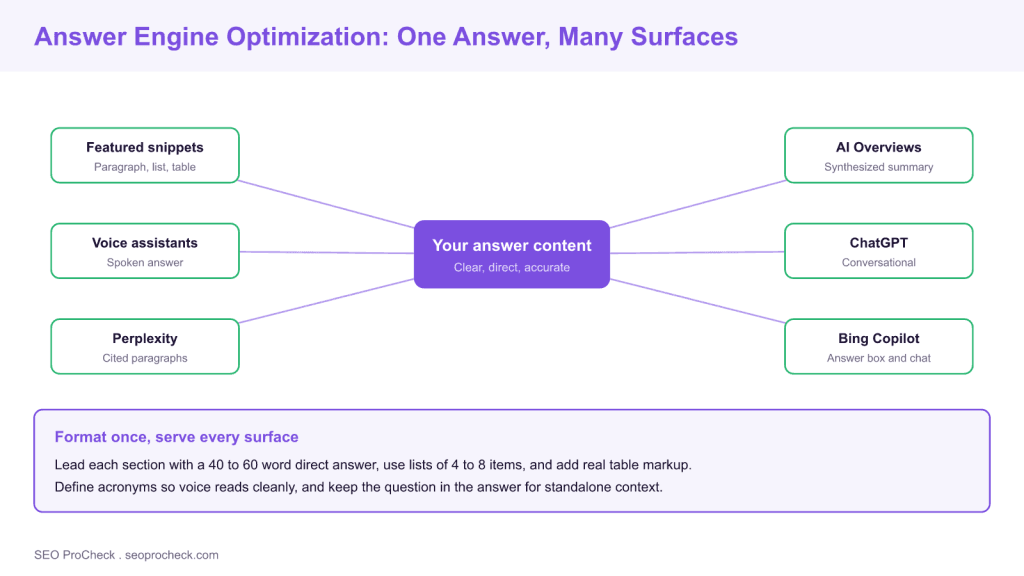
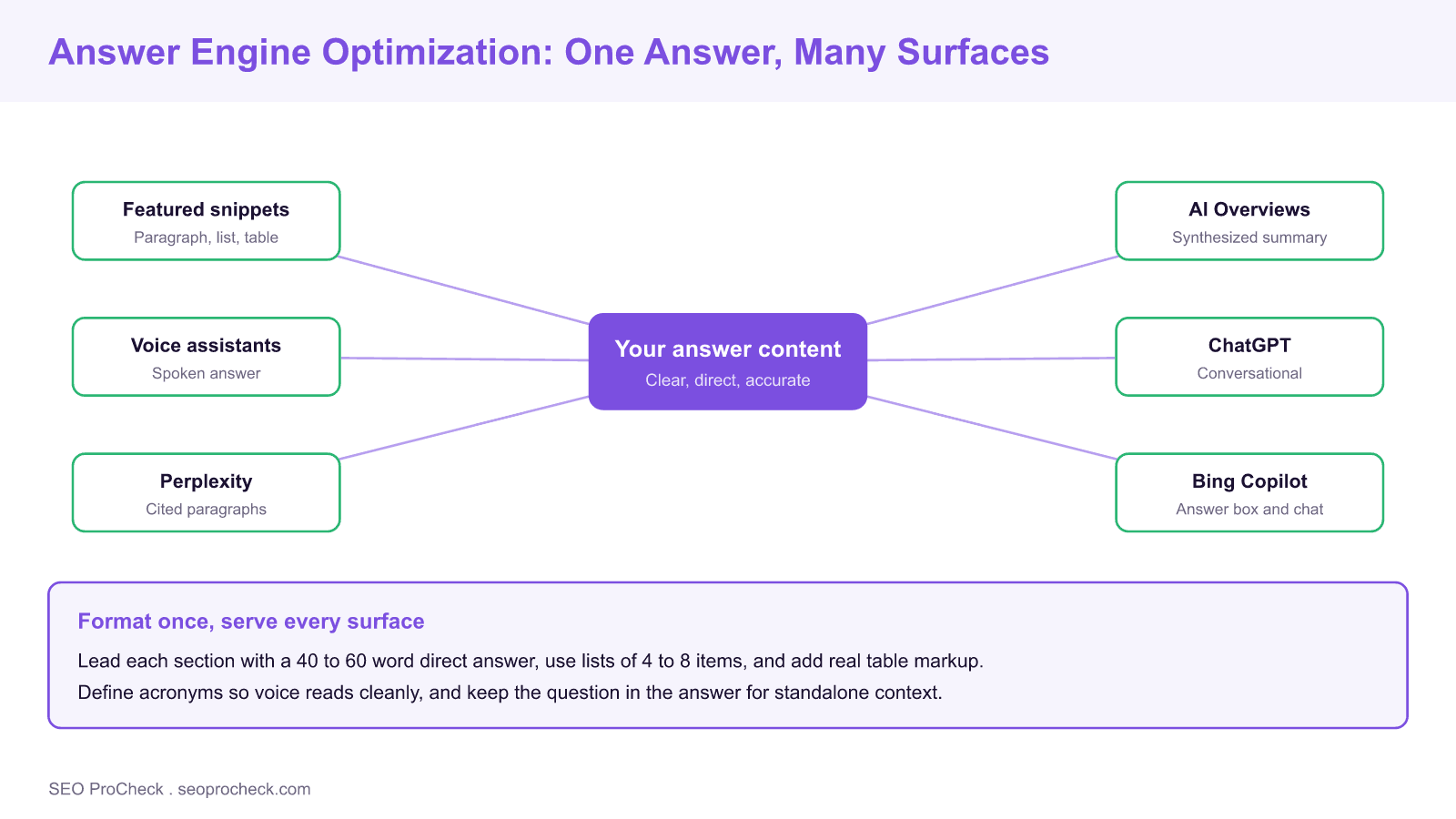
Multiple platforms now provide direct answers: Google Featured Snippets and AI Overviews, Bing's answer boxes, voice assistants (Alexa, Siri, Google Assistant), and AI search engines (Perplexity, ChatGPT). Each platform has distinct selection criteria and content presentation formats. Effective AEO considers the entire ecosystem rather than optimizing for a single platform. Content that performs well as answers tends to share characteristics: clear structure, direct responses, factual accuracy, and comprehensive coverage.
| Platform | Answer Format | Primary Content Source |
|---|---|---|
| Google Featured Snippets | Paragraph, list, table | Top-ranking pages |
| Google AI Overviews | Synthesized summary | Multiple authoritative sources |
| Voice Assistants | Spoken response | Featured snippets, knowledge graph |
| Perplexity AI | Cited paragraphs | Real-time web search |
| ChatGPT | Conversational | Training data + web search |
| Bing | Answer box, chat | Indexed pages, knowledge sources |
Question-First Content Strategy
Build content around questions your audience actually asks. Use keyword research tools to identify question-format queries with sufficient volume. Analyze "People Also Ask" for related questions to address. Structure content with questions as headers followed by direct answers in the first 1-2 sentences, then elaboration. Create content for the full question journey from basic definitions to advanced topics. FAQ sections consolidate quick answers while dedicated pages provide comprehensive coverage for complex questions.
Answer Formatting Best Practices
Format content for easy answer extraction. For paragraph snippets: answer in 40-60 words, place directly after the question header. For list snippets: use numbered or bulleted lists with 4-8 items. For table snippets: use proper HTML table markup with clear headers. Voice search optimization requires answers that sound natural when spoken (avoid abbreviations, define acronyms). Include the question or topic in the answer for context when extracted. Avoid starting answers with "I" or brand names that break snippet context.
Measuring AEO Success
Track featured snippet ownership for target queries using rank tracking tools that identify SERP features. Monitor "People Also Ask" presence using specialized tracking. Measure voice search performance through Smart Speaker testing (asking queries and noting which sources are cited). Track zero-click metrics in Search Console (high impressions, low clicks may indicate answer provision). Compare click-through rates for queries where you own featured snippets versus regular results. Monitor AI search citations using emerging visibility tools and manual testing.
New & related: SEO vs AEO vs GEO: what each one means and how they actually differ.
Building an Answer Inventory
Treat AEO as a content operation rather than a one time edit. Start by mining questions from People Also Ask, autocomplete, on site search logs, and sales or support tickets, then group them by intent so related questions live on the same page. For each question, write a self contained answer of roughly 40 to 60 words, choose the format that fits, and place it immediately under a heading phrased as the question. Because the same passage can be lifted by different engines, formatting it well once pays off across every surface shown in the diagram above.
| Answer Type | Best Format | Length Target | Placement |
|---|---|---|---|
| Definition or explanation | Short paragraph | 40 to 60 words | Directly under the question heading |
| Process or steps | Numbered list | 4 to 8 steps | After a one line intro |
| Comparison | HTML table | 3 to 6 rows | Near the top of the section |
| Yes or no question | Lead with the verdict | One to two sentences | First line of the answer |
| Voice friendly answer | Spoken style sentence | One to two sentences | Acronyms defined in place |
Tracking Answer Ownership
Measure the surfaces you can see and sample the ones you cannot. Rank trackers that flag SERP features tell you which queries you own as featured snippets and where People Also Ask appears. For AI search engines, run periodic manual checks: ask your target questions in Perplexity, ChatGPT with browsing, and Google AI Overviews, and note which sources are cited. In Search Console, a pattern of high impressions with low clicks on question queries can signal that an answer surface is satisfying users before they click. AEO overlaps heavily with overview strategy, so pair this with the AI Overviews optimization guide, and use structured FAQ schema to make your question and answer pairs easier for engines to extract.
Frequently Asked Questions
What is the difference between AEO and SEO?
SEO aims to rank pages highly in the list of results, while AEO shapes content to be chosen as the direct answer in snippets, AI Overviews, voice responses, and AI chat. They overlap heavily, since answer surfaces usually draw from pages that already rank well, so AEO complements rather than replaces SEO.
How do I optimize content for featured snippets?
Place a direct answer immediately under a heading that matches the query, keep paragraph answers to about 40 to 60 words, and use numbered or bulleted lists for steps and proper table markup for comparisons. Snippets are usually pulled from pages already ranking on the first page.
Does AEO help with voice search?
Yes. Voice assistants often read from featured snippets and knowledge sources, so a concise, spoken style answer that defines acronyms and avoids abbreviations improves voice results. Keeping the question context inside the answer helps it make sense when read aloud in isolation.
How is AEO measured?
Track featured snippet ownership and People Also Ask presence with rank tracking tools that detect SERP features, watch zero click patterns in Search Console, and manually test AI engines to see which sources are cited. There is no single dashboard, so combine automated tracking with periodic manual checks.
What content format wins the most answers?
There is no single winner. Definitions win with short paragraphs, processes win with numbered lists, and comparisons win with tables. Matching the format to the question, then leading with a direct answer, is what consistently gets content selected across surfaces.
Do I need separate pages for every question?
No. Group related questions on a single comprehensive page and use FAQ sections for quick answers, reserving dedicated pages for complex topics that need depth. Consolidating related questions avoids thin content while still giving each question a clear, extractable answer.
Claude Vincent is a technical SEO consultant focused on crawlability, rendering, and AI-search visibility. He writes the field guides and case studies at SEO ProCheck, with a bias toward the durable, unglamorous work that decides whether search engines and AI answer engines can actually read and cite a site.
About SEO ProCheck
Technical SEO consulting and GEO strategy with 20 years of enterprise experience. Case studies, resources, and tools for search and AI visibility.
Work With Me
Technical SEO audits, GEO strategy, site migrations, and international SEO. Hourly consulting for teams who need hands-on support, not just reports.
Subscribe to our newsletter!







Recent Posts
- Can AI Crawlers Actually Read Your Site? I Measured 400 of the Biggest September 5, 2026
- The Pre-Publish Quality Gate for AI-Assisted Content August 6, 2026
- AGENTS.md vs llms.txt vs llms-full.txt: Which Agent File Does What July 18, 2026