


AI Summary
Google AI Overviews cite pages that already rank in the classic top 10: 76% of citations come from the first ten results, and position 1 carries a 33% citation probability. The fastest route to AI Overview citations is strong organic SEO plus structural choices, schema, tables and tight answers, that make your content easy for a model to lift.
- 76% of AI Overview citations come from Google top 10 results (Ahrefs).
- Position 1 gives 33% citation odds versus 13% at position 10, a 2.5x gap.
- FAQPage schema correlates with 3.2x higher AI Overview appearance, tables with 2.5x more citations.
- Brand mentions correlate with AI visibility (0.664) far more than backlinks (0.218).
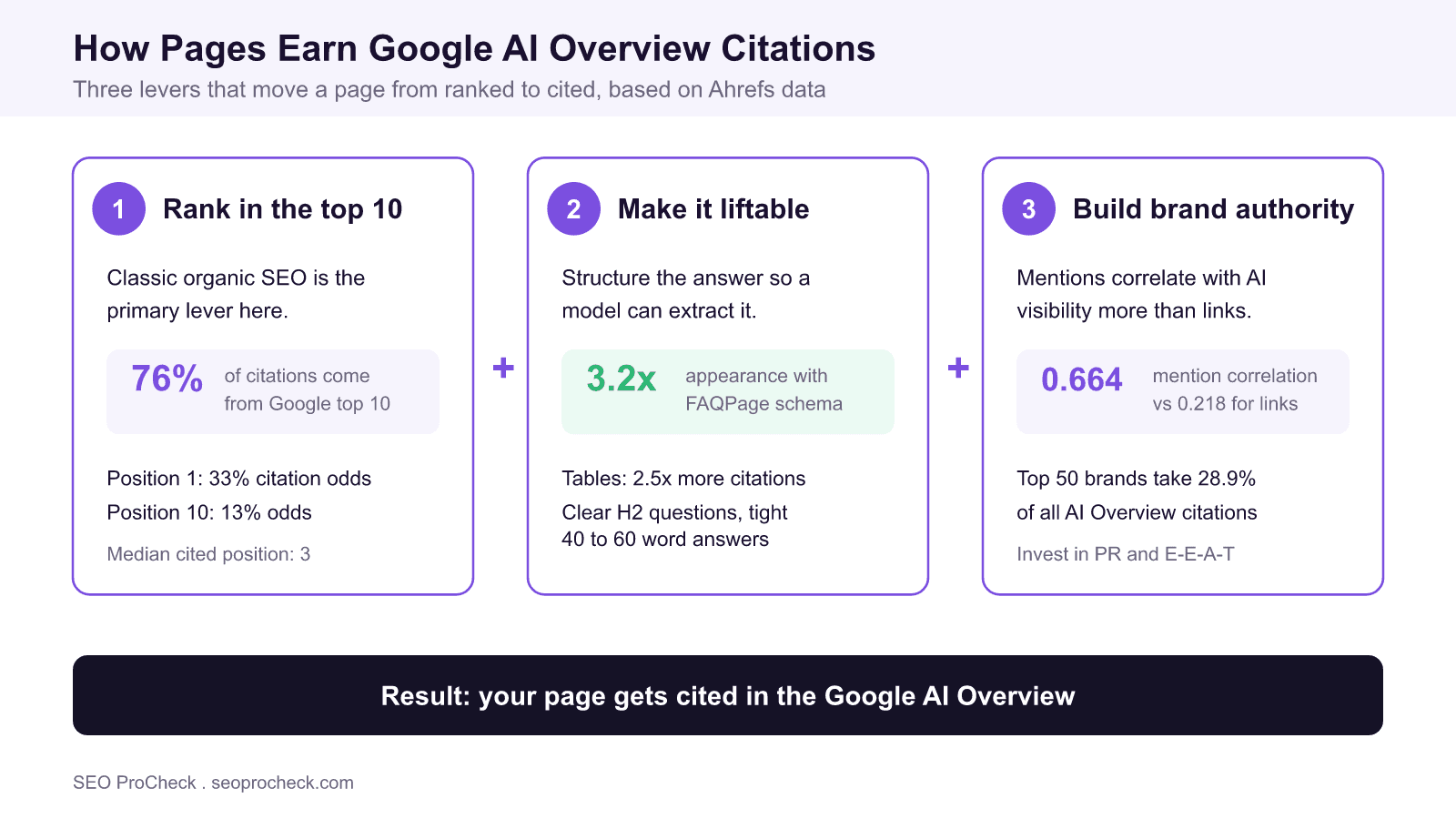
Most "AI Overview optimization" advice is hand-waving. The data isn't. Google AI Overviews cite your page overwhelmingly when you already rank in the top 10, so the fastest route to AI citations is ruthlessly good classic SEO, plus a handful of structural choices that make your content easy to lift. Below is what the numbers actually say, and the same playbook I implement for clients.
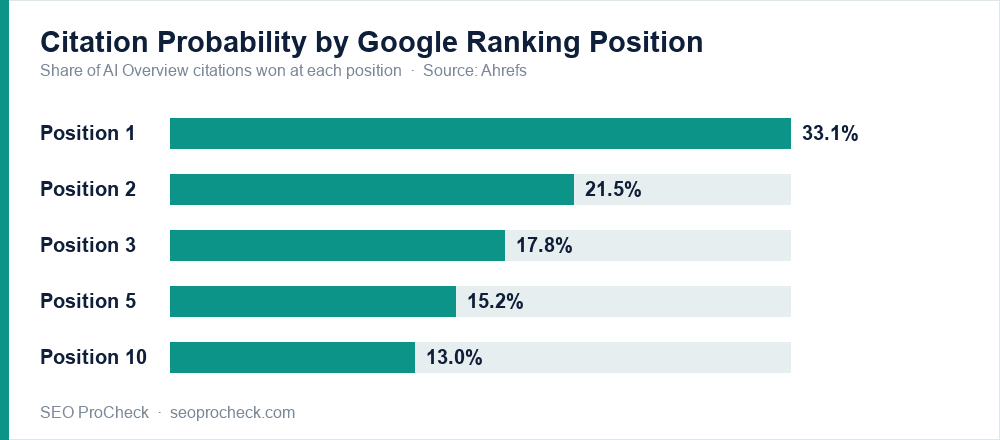
Google AI Overviews show the strongest correlation between organic rankings and AI citations of any platform. According to Ahrefs research, 76% of AI Overview citations come from pages ranking in Google's top 10, with position #1 providing a 33% citation probability.
Key Statistics: AI Overview Citation Patterns
| Metric | Value | Source |
|---|---|---|
| Citations from Google top 10 | 76.10% | Ahrefs |
| Median ranking position for citations | Position 3 | Ahrefs |
| Position #1 citation probability | 33.07% | Ahrefs |
| Position #10 citation probability | 13.04% | Ahrefs |
| Sources per AI Overview response | 5-28 | Ahrefs |
| Maximum documented links | 95 | Ahrefs |
Citation Probability by Ranking Position
Ahrefs' analysis of 1.9 million citations from 1 million AI Overviews found a clear correlation between ranking position and citation likelihood:
| Ranking Position | Citation Probability | Relative to Position 1 |
|---|---|---|
| Position 1 | 33.07% | 100% (baseline) |
| Position 2 | 21.54% | 65% |
| Position 3 | 17.82% | 54% |
| Position 5 | 15.21% | 46% |
| Position 10 | 13.04% | 39% |
Key insight: Position #1 provides 2.5x the citation probability of position #10.
In client audits I read that curve as a priority list, not a nice-to-have. If a target query already triggers an AI Overview and you sit at position 6 to 9, the highest-leverage work is usually not new schema, it is closing the gap into the top 3 on the underlying organic result, because that is where citation probability roughly doubles. I confirm the current AI Overview and its citing URLs by hand for each priority query (this is also how AI tools pick their sources) before touching anything, then run the page against the liftability list below.
How to Optimize for AI Overview Citations
1. Focus on Traditional Google SEO
Unlike other AI platforms, Google AI Overviews directly reward organic rankings. Standard Google SEO remains the primary strategy:
- Target high-volume keywords where you can rank top 10
- Build topical authority in your domain
- Create comprehensive, well-structured content
- Earn quality backlinks from authoritative sources
2. Build Brand Authority
Ahrefs found that brand mentions correlate 3x stronger with AI visibility than backlinks (0.664 vs 0.218). Top 50 brands account for 28.9% of all AI Overview citations.
- Invest in PR and earned media
- Build brand mentions across the web
- Establish E-E-A-T signals (experience, expertise, authority, trust)
- Get cited by authoritative publications in your industry
3. Use Structured Data
While Google states structured data isn't required for AI features, research shows significant impact:
| Schema Type | Impact on AI Overview Appearance |
|---|---|
| FAQPage schema | 3.2x higher likelihood |
| Proper heading hierarchy | 40% more likely to be cited |
| Tables in content | 2.5x more citations |
| List formatting | 50% of top citations use lists |
4. Optimize for Featured Snippets
AI Overviews often pull from the same content that wins featured snippets:
- Answer questions directly in the first paragraph
- Use the question as an H2 heading
- Provide concise, factual answers (40-60 words)
- Follow with supporting detail
A Liftability Checklist for AI Overview Citations
Ranking gets you into the candidate pool, liftability decides whether the model can quote you cleanly. This is the checklist I run on every page that targets an AI Overview query. For the schema side, our FAQPage and structured data guide covers valid markup.
| Element | What to ship | Why it helps the model |
|---|---|---|
| Direct answer | A 40 to 60 word answer in the first paragraph under the H2 | Gives the model a clean, self-contained passage to quote |
| Question headings | H2 or H3 phrased as the user query | Maps your section to the exact prompt the Overview answers |
| Comparison tables | One labelled table per key comparison | Tables correlate with 2.5x more citations (Ahrefs) |
| FAQPage schema | Valid FAQPage on genuine on-page Q&A | Correlates with 3.2x higher AI Overview appearance |
| Cited facts | Named sources and dates next to every statistic | Signals trust and gives the model an attribution anchor |
Google-Extended: Controlling AI Training
According to Google's documentation, Google-Extended is a robots.txt control token (not a crawler) that lets you block AI training while maintaining search visibility:
User-agent: Google-Extended
Disallow: /
This prevents your content from being used to train Google's AI models but does not affect:
- Regular Google search rankings
- AI Overview citations (these use existing search index)
- Google Discover or News visibility
AI Overview Trigger Queries
Not all queries trigger AI Overviews. They appear most frequently for:
- Informational queries ("how to," "what is")
- Comparison queries ("X vs Y")
- Research queries ("best," "top")
- Complex questions requiring synthesis
Transactional and navigational queries rarely trigger AI Overviews.
What's Changed Since Ahrefs Published This Data
The Ahrefs studies cited here remain the best public dataset on ranking versus AI citation, and the core finding is stable: organic position still drives AI Overview citations. Two things have shifted in how I apply it as of mid 2026. First, AI Overviews now trigger on a wider set of queries, including commercial and long-tail terms that used to return only classic results, so the citation opportunity reaches more of a typical content library than it did at launch. Second, Google has expanded AI Mode, a fuller conversational surface that leans on the same organic index, which means the top-10 dependency the data describes applies there too. None of this changes the playbook: earn the ranking, structure the answer, and build the brand signals that correlate with AI visibility. It only widens the set of queries where the payoff shows up. Treat the exact percentages as directional and re-check the live AI Overview for your own priority queries, since Google tunes these surfaces continuously.
Frequently Asked Questions
Do I need to do anything special for AI Overviews?
Focus on ranking well in traditional Google search. 76% of AI Overview citations come from top 10 results. Good SEO is good AI Overview optimization.
Does blocking Google-Extended affect AI Overview citations?
No. Google-Extended controls AI training, not AI Overview citations. Your content can still appear in AI Overviews even if you block Google-Extended.
How many sources do AI Overviews cite?
Typically 5-28 sources per response, though one documented response contained 95 links.
Why does position #1 matter so much?
Position #1 provides 33% citation probability versus 13% at position #10. That's 2.5x the visibility from a single position improvement.
Do tables and lists really increase AI Overview citations?
Ahrefs found that content with tables correlates with 2.5x more citations, and about half of top citations use lists. The mechanism is practical: structured blocks give the model a discrete, quotable unit instead of a wall of prose. Add a genuinely useful table or list where the query invites one, do not pad with filler structure.
How fast do AI Overview citations follow a ranking improvement?
There is no official refresh cadence, but AI Overviews draw on the live search index, so citations tend to move within days to a few weeks of a durable ranking change, not instantly. Track it by rechecking the AI Overview and its citing URLs for your priority queries on a schedule rather than assuming a same-day update.
Sources
- Ahrefs: 76% of AI Overview Citations Pull From Top 10 Pages
- Ahrefs: An Analysis of AI Overview Brand Visibility Factors
- Google: About AI Overviews
- Google: Common Crawlers Overview
Related Research
- How AI Search Tools Source Information from Organic Search Results
- Brand Mentions vs Backlinks: What Matters for AI Visibility
- Schema Markup for AI Search: FAQPage and Structured Data
Related Guides on SEO ProCheck
- Generative Engine Optimization (GEO) FAQ, the broader framework for ranking across AI search.
- E-E-A-T FAQ, the trust signals that drive both rankings and AI citations.
- Schema Markup FAQ, structured data that makes your content machine-liftable.
Want your pages cited in AI Overviews?
I run technical SEO audits and content optimization that target exactly this, earning organic top-10 positions and the AI citations that follow. See how an advanced SEO audit works →
Take this with you
The assistant links open with a question about this page already written. Nothing is sent until you press enter.
Claude Vincent is a technical SEO consultant focused on crawlability, rendering, and AI-search visibility. He writes the field guides and case studies at SEO ProCheck, with a bias toward the durable, unglamorous work that decides whether search engines and AI answer engines can actually read and cite a site.
About SEO ProCheck
Technical SEO consulting and GEO strategy with 20 years of enterprise experience. Case studies, resources, and tools for search and AI visibility.
Work With Me
Technical SEO audits, GEO strategy, site migrations, and international SEO. Hourly consulting for teams who need hands-on support, not just reports.
Subscribe to our newsletter!








Recent Posts
- Most Top Sites Never Say Who They Are in Structured Data October 14, 2026
- Homepage Titles Are Mostly Too Short, Not Too Long October 8, 2026
- Who Actually Serves an llms.txt? 184 Top Sites Measured September 29, 2026