

Voice Search Adoption Trends
- January 20, 2025
- AEO (Answer Engine Optimization), AI and Search
AI Summary
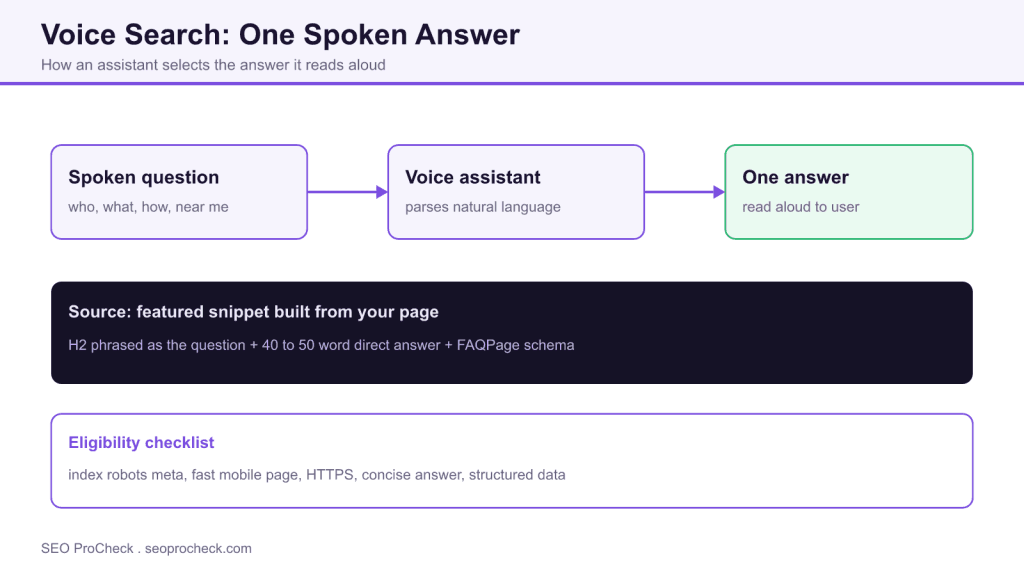
Voice search optimization means structuring a page so an assistant such as Google Assistant, Siri or Alexa can read one concise answer aloud. The practical target is the featured snippet and a short answer block near the top of the page, not a separate voice ranking.
- Voice results usually pull from the featured snippet or a concise answer high on the page.
- Spoken queries are longer, conversational and phrased as full questions.
- Assistants read a single answer, so a clear 40 to 50 word response beats keyword stuffing.
- Local intent and FAQ style question and answer pairs are the most common voice use cases.
Understanding Voice Search
Voice Search represents a significant aspect of SEO strategy that practitioners need to understand thoroughly. As search algorithms evolve and user behavior changes, staying current with best practices in this area becomes increasingly important. This guide provides comprehensive coverage of the key concepts and actionable recommendations.
Strategic Importance
The role of voice search in overall SEO success cannot be understated. It influences multiple ranking factors and affects user experience. Sites that excel in this area typically see better organic performance across key metrics. Understanding the strategic implications helps prioritize efforts and allocate resources effectively.
Implementation Approach
Effective implementation requires a systematic approach. Begin with thorough assessment of your current state. Identify gaps and opportunities through analysis. Develop an action plan with clear priorities. Execute methodically while monitoring for issues. Iterate based on results and industry changes.
Best Practices
Industry best practices have evolved through collective experience and testing. Following established guidelines helps avoid common pitfalls and accelerates results. However, best practices should be adapted to your specific situation rather than applied blindly. Test and measure to confirm what works for your site.
Future Considerations
The landscape continues to evolve with new technologies and algorithm updates. Stay informed about developments that may affect your strategy. Build flexibility into your approach to accommodate changes. Focus on fundamentals that provide long-term value rather than short-term tactics that may become obsolete.
How voice queries differ from typed queries
Voice queries are spoken in full sentences, so they run longer and read as natural questions. Someone types best espresso machine but says what is the best espresso machine for a small kitchen. That shift toward conversational, question shaped phrasing is the single most useful thing to design for. Pages that answer the exact question in plain language, high on the page, are the ones assistants can quote.
| Attribute | Typed query | Voice query |
|---|---|---|
| Length | 1 to 3 words | 6 or more words |
| Phrasing | Keywords, fragments | Full natural question |
| Intent | Mixed | Often local or task based |
| Result consumed | A page of links | One spoken answer |
| Optimization target | Ranking position | Featured snippet plus answer block |
What actually wins the spoken answer
Assistants overwhelmingly read from the featured snippet, which is drawn from a page that already ranks near the top. So the work is ordinary on page SEO aimed at snippet ownership: place an H2 that mirrors the question, then answer it immediately in 40 to 50 words before you elaborate. Add FAQPage structured data, keep the mobile page fast, and serve over HTTPS. The page must also be indexable; a stray noindex removes it from consideration entirely.
A reliable answer block looks like this: a question heading, then a short standalone paragraph a person could read out loud and understand without any surrounding context.
A repeatable voice and answer workflow
Run this loop per target page:
- Mine question queries in Google Search Console. Filter the Performance report for queries containing who, what, why, how, where, when, best, or near.
- Map each recurring question to the single best page.
- Add an H2 that restates the question and a 40 to 50 word direct answer immediately below it.
- Add FAQPage schema built from the visible questions and answers.
- Confirm the page is indexable and passes Core Web Vitals on mobile.
- Track featured snippet ownership and question keyword impressions over time.
Measuring voice and answer visibility
There is no dedicated voice report, so use proxies. Watch the count of queries where you own the featured snippet, the impressions on question shaped keywords in Search Console, and the results of testing the exact phrases out loud on a real device. Rising question impressions plus snippet ownership is the clearest signal that your answer optimization is working.
Frequently asked questions
Is voice search a separate ranking system?
No. Assistants read from standard organic results, usually the featured snippet. Winning voice means winning the snippet and the short answer that feeds it, so classic on page SEO still applies.
How long should a voice answer block be?
Aim for 40 to 50 words that answer the question directly and can stand alone. Put it immediately under a heading that mirrors the question, then expand below for readers who want depth.
Does structured data help voice results?
FAQPage and HowTo markup clarify question and answer relationships and support eligibility for rich results and assistant answers. It does not force selection, but it removes ambiguity for the engine.
Which queries are most likely to trigger voice answers?
Short factual questions, how to steps, and local intent such as opening hours or nearest location. These map cleanly to a single concise spoken response.
Do I need a fast mobile page for voice?
Yes. Most spoken queries happen on phones and smart speakers backed by mobile results, so mobile speed and Core Web Vitals directly affect eligibility.
How do I measure voice performance without a voice report?
Track featured snippet ownership, impressions on question keywords in Search Console, and manual on device testing of your target phrases. Trends across these proxies stand in for a direct metric.
For related coverage, see answer engine optimization, local search behavior, and meta robots directives.
Claude Vincent is a technical SEO consultant focused on crawlability, rendering, and AI-search visibility. He writes the field guides and case studies at SEO ProCheck, with a bias toward the durable, unglamorous work that decides whether search engines and AI answer engines can actually read and cite a site.
About SEO ProCheck
Technical SEO consulting and GEO strategy with 20 years of enterprise experience. Case studies, resources, and tools for search and AI visibility.
Work With Me
Technical SEO audits, GEO strategy, site migrations, and international SEO. Hourly consulting for teams who need hands-on support, not just reports.
Subscribe to our newsletter!




Recent Posts
- Can AI Crawlers Actually Read Your Site? I Measured 400 of the Biggest September 5, 2026
- The Pre-Publish Quality Gate for AI-Assisted Content August 6, 2026
- AGENTS.md vs llms.txt vs llms-full.txt: Which Agent File Does What July 18, 2026