

Voice Search Optimization in 2025
- April 6, 2026
- AEO (Answer Engine Optimization), AI and Search
AI Summary
Voice search optimization means shaping a page so an assistant can lift one clear, spoken answer of about 40 to 50 words. You win by pairing conversational question headings with concise answer blocks, valid FAQ or speakable schema, accurate local profile data, and fast mobile delivery.
- Place a self-contained 40 to 50 word answer directly under each question heading.
- Use FAQPage, QAPage, or speakable structured data that mirrors your visible text.
- For near me queries, accurate Google Business Profile and LocalBusiness schema outrank blog copy.
- Track question queries in Search Console to approximate spoken visibility.
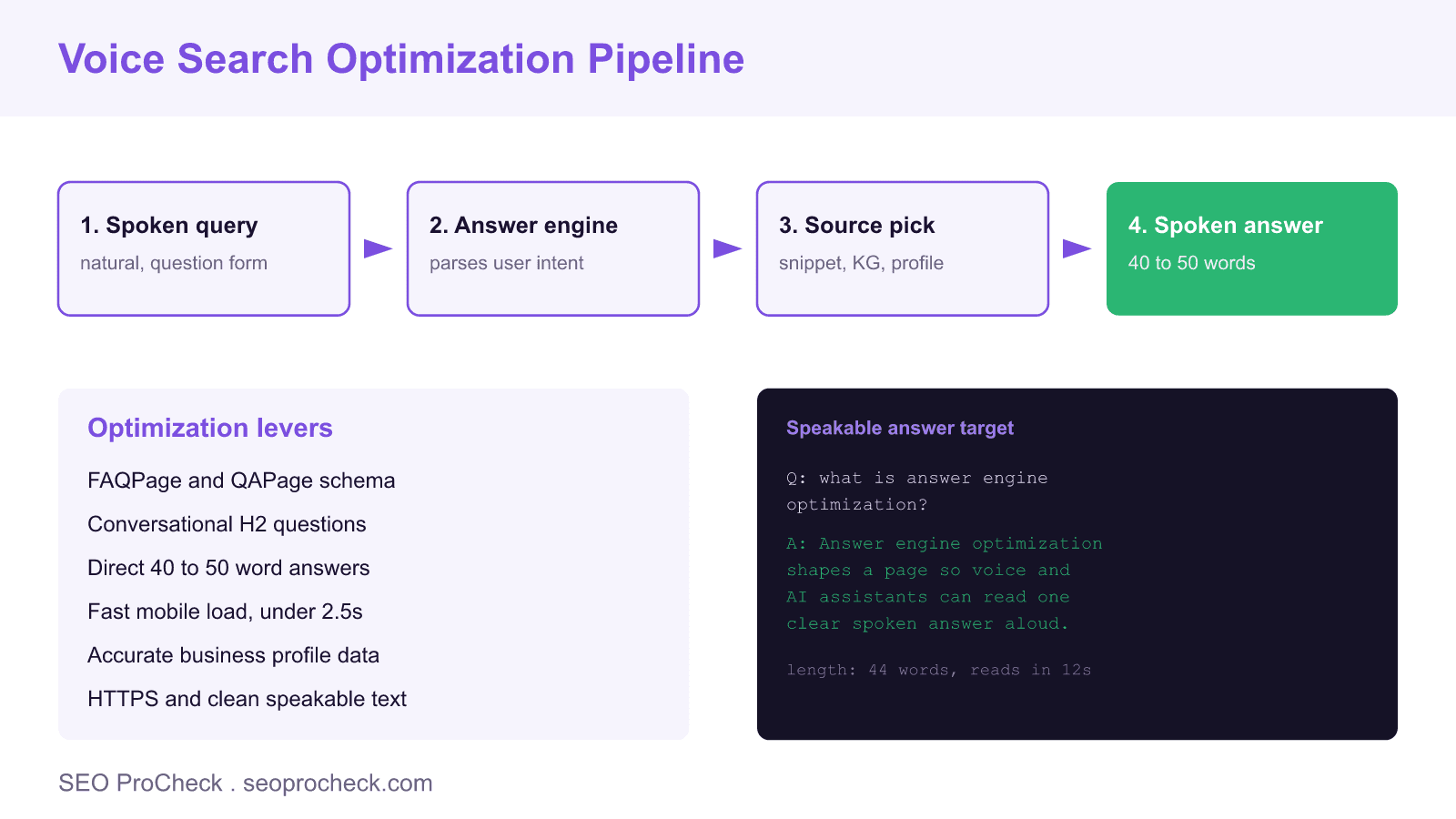
Voice search is not a separate index. When someone speaks a question to Google Assistant, Siri, or Alexa, the assistant runs a normal query, picks one result it trusts, and reads a short passage aloud. Optimizing for voice in 2025 is therefore mostly about being the single passage an assistant is willing to speak, and about making that passage short enough to read in one breath. This guide covers the answer format, the schema, the query research, and the local signals that decide whether your page becomes the spoken answer.
How an assistant chooses a spoken answer
A spoken result usually comes from one of three places: a featured snippet drawn from a ranking page, a knowledge graph entity, or a local business profile. Assistants prefer passages that answer the exact question, sit near the top of a page, and stand on their own. If your best answer is buried in paragraph four or depends on the sentence before it, the assistant will skip it for a competitor whose answer is cleaner. The practical takeaway: write the answer as a standalone unit and put it where a snippet extractor can find it.
The 40 to 50 word answer pattern
The most reliable voice pattern is a question heading followed immediately by a direct answer of roughly 40 to 50 words. Lead with the answer, then add one qualifying sentence. Here is the pattern applied to this very topic:
<h2>What is voice search optimization?</h2>
<p>Voice search optimization is the practice of structuring a page
so an assistant can read one correct answer aloud. It pairs
conversational headings, a 40 to 50 word answer block, valid
schema, and fast mobile delivery.</p>
Notice the answer never says "as mentioned above" or "in this section." Those phrases break when the passage is read in isolation. Keep the first sentence a complete definition, then use the second sentence to add nuance. This is the same discipline used to earn AI Overview citations, and it also feeds concise TL;DR summaries for machine readers.
Structured data for spoken answers
Structured data does not guarantee a read, but it makes your answers unmistakable. FAQPage is the workhorse for pages with several questions. QAPage suits a single user question with answers. The speakable property, still experimental, marks the exact CSS selectors an assistant may read. A minimal FAQ block looks like this:
{
  "@context": "https://schema.org",
  "@type": "FAQPage",
  "mainEntity": [{
    "@type": "Question",
    "name": "What is voice search optimization?",
    "acceptedAnswer": {
      "@type": "Answer",
      "text": "Voice search optimization structures a page so an assistant can read one clear answer aloud."
    }
  }]
}
Two rules keep this safe: the markup text must match the visible answer word for word, and every question in the schema must actually appear on the page. Mismatched or invisible FAQ markup is a manual action risk, not a shortcut.
Research conversational queries
Spoken questions are longer and more natural than typed ones. People say "where can I get my brakes fixed near me" rather than "brake repair." Mine these in three places: the People Also Ask box, Search Console rows that begin with question words, and your own site search logs. Group them by intent, then map each cluster to a heading and a 40 to 50 word answer. Understanding how SEO, AEO, and GEO differ helps you decide which clusters deserve a full page versus a single FAQ entry.
Near me and local voice queries
A large share of spoken searches carry local intent, and for those the assistant reads from a business profile, not a blog. Keep your Google Business Profile categories, hours, and phone number accurate, keep name, address, and phone consistent across directories, and add local business schema with geo coordinates and opening hours. Enable click-to-call so an assistant can complete the action it just read aloud.
Query type to optimization map
| Query type | Spoken example | What to optimize |
|---|---|---|
| Informational | what is a heat pump | Question heading plus 40 to 50 word answer, FAQPage schema |
| Local near me | plumber near me open now | Google Business Profile, LocalBusiness schema, accurate hours |
| Transactional | book a table for four tonight | Clear call to action, hours, click-to-call, booking link |
| Navigational | open my bank app | Brand entity data, consistent name, sitelinks |
Technical delivery
Assistants favor pages that load fast on mobile and serve over HTTPS. Keep the answer block in server rendered HTML so it does not depend on JavaScript that a lightweight crawler may skip. Watch mobile largest contentful paint, keep it under about 2.5 seconds, and make sure the passage an assistant needs is present in the initial HTML response rather than injected later.
Measurement
There is no clean voice report, so triangulate. In Search Console, filter queries by question words and track impressions and average position for those rows. Watch which of your pages hold featured snippets, since snippets feed Google Assistant reads. For local intent, monitor profile calls, direction requests, and website clicks. Rising question impressions plus held snippets is the closest signal that your spoken visibility is improving.
Frequently asked questions
What is voice search optimization?
Voice search optimization is the practice of structuring a page so voice assistants and answer engines can read a single, correct answer aloud. It combines conversational phrasing, concise answer blocks, structured data, and fast mobile delivery so an assistant can lift your text with confidence.
How long should a spoken answer be?
Aim for a self-contained answer of roughly 40 to 50 words placed directly under a question heading. Assistants read one passage aloud, so the answer must make sense without the surrounding paragraphs and should lead with the direct response before any qualifier.
Does schema markup help voice search?
Structured data does not force an assistant to read your page, but FAQPage, QAPage, and speakable markup make your answers easier to identify and match to a spoken question. Clean, valid markup that mirrors your visible text is the safe way to help machines parse your content.
How do I optimize for near me voice queries?
Keep your Google Business Profile accurate, use consistent name, address, and phone data across the web, and add LocalBusiness schema with hours and geo coordinates. Many spoken queries end in near me, so assistants lean on profile data and local structured data rather than a blog page.
Which sources do voice assistants use?
Google Assistant leans on the Google index and featured snippets, Alexa pulls from Bing and its own answer sources, and Siri blends several providers. Because the underlying index varies, strong general SEO plus explicit answer blocks is more reliable than tuning for one device.
How do I measure voice search performance?
Filter Google Search Console for question queries that start with words like what, how, and where, then track impressions and average position for those rows. Pair that with featured snippet wins and profile call or direction actions to approximate spoken visibility.
Claude Vincent is a technical SEO consultant focused on crawlability, rendering, and AI-search visibility. He writes the field guides and case studies at SEO ProCheck, with a bias toward the durable, unglamorous work that decides whether search engines and AI answer engines can actually read and cite a site.
About SEO ProCheck
Technical SEO consulting and GEO strategy with 20 years of enterprise experience. Case studies, resources, and tools for search and AI visibility.
Work With Me
Technical SEO audits, GEO strategy, site migrations, and international SEO. Hourly consulting for teams who need hands-on support, not just reports.
Subscribe to our newsletter!







Recent Posts
- Can AI Crawlers Actually Read Your Site? I Measured 400 of the Biggest September 5, 2026
- The Pre-Publish Quality Gate for AI-Assisted Content August 6, 2026
- AGENTS.md vs llms.txt vs llms-full.txt: Which Agent File Does What July 18, 2026