Google AI Overviews: Optimization Strategy Guide
- May 23, 2025
- AI Overviews and SGE, AI and Search
AI Summary
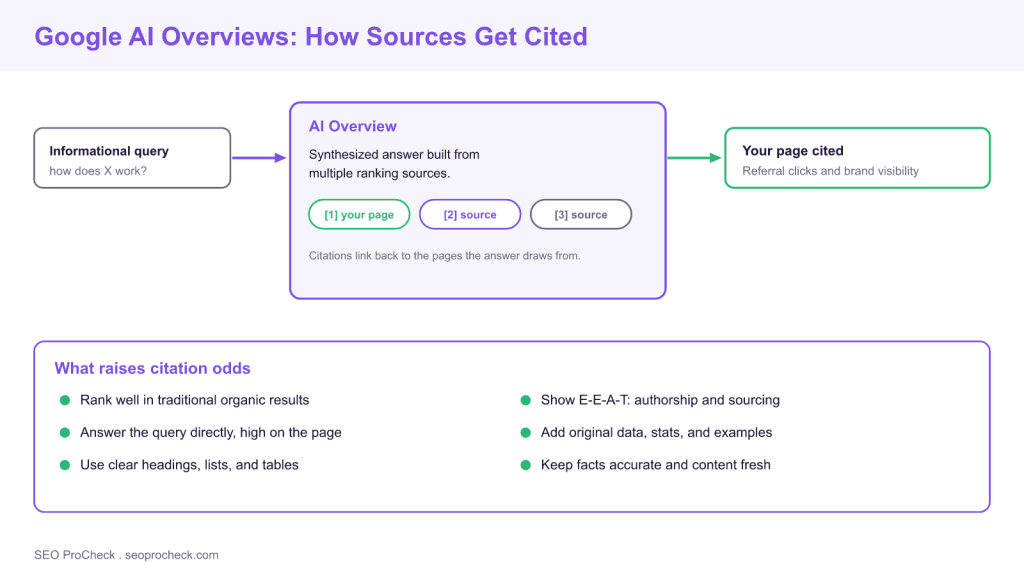
Google AI Overviews are AI generated summaries that synthesize several sources at the top of results for many informational queries. You cannot force inclusion, but you raise citation odds by ranking well, answering directly and early, structuring content for extraction, and demonstrating experience and sourcing.
- AI Overviews trigger most on how to, comparison, and explanatory queries, and least on transactional or navigational ones.
- Pages cited tend to rank well already and present clear, extractable answers with headings, lists, and tables.
- Original data, accurate facts, and visible E-E-A-T signals increase the chance of being selected and cited.
- Search Console does not separate AI Overview traffic, so use SERP feature tracking to measure presence and impact.
Understanding AI Overviews
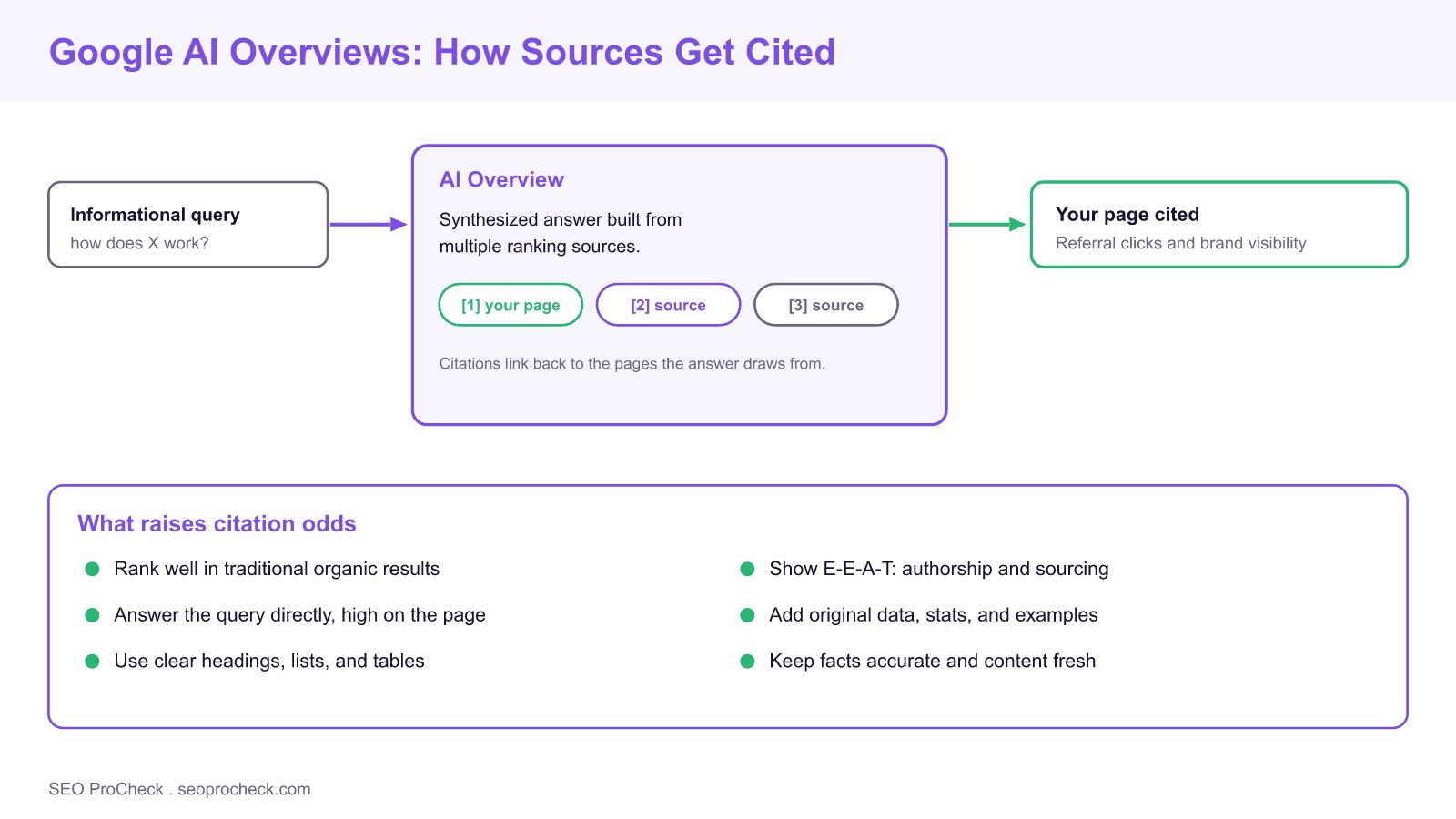
Google AI Overviews (formerly Search Generative Experience or SGE) displays AI-generated summaries directly in search results for informational queries. These summaries synthesize information from multiple sources, fundamentally changing how users interact with search results. For SEO, AI Overviews represents both a challenge (potential traffic reduction from zero-click answers) and an opportunity (being cited as a source in AI responses). Understanding how AI Overviews selects and cites sources is essential for maintaining organic visibility in the evolving search landscape.
When AI Overviews Appears
AI Overviews triggers primarily for informational queries where synthesized answers provide value, such as "how to" questions, comparisons, explanations, and research topics. Commercial and transactional queries less frequently trigger AI Overviews, preserving traditional SERP formats for shopping and buying intent. Local queries, simple factual lookups, and navigational searches typically don't trigger AI summaries. Understanding which query types in your niche trigger AI Overviews helps prioritize optimization efforts.
| Query Type | AI Overview Frequency | Optimization Priority |
|---|---|---|
| How-to questions | Very High | Structure for featured content |
| Comparisons | High | Create comprehensive comparison content |
| Explanatory queries | High | Clear definitions, examples |
| Product research | Medium | Detailed product information |
| Transactional | Low | Traditional SEO optimization |
| Local/Navigational | Very Low | Standard local SEO |
Source Selection Factors
AI Overviews cites sources that demonstrate authority, accuracy, and comprehensive coverage. Pages that rank well in traditional organic results are more likely to be cited, but citation doesn't strictly follow ranking order. Content that provides clear, factual information with proper structure (headers, lists, tables) is easier for AI to extract and attribute. E-E-A-T signals influence source selection, with established authorities more frequently cited than newer or less-known sources. Original research, data, and unique insights increase citation likelihood.
Content Optimization for AI Overviews
Structure content for easy extraction by using clear headings that match search intent, providing direct answers near the beginning of sections, and using lists and tables for comparative information. Write comprehensive content that covers topics thoroughly, as AI Overviews synthesizes multiple aspects of a topic. Include specific data points, statistics, and examples that add unique value. Ensure factual accuracy and cite authoritative sources, as AI Overviews appears to favor content that demonstrates verification and sourcing. Update content regularly to maintain freshness signals.
Measuring AI Overview Impact
Track AI Overview presence for target keywords using SERP tracking tools that identify AI features. Monitor click-through rates for queries where AI Overviews appears, comparing to historical CTR before AI features. Watch for citation patterns, noting which pages are cited and what content is extracted. Google Search Console doesn't currently separate AI Overview traffic, making third-party tracking tools essential for understanding impact. Some SEO tools now track "AI visibility" specifically, measuring citation frequency across AI search features.
Structuring a Page for Extraction
AI Overviews assemble an answer from passages, so the unit that gets cited is a clear passage, not the whole article. Give the system easy passages to lift: put a direct, self contained answer in the first two sentences under a heading that matches the question, then expand with detail, examples, and data. Use descriptive H2 and H3 headings phrased the way people ask, short paragraphs, and lists or tables for anything comparative. Define terms in place rather than assuming context, because a passage may be read in isolation. This is the same discipline that wins featured snippets, so the two goals reinforce each other.
| Content Element | Why It Helps Extraction | Practical Move |
|---|---|---|
| Question style heading | Matches query intent | Phrase H2s as the questions users ask |
| Direct opening answer | Gives a liftable passage | Answer in the first 40 to 60 words |
| Lists and tables | Easy to parse and quote | Use for steps, comparisons, specs |
| Original data and stats | Adds unique, citable value | Publish first party numbers with sources |
| Author and sourcing | Signals E-E-A-T | Name the author, cite references |
Measuring Presence and Protecting Traffic
Because Google Search Console does not label AI Overview impressions or clicks, you need SERP feature tracking to know where overviews appear for your terms and whether your pages are cited. Watch click through rate on informational queries over time: a drop while impressions hold steady can indicate more zero click behaviour from overviews. The defensive play is to keep earning the citation and to deepen pages so that users who do click get more than the summary provided. Optimising for overviews sits alongside broader answer strategy, so pair this with our answer engine optimization guide and the distinctions in SEO versus AEO versus GEO. For the citation mechanics specifically, our research note on optimizing for AI Overview citations goes deeper, and structured Q&A from a FAQ schema block can make answers easier to extract.
Frequently Asked Questions
What are Google AI Overviews?
AI Overviews are AI generated summaries that appear at the top of Google results for many informational queries. They synthesize information from multiple sources and link to the pages the answer draws from, changing how users interact with the results page.
How do I get my content into AI Overviews?
There is no submission or guaranteed method. In practice, pages that rank well, answer the query directly and early, use clear structure, and demonstrate experience and sourcing are more likely to be cited. Original data and accurate, comprehensive coverage also help.
Do AI Overviews reduce website traffic?
They can, especially for simple informational queries where users get the answer without clicking. The impact varies by query type and niche. Being cited within the overview preserves some visibility and referral clicks, so earning the citation matters more than avoiding overviews.
Which queries trigger AI Overviews most?
How to questions, comparisons, and explanatory or research queries trigger overviews most often. Transactional, navigational, and simple local lookups trigger them far less, which is why optimization effort should focus on informational content in your niche.
Can I opt out of AI Overviews?
There is no reliable public opt out that keeps you in normal results while excluding overviews. Blocking Google from using your content would also remove you from the underlying features. The practical approach is to compete for the citation rather than opt out.
How do I measure AI Overview performance?
Use SERP tracking tools that detect AI features to see where overviews appear and whether your pages are cited, since Search Console does not separate this traffic. Monitor click through rate trends on informational queries to gauge the effect on clicks.
Claude Vincent is a technical SEO consultant focused on crawlability, rendering, and AI-search visibility. He writes the field guides and case studies at SEO ProCheck, with a bias toward the durable, unglamorous work that decides whether search engines and AI answer engines can actually read and cite a site.
About SEO ProCheck
Technical SEO consulting and GEO strategy with 20 years of enterprise experience. Case studies, resources, and tools for search and AI visibility.
Work With Me
Technical SEO audits, GEO strategy, site migrations, and international SEO. Hourly consulting for teams who need hands-on support, not just reports.
Subscribe to our newsletter!