

Monitoring Your AI Search Visibility
- February 18, 2026
- GEO (Generative Engine Optimization), AI and Search
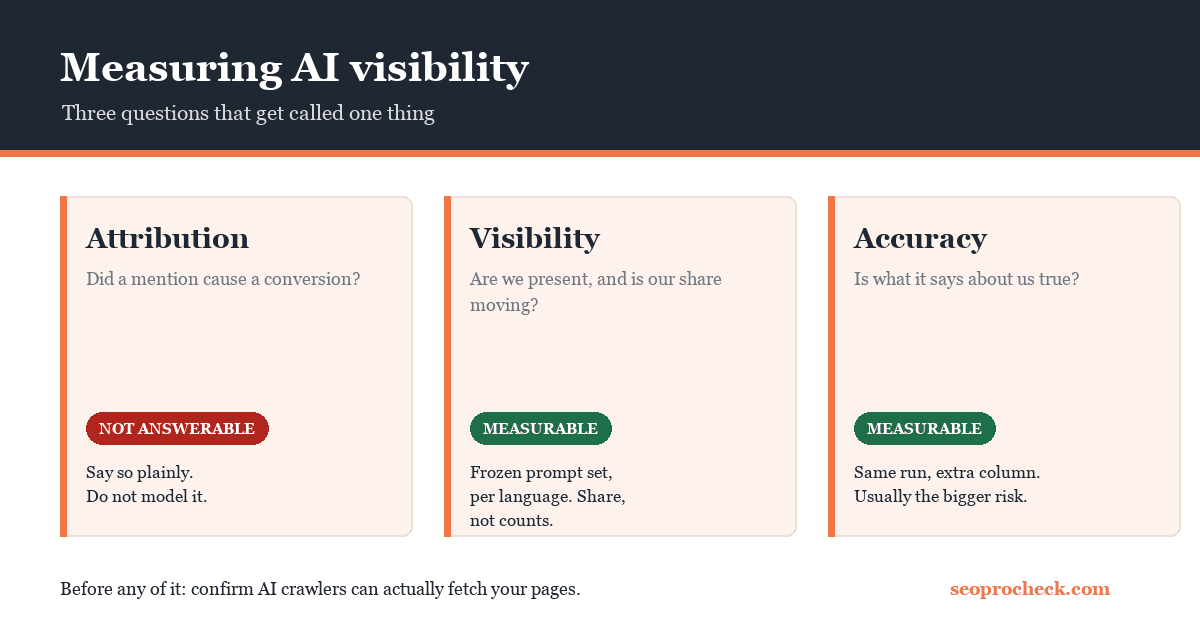
TL;DR: "Measuring AI visibility" collapses three separate questions into one, which is why every answer sounds evasive. Whether a mention caused a conversion is not answerable today. Whether you are present, and whether your share is moving, is answerable if you freeze a prompt set and run it per language. Whether what is being said about you is correct is also answerable, and in regulated categories it is the bigger exposure. Before any of it, confirm the AI crawlers can actually fetch your pages, because a visibility tool reads the answer, not the access, and will report healthy numbers on a site that is being blocked.
Measuring AI search visibility is a different problem from earning it. Getting cited is about content, structure, and authority. Monitoring answers a harder question: how often, and how accurately, does an assistant mention you when someone asks about your topic? The honest starting point is that this is messier than classic rank tracking.
Start by splitting the question in three
Most conversations about AI visibility go in circles because three unrelated questions are being asked at the same time and answered as if they were one. Separate them and two of the three turn into ordinary work.
| The question | Honest status | What to do about it |
|---|---|---|
| Attribution. Did a mention cause a conversion, a purchase, a signup, a booking? | Not answerable today | Say so plainly. Do not model it, and be wary of any tool that claims it |
| Visibility. Are we present, and is our share moving? | Measurable with discipline | Frozen prompt set, run per language, report share rather than counts |
| Accuracy. Is what it says about us true? | Measurable, and usually the bigger risk | Same run, different scoring column. Often the real business case |
Attribution is the one everyone wants and nobody has. There is usually no click to follow, and the sessions that do arrive are undercounted by design. Naming that limit out loud is what makes the other two numbers credible.
Why AI visibility is hard to measure
Traditional SEO gave you a tidy feedback loop: a keyword has a position, a volume, and a click. AI search breaks most of that.
First, there is no single dashboard. Each assistant is its own walled surface, and none publishes a public "you were cited here" report the way a SERP shows its top ten.
Second, citations are probabilistic. Ask the same question twice and you can get different sources, different phrasing, and a different mention of your brand. The model is sampling, not reading a fixed ranking. A single test tells you almost nothing; a pattern across many tests starts to mean something.
Third, the surfaces vary. ChatGPT, Claude, Perplexity, and Google AI Overviews retrieve and cite differently, refresh on different schedules, and weigh sources in their own ways. Being named in one says little about the others. Visibility is not one number; it is a set of separate readings you take one surface at a time.
What you can track today
Several signals are available right now. None is complete alone, but together they form a workable picture.
Manual prompt testing. Run the questions a real buyer would ask through each assistant yourself. This is the most direct read on whether you are mentioned, how you are described, and which competitors appear beside you. It is slow and hands-on, which is exactly why it stays honest.
AI referral traffic. Your analytics platform can isolate visits arriving from AI tools by their referrer, so you can see which sessions came from ChatGPT, Perplexity, and similar sources. This misses answers where nobody clicked through, but a rising or falling AI referral trend is a real signal.
Brand-mention monitoring. Track where your name surfaces across the web. The pages assistants tend to cite are often the same authoritative sources that mention you elsewhere, so this is an indirect but practical proxy for the source pool models draw from.
Dedicated AI rank trackers. A new category of tools runs prompts at scale and logs whether and how your brand appears across assistants. The space is young and methods differ, so treat their numbers as estimates, but they automate the tedious part of prompt testing.
Search Console. Where Google surfaces AI Overview data, your impressions and clicks can reflect that exposure, even when it is not broken out as its own line. It remains a useful input for the Google side. If the Overviews surface is your focus, our guide on optimizing for Google AI Overview citations covers the levers worth pulling.
Check the door before you measure the room
An assistant can only describe pages it can actually fetch. This is the check almost nobody runs, and it invalidates everything downstream when it fails.
Two separate things break it. The first is blocking: bot protection, firewall rules, and rate limiting refuse AI crawlers, often without anyone intending it. The second is rendering: most AI crawlers do not execute JavaScript at all.
Vercel and MERJ measured this across 569 million GPTBot requests and 370 million ClaudeBot requests and found that none of the major AI crawlers render JavaScript, including those from OpenAI, Anthropic, Meta, ByteDance, and Perplexity. They do sometimes fetch JavaScript files, ChatGPT in 11.50% of requests and Claude in 23.84%, but they retrieve them as text and never execute them. Two exceptions are worth knowing: AppleBot renders through a browser-based crawler, and Google's Gemini rides on Googlebot's Web Rendering Service.
The practical consequence is blunt. If your content only exists after JavaScript runs, most assistants never see it, no matter how good it is. Our guide to SSR versus CSR and why rendering decides AI visibility covers the fix, and JavaScript, AI search and server side rendering goes deeper on the implementation.
For blocking, test it directly rather than trusting a dashboard. Request your own pages with each crawler's user agent, from outside your own network:
curl -s -o /dev/null -w "%{http_code}\n" -A "GPTBot/1.2" https://example.com/your-page/
curl -s -o /dev/null -w "%{http_code}\n" -A "ClaudeBot/1.0" https://example.com/your-page/
curl -s -o /dev/null -w "%{http_code}\n" -A "PerplexityBot/1.0" https://example.com/your-page/
Anything other than 200 or a clean redirect chain ending in 200 is a problem. A 403 usually means a firewall rule, not a robots.txt directive, which is why it survives a robots.txt review. Our walkthrough on whether your WAF is blocking GPTBot covers how to confirm and fix it, and the AI Crawler Checker runs the test for you. For the robots.txt side, see AI crawler access and robots.txt considerations.
This matters more than it sounds, because deliberate blocking is now common enough to be background noise. Published estimates vary widely by sample: roughly a quarter of the top 1,000 sites block GPTBot, around 79% of major news sites block AI training crawlers, but only about 15% across a broader sample of nearly 11,000 domains. The spread tells you the number depends entirely on who was measured. What nobody has measured is how many sites block AI crawlers by accident, which in our experience is the more common case.
Report share, not mention counts
Most tools count mentions. Counting is the wrong unit, because the number rises whenever the prompt set grows. Ask more questions, get more mentions, and nothing has actually improved.
Share is the unit that survives. Out of every brand named across your fixed prompt set, how often was it you?
Worked example. You run 50 prompts. Your brand is named in 18 of the answers. Across those 50 answers, 210 brand mentions occur in total, of which 18 are yours.
Presence rate = 18 / 50 = 36% of answers name you.
Share of voice = 18 / 210 = 8.6% of all brands named are you.
Both numbers matter and they move independently. Presence can climb while share falls, which means the category is getting more crowded rather than you getting weaker. Reporting only the raw count of 18 hides both readings.
The prompt set has to be frozen, versioned, and dated for any of this to mean anything. Change the questions and you have started a new baseline, not continued the old one.
Run a control group
Models update without notice, and a shift in your numbers may be a shift in the model rather than a result of your work. Without something to compare against, you cannot tell the difference.
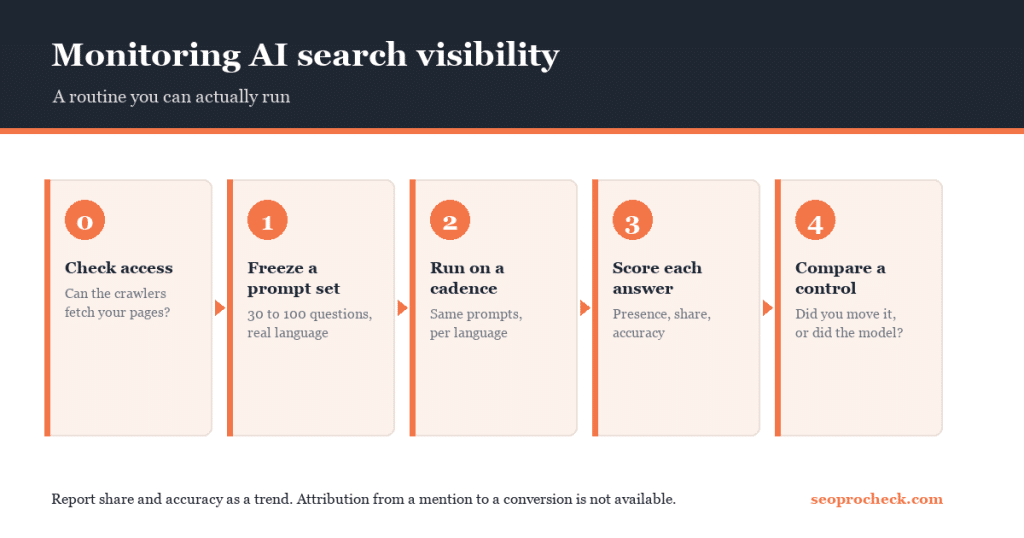
The fix is cheap and almost nobody does it. Alongside the prompts you are actively working on, run a second set you are deliberately not touching. If both move together, the model changed. If only the worked set moves, you did something. That single piece of structure is the difference between a report and a guess.
A simple monitoring routine
You do not need a complex stack to start. You need consistency. A routine that runs every month beats a sophisticated audit you do once.
Build a test set. Write ten to twenty prompts covering your most important topics, in the natural language a person would actually use. Keep them fixed so results stay comparable over time.
Set a cadence. Monthly is a sensible default; move to every two weeks during an active campaign. The point is to repeat the same tests on a schedule, not to check obsessively.
Log what you find. For each prompt and assistant, record whether you were mentioned, which source was cited, and the sentiment of the description. A plain spreadsheet is enough. Over a few cycles, the log shows direction: more mentions, better framing, new competitors crowding in. That trend line is the real deliverable, and it pairs naturally with the work in how to get cited in AI search.
Gate what you publish. Monitoring tells you how the pages you shipped are doing; it cannot rescue pages that never deserved to ship. The production side has its own discipline, and we keep it in one place: the pre-publish quality gate for AI-assisted content, five checks every page passes before it goes out.
Being described wrongly is worse than not being mentioned
Almost every conversation about AI visibility is about presence. Very little of it is about correctness, and for regulated businesses that is the wrong way round.
Consider what an incorrect answer actually costs. Wrong pricing, a wrong statement about what is covered, or a wrong description of what you do, delivered confidently to somebody making a decision about their health or their money. That is not a marketing problem. It is a legal and trust problem that happens to live in a marketing channel.
It is measurable with the same run of prompts and one extra column. Score every mention against a simple rubric:
- Correct. Accurate and reasonably complete.
- Incomplete. Nothing false, but missing something that changes the decision.
- Wrong. Contains a claim that is not true.
A subject expert can score fifty answers in about an hour, which makes this one of the cheapest useful things in the whole programme.
Record the cited source alongside the score, because first party and third party citations are different problems. If the assistant is describing you from your own pages and getting it wrong, the fix is your content. If it is describing you from somebody else's page, the fix is outreach, correction, or building a stronger first party source that outranks it. Our work on machine readable entity markup and brand mentions versus backlinks both feed this.
Measure it per language, not once in English
The competitive set changes completely with the language. Ask an assistant about a category in English and you get the answer set that dominates English language sources. Ask the same question in German or Spanish and the names are frequently different companies entirely.
That means a single English prompt set tells you nothing about your other markets. "Our AI visibility is strong" almost always means "our AI visibility is strong in English."
Four things change when you go multilingual:
- Prompt sets. Written in the language, by somebody who searches in it, not translated from the English set.
- Competitor lists. Built per market, because share of voice is meaningless against the wrong denominator.
- Scoring. Accuracy has to be judged by a native speaker. Correct grammar about the wrong thing is still wrong.
- Retrievability. Geo blocking, consent walls, and regional redirects can stop a crawler reaching localised pages that look perfectly fine from head office.
Entity consistency matters more here than phrasing. Your brand needs to be described the same way across languages so the model resolves it as one entity rather than several loosely related ones. See entity SEO for the underlying mechanics, and hreflang implementation for the traditional search side of the same problem.
The framing that ends the argument
The reason AI visibility measurement feels broken is that people keep trying to force it into a paid search shape: impressions, clicks, cost per acquisition, attribution.
Structurally it is much closer to public relations and brand tracking. Share of voice, sentiment, accuracy, prominence, measured on a fixed panel over time. Nobody demands click attribution from a brand tracking study, and nobody should demand it here yet either.
Say that out loud in the meeting and the conversation changes. It hands a content or brand lead a model they already understand, and it stops the attribution argument before it starts.
If a monetary figure is genuinely required, price the share you hold as media: what it would cost to buy equivalent presence at current cost per click. Label it as an analogue, because that is exactly what it is. It is a number a finance team can read without anybody pretending it is attribution. For where the tooling currently sits, see what an AI search tool actually replaces.
Honest limits
Be clear with yourself and your stakeholders: this measurement is directional, not precise. Because answers vary between runs, your numbers are samples, not exact counts. You are tracking whether visibility trends up or down, not pinning it to a decimal.
The tooling is also early and will keep shifting as assistants change how they retrieve and cite. Anchor decisions in the trend and the qualitative read, not in any single figure, and you get genuine value without overclaiming what the data can support.
FAQ
Can I track AI visibility as precisely as keyword rankings?
No. Because assistant responses are probabilistic and vary between runs, you get a directional read rather than a fixed position. Repeat the same prompts on a schedule and watch the trend instead of any single result.
How often should I check?
Monthly works for most sites. Move to every two weeks during an active push. Consistency and a fixed prompt set matter more than frequency, since comparable tests are what reveal change.
Do I need a paid AI rank tracker?
Not to begin. Manual prompt testing plus AI referral traffic and brand-mention monitoring takes you a long way. Add a dedicated tracker when running prompts by hand becomes the bottleneck, and treat its figures as estimates.
Can I prove an AI mention led to a conversion?
No, and that is worth saying before somebody asks. There is usually no click to attribute, and the sessions that do arrive are undercounted. Report presence, share, and accuracy as a trend instead, and price the share as media if a figure is required for a budget conversation.
Do AI crawlers read JavaScript content?
Mostly not. Vercel and MERJ measured 569 million GPTBot and 370 million ClaudeBot requests and found no JavaScript execution by the major AI crawlers, though they do fetch JavaScript files as text. AppleBot renders, and Gemini uses Googlebot's rendering service. If your content depends on client side rendering, assume most assistants cannot see it.
My visibility tool shows healthy numbers. Is that enough?
Not on its own. A visibility tool reads the assistant's answer, not your server's response, so it will keep reporting numbers even when AI crawlers are being refused at your firewall. Test crawler access directly with the user agent strings before you trust any dashboard.
Sources
- Vercel and MERJ, The rise of the AI crawler, 17 December 2024. JavaScript rendering behaviour across GPTBot, ClaudeBot, PerplexityBot, Meta and ByteDance, measured over 569 million and 370 million requests.
- Blocking rate estimates vary by sample and methodology. Figures cited above come from published robots.txt surveys of the top 1,000 sites, of major news publishers, and of a broader set of roughly 11,000 domains. Treat any single headline percentage with caution.
Want a clear read on your AI search visibility?
Our advanced SEO audit looks at how your site shows up across AI surfaces and traditional search, then gives you a monitoring plan you can actually run.
Take this with you
The assistant links open with a question about this page already written. Nothing is sent until you press enter.
Claude Vincent is a technical SEO consultant focused on crawlability, rendering, and AI-search visibility. He writes the field guides and case studies at SEO ProCheck, with a bias toward the durable, unglamorous work that decides whether search engines and AI answer engines can actually read and cite a site.
About SEO ProCheck
Technical SEO consulting and GEO strategy with 20 years of enterprise experience. Case studies, resources, and tools for search and AI visibility.
Work With Me
Technical SEO audits, GEO strategy, site migrations, and international SEO. Hourly consulting for teams who need hands-on support, not just reports.
Subscribe to our newsletter!








Recent Posts
- Most Top Sites Never Say Who They Are in Structured Data October 14, 2026
- Homepage Titles Are Mostly Too Short, Not Too Long October 8, 2026
- Who Actually Serves an llms.txt? 184 Top Sites Measured September 29, 2026