

Content Structure for LLM Extraction
- August 18, 2024
- GEO (Generative Engine Optimization), AI and Search
AI Summary
Structuring content for LLM extraction means writing self-contained passages that an AI engine can lift verbatim to answer a question. Lead each section with a question based heading and an answer-first sentence, use real lists and tables instead of images of text, and keep entity naming consistent so every chunk stands on its own.
- Retrieval systems pull short passages, so put the direct answer in the first sentence under a clear heading
- Use HTML tables and lists for structured data; text trapped in images is invisible to extraction
- Define entities and acronyms on first use so each passage is self-contained
- FAQ schema turns explicit question and answer pairs into near ideal retrieval units
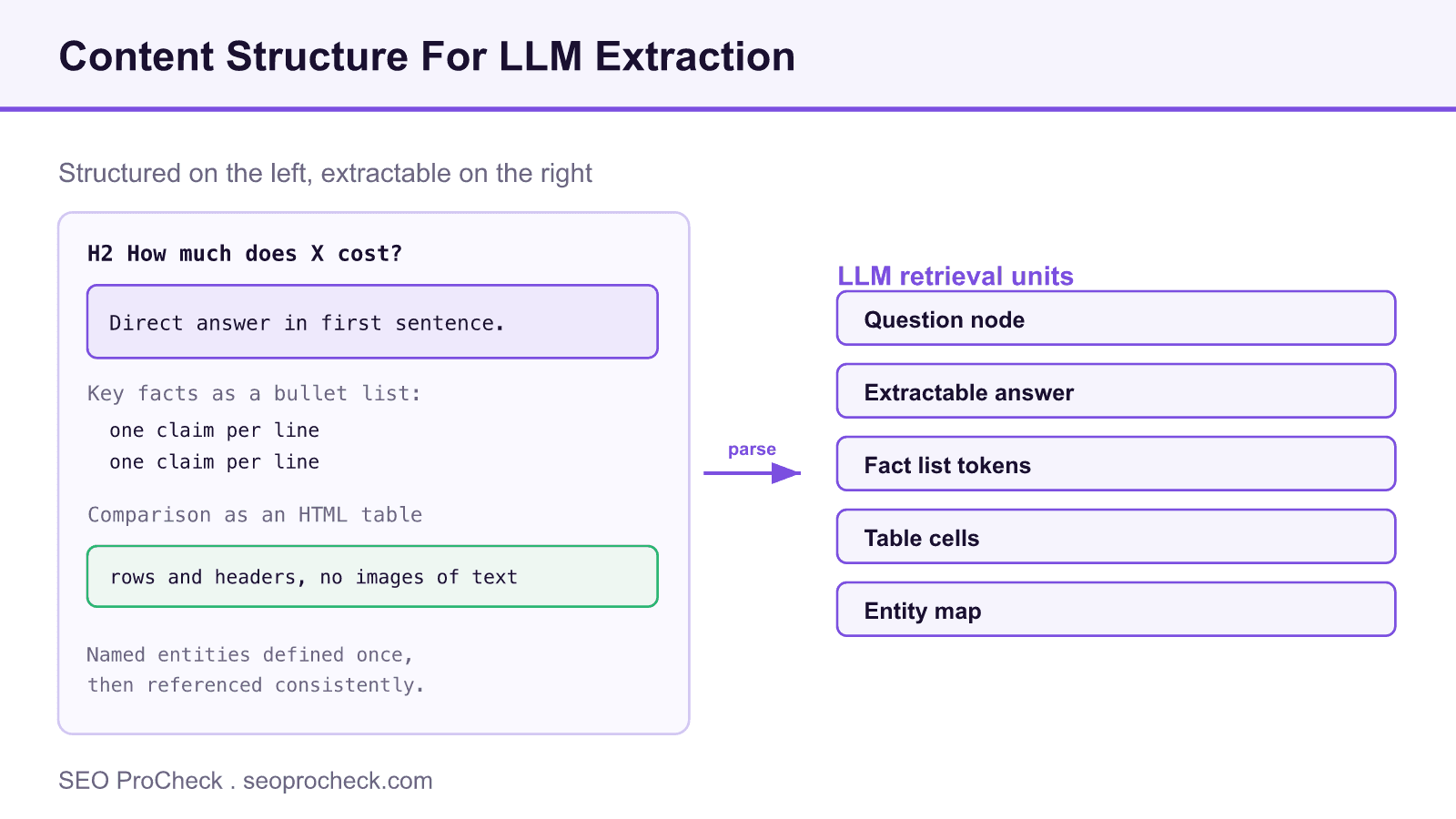
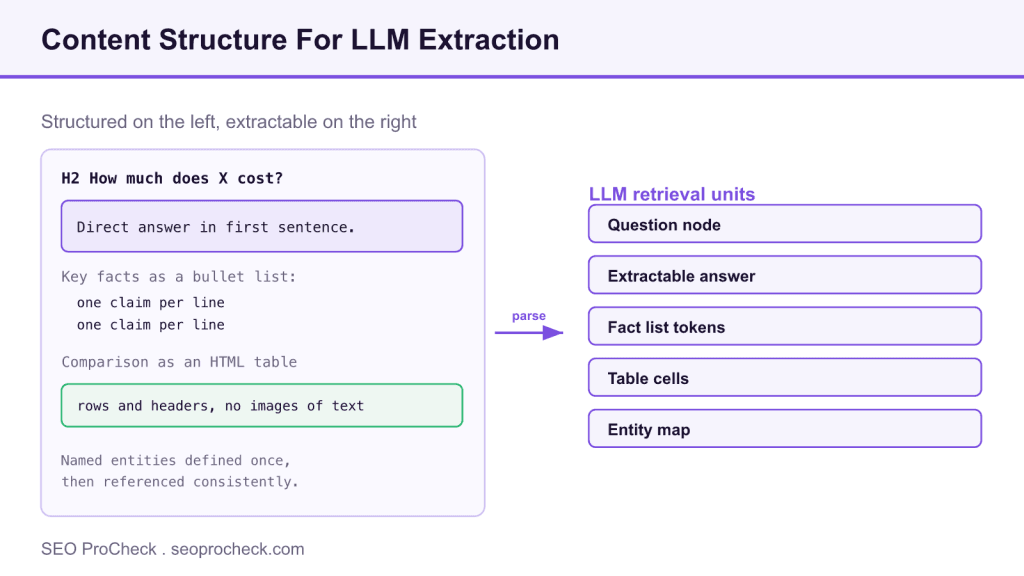
Generative engines such as Google AI Overviews, ChatGPT, and Perplexity do not read your article the way a person does. They chunk it, embed the chunks, and retrieve the few passages most relevant to a query, then synthesize an answer and, if you are fortunate, cite you. Optimizing for that pipeline is a structural discipline: the goal is to make sure the passage that answers a given question is clean, complete, and easy to lift. This guide covers the concrete patterns that make content extractable.
Lead with the answer under a question heading
The single highest leverage pattern is answer-first writing beneath a heading phrased as the question a user would ask. Instead of an H2 that reads "Overview of pricing," write "How much does the plan cost?" and make the very first sentence the direct answer. Compare:
<h2>How much does the Pro plan cost?</h2>
<p>The Pro plan costs 49 dollars per month billed annually.</p>
That paragraph is a self-sufficient retrieval unit: quoted on its own it still answers the question. A version that opens with three sentences of context before the number forces the model to guess where the answer is, and often loses the citation.
One idea per sentence, one topic per passage
Extraction favors clarity. Keep sentences to a single claim and group them into passages of roughly two to four sentences, each covering one narrow subtopic under its own heading. Avoid pronoun chains that only resolve if you have read the previous paragraph. If a passage says "it supports this," an LLM retrieving that chunk in isolation cannot tell what "it" or "this" means.
Use real structure for structured data
Match the format to the information:
- Comparisons and specifications go in an HTML
<table>with header cells, so each row is an atomic, labeled fact. - Sequences and procedures go in an ordered list, one step per item.
- Option sets and criteria go in a bulleted list.
- Definitions can use a description list so the term and its meaning stay bound together.
Critically, never lock data inside an image. A pricing table saved as a screenshot is invisible to extraction; the same numbers in real HTML are directly quotable. Our note on the forgotten HTML expands on why semantic markup still decides what machines can read.
Keep entities consistent and defined
Name each product, person, or concept the same way throughout, and define it on first use. If a passage introduces an acronym, expand it there rather than assuming the reader saw the expansion higher up the page. Consistent entity naming lets the model build a stable map of what the page is about, which improves both retrieval and the accuracy of any answer it generates.
Reinforce with FAQ schema
An explicit question paired with an explicit answer is close to the perfect retrieval unit. Marking your visible FAQ with FAQPage schema removes ambiguity about which text answers which question and makes the pair eligible for AI answers, though Google stopped showing FAQ rich results for every site on May 7, 2026. Keep the schema text identical to what is on the page.
Structure elements and why extraction favors them
| Structure element | Best use | Why an LLM favors it |
|---|---|---|
| Question based heading | Section that answers a query | Matches user query phrasing directly |
| Answer-first paragraph | The direct response | Self-contained, quotable out of context |
| HTML table | Comparisons, specs | Each row is an atomic labeled fact |
| Ordered list | Steps and sequences | Clear discrete units in order |
| FAQ schema | Common questions | Explicit question to answer mapping |
Structure is only half the battle; the other half is understanding selection. See how engines pick winners in our guides on how AI engines choose sources and on winning featured snippets, then explore the full generative engine optimization hub.
Frequently asked questions
What does content structure for LLM extraction mean?
It means organizing a page so a large language model can lift self-contained, accurate passages from it to answer a question. That involves question based headings, answer-first paragraphs, one idea per sentence, real lists and tables, and consistent entity naming, so each chunk stands on its own when retrieved.
Why do answer engines prefer answer-first content?
Retrieval systems pull short passages, not whole articles. When the direct answer sits in the first sentence under a clear heading, that passage is self-sufficient and easy to quote, which raises the odds it becomes the cited source. Burying the answer under preamble makes the passage ambiguous out of context.
Should I use tables and lists or paragraphs?
Use structured formats for structured information. Comparisons belong in an HTML table, sequences in an ordered list, and option sets in a bulleted list, because each row or item is a clean unit an LLM can extract. Keep prose for narrative and nuance.
Do images of text hurt LLM extraction?
Yes. Text baked into an image is invisible to most extraction pipelines, so any data, comparison, or specification locked in a screenshot is effectively lost. Put the information in real HTML and use the image only to illustrate.
How does FAQ schema help AI extraction?
FAQ schema pairs an explicit question with an explicit answer in a machine readable structure, which is close to the ideal retrieval unit. It removes ambiguity about what the answer to a given question is and makes the pair easy to surface in AI answers (Google stopped showing FAQ rich results on May 7, 2026).
How long should an extractable passage be?
Aim for a complete thought in roughly two to four sentences under a descriptive heading. Long enough to be accurate and self-contained, short enough to quote whole. Define any entity or acronym on first use so the passage does not depend on text elsewhere on the page.
Take this with you
The assistant links open with a question about this page already written. Nothing is sent until you press enter.
Claude Vincent is a technical SEO consultant focused on crawlability, rendering, and AI-search visibility. He writes the field guides and case studies at SEO ProCheck, with a bias toward the durable, unglamorous work that decides whether search engines and AI answer engines can actually read and cite a site.
About SEO ProCheck
Technical SEO consulting and GEO strategy with 20 years of enterprise experience. Case studies, resources, and tools for search and AI visibility.
Work With Me
Technical SEO audits, GEO strategy, site migrations, and international SEO. Hourly consulting for teams who need hands-on support, not just reports.
Subscribe to our newsletter!








Recent Posts
- Most Top Sites Never Say Who They Are in Structured Data October 14, 2026
- Homepage Titles Are Mostly Too Short, Not Too Long October 8, 2026
- Who Actually Serves an llms.txt? 184 Top Sites Measured September 29, 2026