


AI Summary
Link building earns backlinks from other sites to build authority and rankings, and quality matters far more than quantity. The strongest links are editorially given from relevant, trusted pages, sit inside the main content, and use natural anchor text, while paid or manipulative links risk manual actions.
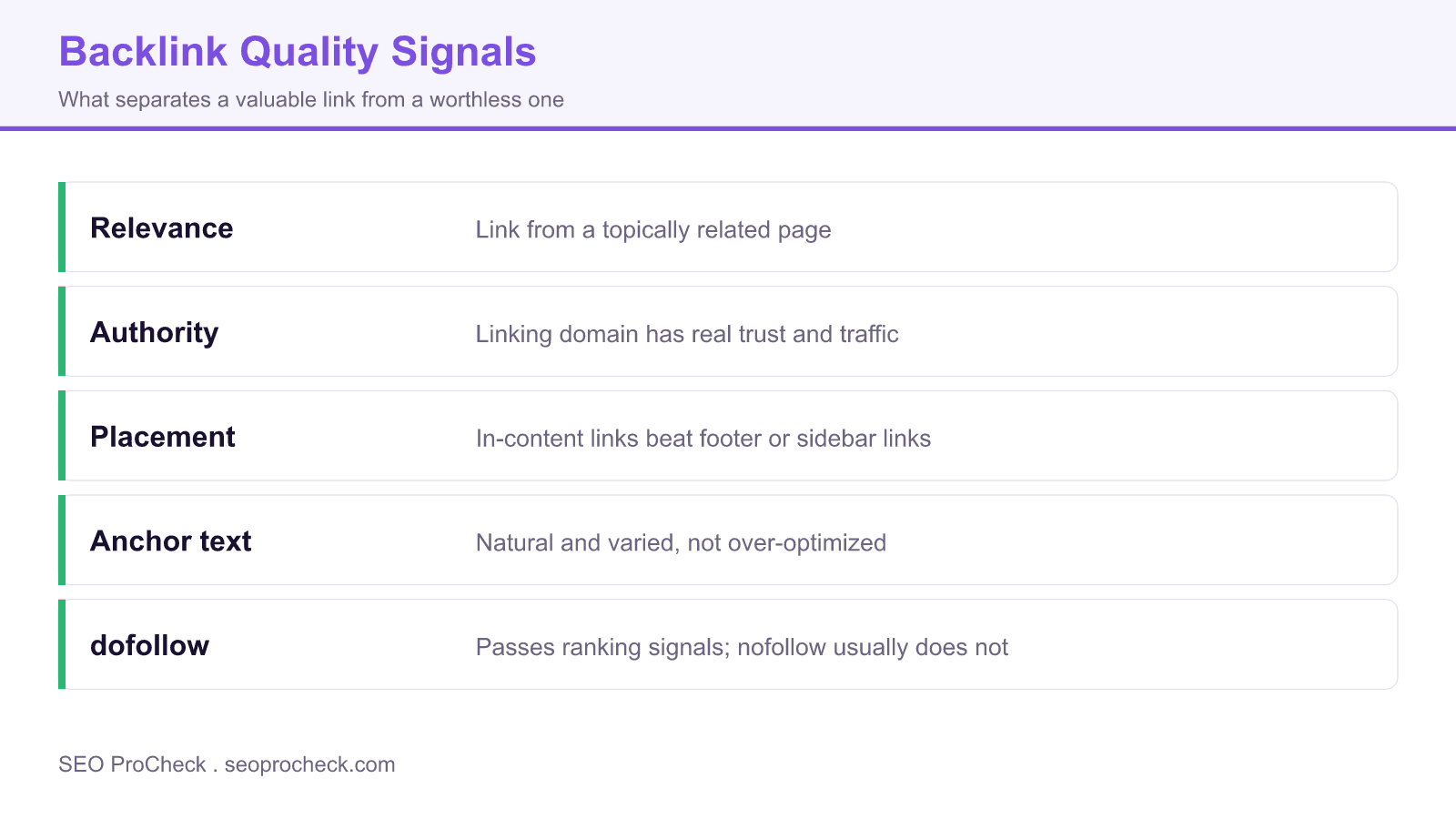
- Relevance and authority of the linking page outweigh raw link counts.
- In content editorial links pass more value than footer, sidebar, or author bio links.
- Keep anchor text natural and varied, since exact match anchors at scale look manipulative.
- Avoid buying dofollow links, large scale exchanges, and private blog networks.
Complete guide to link building for SEO. How backlinks work, ethical link building strategies, outreach methods, and avoiding tactics that can harm your site.
Table of Contents
Link Building Basics
What are backlinks?
Links from other websites pointing to your site. Also called inbound links or external links. Backlinks act as votes of confidence, signaling to search engines that others find your content valuable. One of Google's most important ranking factors since the beginning.
Why do backlinks matter for SEO?
Backlinks pass authority (link equity) to your site. Pages with more quality backlinks typically rank higher. Links from authoritative sites carry more weight. Google's PageRank algorithm was built on link analysis. Links remain a top 3 ranking factor despite algorithm evolution.
What is link building?
The process of acquiring backlinks from other websites to improve search rankings. Includes creating link-worthy content, outreach to relevant sites, digital PR, and relationship building. Ethical link building focuses on earning links through value, not manipulation.
What's the difference between natural and built links?
Natural links: earned without direct effort because content is valuable. Built links: acquired through deliberate outreach, PR, or promotion. Google values both when legitimate. The best strategy creates content worthy of natural links while actively promoting it.
What's the difference between dofollow and nofollow links?
Dofollow links pass link equity (ranking value). Nofollow links include rel="nofollow" telling search engines not to pass equity. Google also has rel="sponsored" for paid links and rel="ugc" for user-generated content. Nofollow links still have value for traffic and brand awareness.
What is link velocity?
The rate at which you acquire new backlinks over time. Sudden spikes in link velocity can appear unnatural. Gradual, consistent growth looks more organic. Viral content naturally creates velocity spikes; otherwise, steady growth is preferable. Monitor but don't obsess.
Link Quality
Is link quality or quantity more important?
Quality, definitively. One link from a high-authority, relevant site outweighs hundreds of low-quality links. Low-quality links at scale can trigger penalties. Focus on earning links from reputable, relevant sources. Quality signals: domain authority, relevance, editorial placement, traffic.
How do I evaluate link quality?
Consider: domain authority/rating, topical relevance, site traffic, editorial standards, link placement (content vs footer), anchor text naturalness, linking page quality, and whether the site links to spam. Would you be proud to be associated with this site?
What is domain authority?
Moz metric (0-100) predicting ranking ability based on link profile. Ahrefs uses Domain Rating (DR), Semrush uses Authority Score. These are third-party estimates, not Google metrics. Useful for comparison but not exact measures of link value. Google doesn't use these numbers.
How important is link relevance?
Very important. Links from topically relevant sites carry more weight. A cooking site linking to your recipe is more valuable than a random link from an unrelated site. Relevance can be at domain level, page level, or content level. Seek links from your industry.
Does anchor text matter for backlinks?
Yes, anchor text provides context about the linked page. Natural anchor text distribution includes: branded, URL, generic ("click here"), and keyword-rich. Too many exact-match keyword anchors looks manipulative and can trigger penalties. Natural profiles are diverse.
Does link placement on a page matter?
Contextual links within content are more valuable than sidebar, footer, or navigation links. Links higher on the page may carry slightly more weight. Editorial links (naturally placed in articles) outperform boilerplate links repeated across sites.
Link Building Strategies
How does content marketing help link building?
Create content so valuable others naturally link to it. Data studies, original research, comprehensive guides, tools, and unique insights attract links. Content is the foundation; promotion amplifies reach. Without link-worthy content, outreach efforts struggle.
What are linkable assets?
Content specifically designed to attract links. Examples: original research and data, free tools and calculators, comprehensive guides, infographics, industry surveys, expert roundups. These provide unique value that other sites want to reference and cite.
What is digital PR for link building?
Earning links through newsworthy stories, data-driven content, and journalist relationships. Pitch stories to publications, create research reporters want to cite, respond to journalist queries (HARO, Terkel). Results in high-authority editorial links from news sites.
Is guest posting still effective?
Yes, when done properly. Write genuinely valuable content for relevant, quality sites. Avoid: low-quality "article mills", paying for guest post spots, irrelevant sites, or thin content. Focus on building relationships and providing value, not just extracting links.
What is broken link building?
Finding broken links on other sites, then offering your content as a replacement. Use tools to find 404 links on relevant sites. Create or identify content that serves as alternative. Reach out helpfully, offering to fix their broken link. Win-win approach.
What is resource page link building?
Finding curated resource pages in your niche and suggesting your content for inclusion. Search "keyword + resources" or "keyword + useful links". If your content genuinely fits, reach out suggesting addition. Works best with truly valuable, comprehensive content.
What is the skyscraper technique?
Find popular content with many backlinks. Create something significantly better: more comprehensive, updated, better designed. Reach out to sites linking to the original, suggesting your improved version. Requires genuinely superior content to succeed.
Outreach Methods
How do I do link building outreach?
Find relevant sites that might link to you. Find contact information (email, contact form). Send personalized message explaining why linking benefits them or their readers. Follow up once if no response. Focus on value proposition, not begging for links.
How important is personalization in outreach?
Critical. Generic templates get ignored or marked as spam. Reference specific content on their site. Explain genuine relevance. Show you've actually read their work. Personalization takes more time but dramatically improves response rates.
What makes a good outreach email?
Short and clear. Personalized opening referencing their work. Quick explanation of your content and why it's relevant to their audience. Clear but soft ask. No attachments. Professional signature. Easy to skim. Respect their time.
Should I follow up on outreach?
One follow-up is acceptable, typically 5-7 days later. Brief and polite. After two attempts with no response, move on. Don't pester. Some people simply won't respond; that's normal. Maintain professionalism for potential future opportunities.
How does relationship building help link building?
Long-term relationships yield ongoing link opportunities. Engage on social media, comment helpfully on blogs, collaborate on content, meet at conferences. When you have genuine relationships, link requests feel natural rather than cold outreach.
What to Avoid
Is buying links safe?
No. Google explicitly prohibits buying links for SEO. Paid links should use rel="sponsored" or "nofollow" attributes. Buying links that pass PageRank can result in manual penalties. Risk rarely worth reward. Focus on earning links legitimately.
What are link schemes?
Any attempt to manipulate rankings through links: buying/selling links, excessive link exchanges, automated link building, PBNs (private blog networks), link farms, article spinning networks. Google penalizes sites participating in link schemes. Not worth the risk.
What is a PBN and why should I avoid it?
Private Blog Network: network of sites owned to create backlinks to money site. Google actively hunts PBNs and penalizes sites using them. Footprint detection has improved significantly. Temporary gains, permanent risk. Legitimate link building is safer long-term investment.
What are toxic backlinks?
Links from spammy, penalized, or low-quality sites that could harm your rankings. Signs: irrelevant sites, link farms, sites with thin/scraped content, suspicious anchor text patterns, foreign language sites you have no connection to, known spam domains.
Should I disavow bad links?
Only if you have clear toxic links and have received or expect a manual action. Google largely ignores low-quality links automatically. Disavowing good links by mistake hurts rankings. Most sites never need to disavow. Use sparingly and carefully.
Can competitors hurt me with bad links?
Unlikely. Google claims to ignore obviously spammy links rather than penalize victims. "Negative SEO" via link spam rarely works. If you notice suspicious link patterns, monitor Search Console for manual actions. Disavow only if actually penalized.
Link Analysis
How do I analyze my backlink profile?
Use Ahrefs, Semrush, or Moz to see your backlinks. Review: total links and referring domains, domain authority distribution, anchor text distribution, new vs lost links, top linked pages. Compare against competitors. Identify gaps and opportunities.
How do I analyze competitor backlinks?
Enter competitor domains in backlink tools. See where they get links, what content earns links, and what strategies they use. Find opportunities: sites linking to them that might link to you. Understand what link-worthy content works in your industry.
What is a link gap analysis?
Comparing your backlink profile to competitors to find sites linking to them but not you. These are proven link opportunities; the site already links to similar content. Prioritize gaps from relevant, high-quality sites. Tools automate this comparison.
How do I track new backlinks?
Set up alerts in Ahrefs, Semrush, or Google Alerts for brand mentions. Monitor Search Console Links report (though delayed and sampled). Regular backlink audits. Track outreach campaign results. Knowing what earns links informs future strategy.
Why do I lose backlinks?
Common reasons: linking page deleted or changed, site went offline, CMS migration broke links, webmaster removed link, link rot over time. Some loss is natural. Monitor significant losses from valuable sources. Reach out to recover important lost links when possible.
Quick reference table
Tactics fall on a spectrum from earned to manipulative, and the risk rises as you move down the table. Use a permanent 301 to preserve link equity when URLs move, as explained in our redirects and HTTP status codes FAQ, understand how the nofollow attribute changes what a link passes in our meta robots and X-Robots-Tag reference, and browse related tactics in the off page SEO FAQ.
| Tactic | Category | Risk level |
|---|---|---|
| Editorial and earned links | White hat | Safe |
| Digital PR and data studies | White hat | Safe when genuinely newsworthy |
| Guest posts on relevant sites | White hat | Safe when editorial and not paid |
| Resource page and broken link outreach | White hat | Safe |
| Paid dofollow links | Against Google guidelines | Manual action risk |
| Large scale link exchanges | Against Google guidelines | Penalty risk |
| Private blog networks (PBNs) | Black hat | High penalty risk |
Frequently Asked Questions
Relevance and trust come first: a link from a topically related page on an authoritative site is worth far more than many links from unrelated or low quality pages. Placement inside the main content and natural anchor text add value. One strong editorial link can outweigh dozens of weak ones.
A dofollow link passes ranking signals to the target, while a nofollow link tells search engines not to pass that endorsement. Google now treats nofollow, sponsored, and ugc as hints rather than strict rules. A natural profile contains a healthy mix of both.
Yes. Paying for links that pass ranking signals violates Google guidelines and can trigger a manual action or algorithmic suppression. If you pay for a link for advertising or sponsorship, mark it with the sponsored or nofollow attribute so it does not pass value.
Anchor text helps search engines understand what the linked page is about, so it carries weight. The risk is over optimization: many exact match commercial anchors pointing at one page look manipulative. Aim for a natural mix of branded, URL, and descriptive anchors.
Yes, when they are genuinely editorial and placed on relevant sites for real readers. Guest posting purely to drop optimized links at scale is against guidelines and loses value fast. Focus on sites where the audience overlaps with yours.
Audit your backlinks with a tool that flags spammy or unnatural patterns, then review them manually before acting. Most low quality links can be ignored, since Google discounts them automatically. Reserve the disavow file for clear manipulation tied to a manual action.
Take this with you
The assistant links open with a question about this page already written. Nothing is sent until you press enter.
Claude Vincent is a technical SEO consultant focused on crawlability, rendering, and AI-search visibility. He writes the field guides and case studies at SEO ProCheck, with a bias toward the durable, unglamorous work that decides whether search engines and AI answer engines can actually read and cite a site.
About SEO ProCheck
Technical SEO consulting and GEO strategy with 20 years of enterprise experience. Case studies, resources, and tools for search and AI visibility.
Work With Me
Technical SEO audits, GEO strategy, site migrations, and international SEO. Hourly consulting for teams who need hands-on support, not just reports.
Subscribe to our newsletter!








Recent Posts
- Most Top Sites Never Say Who They Are in Structured Data October 14, 2026
- Homepage Titles Are Mostly Too Short, Not Too Long October 8, 2026
- Who Actually Serves an llms.txt? 184 Top Sites Measured September 29, 2026