

AI Summary
SEO ROI measures the revenue or valued leads earned from organic search against everything you spent to earn them, expressed as a percentage. A credible figure isolates the organic channel, values conversions from real CRM or cart data, counts the full cost, and states its attribution and time lag assumptions out loud.
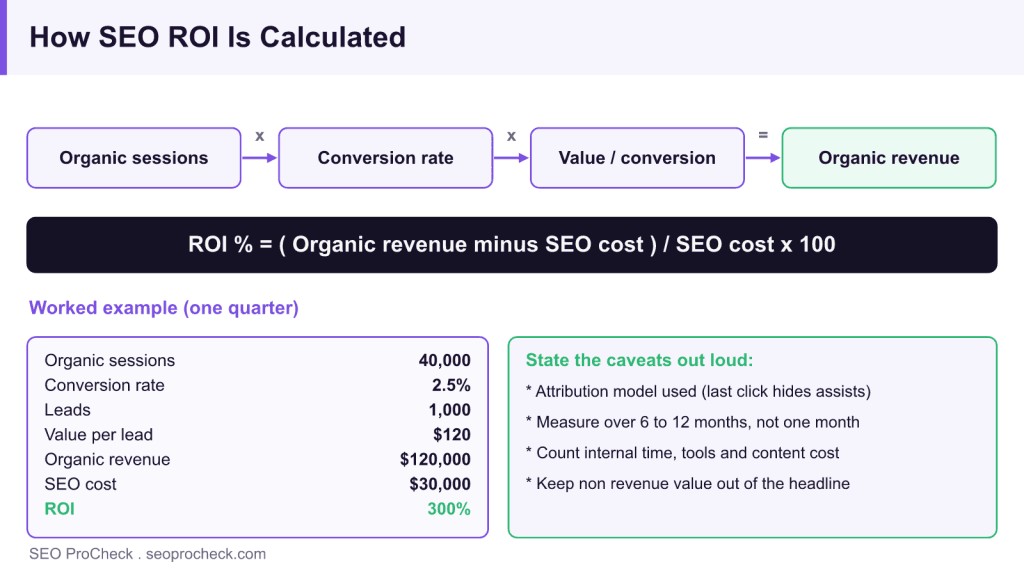
- Formula: ROI percent equals organic revenue minus SEO cost, divided by SEO cost, times 100.
- Value leads by average deal value times close rate; use actual revenue for ecommerce.
- Measure over 6 to 12 months because SEO returns compound with a lag.
- A number with honest caveats survives finance scrutiny; a suspiciously clean one does not.
What SEO ROI means
SEO ROI is the return you get for what you spend on organic search, revenue (or leads valued in money) generated by organic traffic, set against the cost of the people, tools, and content that produced it. The stakes are budget: without a defensible ROI number, SEO is the first line cut when finance goes looking, no matter how well it's working.
The honest version of this number comes with caveats, and pretending otherwise gets you caught. SEO is slow, its results compound, and attribution is genuinely messy. A credible ROI story owns those limits instead of hiding them behind a suspiciously clean figure.
A defensible ROI formula
Start from traffic and work toward money, so every input is one you can point to a source for:
Organic revenue = organic sessions × conversion rate × value per conversion

ROI %           = (organic revenue − SEO cost) ÷ SEO cost × 100
Worked example for a lead-gen site over a quarter:
Organic sessions        =  40,000   (GA4, organic channel)
Conversion rate         =  2.5%     (GA4 goal completions ÷ sessions)
Leads                   =  1,000
Value per lead          =  $120     (avg deal value × close rate, from the CRM)
Organic revenue         =  $120,000

SEO cost (the quarter)  =  $30,000  (retainer + tools + content)
ROI                     =  ($120,000 − $30,000) ÷ $30,000 × 100  =  300%
For ecommerce, swap "leads × value per lead" for actual transaction revenue from analytics, you don't have to model conversion value because the cart already did. The formula is the same; the source of "value" just changes.
ROI inputs, where the number comes from, and the caveat
| Input | Where you get it | Caveat to state out loud |
|---|---|---|
| Organic sessions | GA4 / analytics, organic channel | Excludes brand searches driven by other channels, some "organic" is really PR or ads |
| Conversion rate | Analytics goals / ecommerce tracking | Last-click hides SEO's assist role in earlier touches |
| Value per conversion | CRM close rate × deal size, or cart revenue | Averages hide huge variance between deal types |
| Assisted conversions | Multi-touch / data-driven attribution model | Every attribution model is a defensible guess, not truth |
| SEO cost | Retainer/salaries + tools + content spend | Easy to under-count internal time; include it |
| Time lag | Trend of sessions/revenue over 6 to 12 months | Today's revenue came from work done months ago |
| Non-revenue value | Brand lift, email signups, reduced paid spend | Real but harder to defend, keep it separate from the headline |
How to calculate SEO ROI, step by step
- Isolate organic. Pull sessions and conversions from the organic channel in analytics so you're not crediting SEO for other channels' work.
- Assign a value per conversion. For ecommerce, use actual revenue. For leads, multiply average deal value by close rate from the CRM to get a real per-lead figure.
- Total the true cost. Add retainer or salaries, tools, and content production, including internal time people forget to count.
- Run the formula. (Organic revenue − cost) ÷ cost × 100. That's your headline ROI.
- Apply an attribution model. Check whether a data-driven or multi-touch model materially changes the picture versus last-click, and report which model you used.
- Account for lag. Frame results over 6 to 12 months; matching this month's spend to this month's revenue makes early SEO look like a loss when it's just early.
- State the caveats. Name the attribution assumptions and what's excluded. A number with honest limits survives scrutiny; a perfect one doesn't.
Common mistakes and how to fix them
- Matching this month's cost to this month's revenue. SEO invested now pays out later, so this makes it look unprofitable. Fix: measure over 6 to 12 months and show the trend.
- Last-click tunnel vision. Crediting only the final touch erases SEO's role in earlier research visits. Fix: look at assisted conversions and a multi-touch model.
- Undercounting cost. Leaving out internal salaries and tool spend inflates ROI. Fix: include every real input, not just the invoice.
- Reporting traffic as if it were value. "Sessions up 40%" means nothing to finance. Fix: convert to revenue or valued leads.
- A too-clean number. Presenting one perfect figure with no caveats reads as spin. Fix: state your attribution model and what's excluded up front.
Frequently asked questions
What's a good SEO ROI?
It varies by industry and margin, but because organic traffic has no per-click cost, mature SEO programs often return several times their spend once content and authority compound. The honest answer is "positive and growing over time," measured against your own baseline rather than a universal benchmark.
How long until SEO shows positive ROI?
Commonly six to twelve months in competitive spaces. Early on you're investing ahead of returns, so ROI can look negative before the compounding kicks in. Set that expectation before you start.
How do I handle attribution for SEO?
Accept that it's imperfect and be transparent about your model. Last-click undercounts SEO's assist role; a data-driven or multi-touch model gives a fuller picture. State which you used so the number is defensible.
How do I value organic conversions for a lead-gen business?
Multiply your average deal value by your lead-to-customer close rate to get a realistic value per lead, sourced from the CRM. That turns "1,000 leads" into a dollar figure finance can act on.
Should I count non-revenue benefits?
Track them, but keep them out of the headline ROI. Brand lift, email signups, and reduced paid spend are real value that's harder to defend numerically, report them alongside the core revenue figure, not baked into it.
Related reading
Claude Vincent is a technical SEO consultant focused on crawlability, rendering, and AI-search visibility. He writes the field guides and case studies at SEO ProCheck, with a bias toward the durable, unglamorous work that decides whether search engines and AI answer engines can actually read and cite a site.
About SEO ProCheck
Technical SEO consulting and GEO strategy with 20 years of enterprise experience. Case studies, resources, and tools for search and AI visibility.
Work With Me
Technical SEO audits, GEO strategy, site migrations, and international SEO. Hourly consulting for teams who need hands-on support, not just reports.
Subscribe to our newsletter!






Recent Posts
- Can AI Crawlers Actually Read Your Site? I Measured 400 of the Biggest September 5, 2026
- The Pre-Publish Quality Gate for AI-Assisted Content August 6, 2026
- AGENTS.md vs llms.txt vs llms-full.txt: Which Agent File Does What July 18, 2026