


AI Summary
First link priority is the contested idea that when a page links to the same URL more than once, Google counts only the first link and its anchor text. Google has never confirmed it, so treat it as a hypothesis to hedge against cheaply by making your descriptive link the first one in the HTML source.
- The theory comes from small, old SEO experiments that later tests failed to reproduce cleanly.
- It concerns DOM source order, not the visual order on screen.
- Risk: a generic nav anchor placed first outranks your keyword rich body anchor.
- Fix cheaply, do not rebuild your whole navigation around an unconfirmed effect.
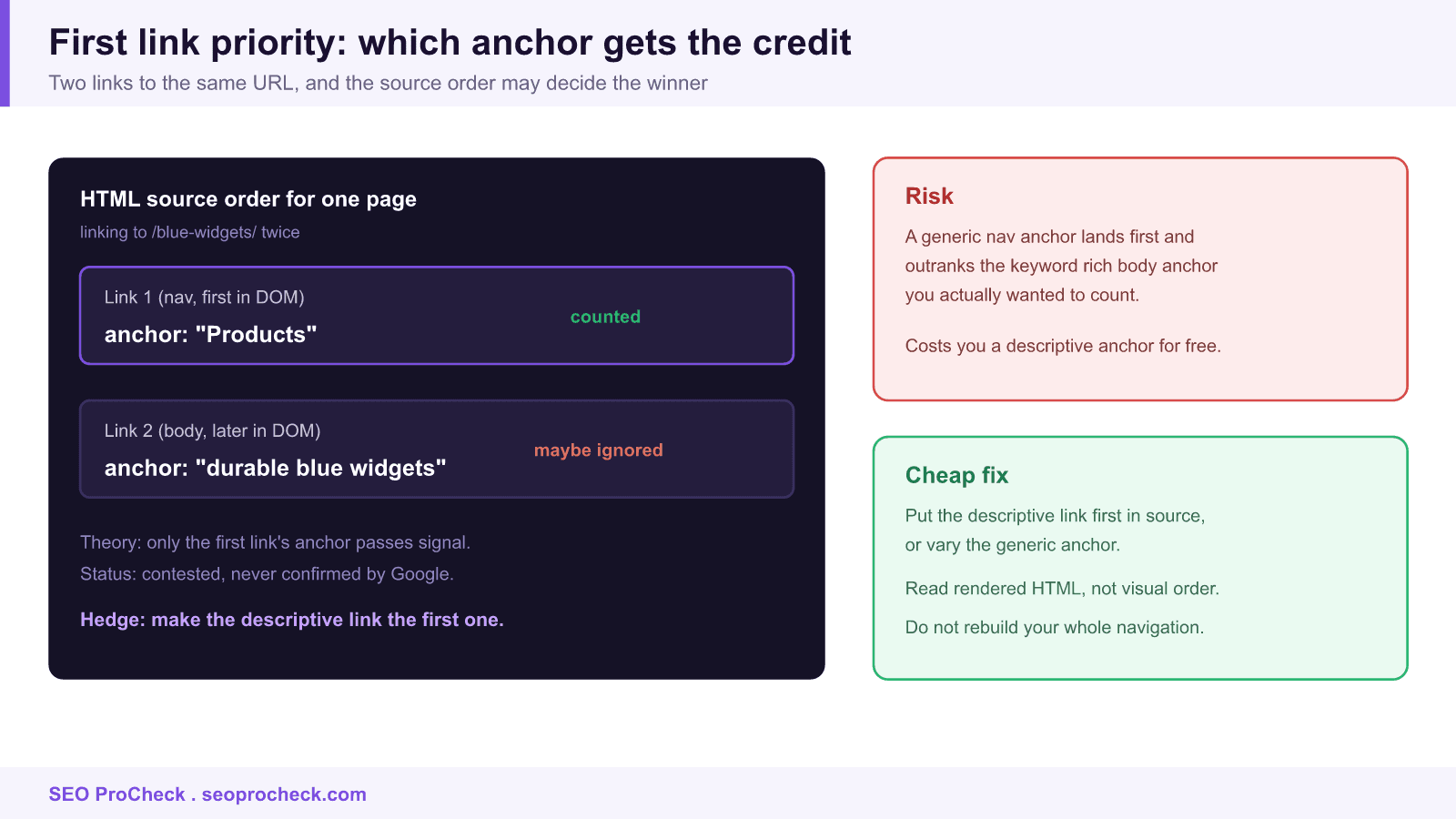
What first link priority claims
First link priority is the long-debated idea that when a page links to the same destination URL more than once, Google only counts the first link, so the first link's anchor text is the one that "wins" and passes signal. It matters because if it's true, a navigation link that says "Home" or "Products" could override the descriptive anchor text you carefully placed in your body copy further down the page.
Be honest about the status of this one: it's an old, contested notion drawn from small-scale SEO experiments, not something Google has officially confirmed. Results have varied across tests and across years, and the algorithm has changed enormously since the experiments that made it famous. Treat it as a hypothesis to design around defensively, not a law.
A real example
Imagine a page that links to /blue-widgets/ twice. The header nav links to it with the anchor "Products." Two-thirds of the way down the body, you link to it again with the anchor "durable blue widgets for outdoor use." Under strict first-link-priority, Google credits only "Products", a generic anchor, and ignores the keyword-rich one you actually wanted to count.
The classic 2008 to 2014-era experiments (Rand Fishkin and others ran versions of this) suggested the first link's anchor was the one that mattered. Later tests muddied that picture, and some found both links could contribute in certain setups. Nobody has produced a clean, repeatable, current result that settles it, which is exactly why you should stop trying to win the argument and just structure pages so it can't bite you.
Where the theory holds up and where it doesn't
| Aspect | What the theory says | Honest assessment |
|---|---|---|
| Which link counts | Only the first link to a given URL | Never officially confirmed by Google |
| Which anchor passes | The first link's anchor text | Supported by some old tests, contradicted by others |
| Nav links vs. body links | Nav (usually first) overrides body anchors | Plausible, but test-dependent and possibly outdated |
| Evidence quality | Established SEO "fact" | Small samples, old, not reproduced cleanly at scale |
| Practical risk | Wrong anchor gets credited | Real enough to design around, cheaply |
| Modern relevance | Still fully applies | Uncertain; Google's link handling has changed a lot |
Because your best anchor text is a real ranking input, the smart move is to make your descriptive link the first one Google meets, then it doesn't matter whether the theory is fully true. This is just careful internal linking hygiene.
How to check and hedge against it
- Find pages that link to the same URL more than once. A site crawler (Screaming Frog, Sitebulb) can export all internal links with their anchors and destinations.
- For each duplicate-link case, check the source order in the HTML, not the visual order. Navigation and header links usually appear first in the DOM.
- Spot the mismatches: a generic nav anchor ("Home," "Learn more") landing before your descriptive body anchor to the same page.
- Where it's easy, make the descriptive link appear first in the source, or vary the generic one so you're not banking a bad anchor.
- Don't contort your templates over it. If the fix means gutting your navigation, it isn't worth it, the effect, if real, is minor.
- Re-run the crawl after changes and confirm your important destinations get a strong descriptive anchor early in the source order.
Common mistakes and how to fix them
- Treating it as confirmed fact. People rebuild whole navigations around a theory Google never validated. Fix: hedge cheaply, don't over-engineer, and spend the real effort on link relevance and page quality.
- Confusing visual order with source order. First-link tests are about DOM order, not what looks first on screen. Fix: read the rendered HTML source to see which link Google meets first.
- Wasting keyword anchors on second links. If a page already links to a URL from the nav, your great body anchor may be redundant under the theory. Fix: put the descriptive anchor first, or link to a different relevant page instead.
- Stuffing multiple keyword links to the same page. Piling on links to force anchor text looks manipulative and helps nothing. Fix: one strong, relevant link beats five forced ones.
- Ignoring it entirely on huge templated sites. At scale, a systematic nav-anchor problem repeats across thousands of pages. Fix: audit the template once; a single fix propagates everywhere.
FAQ
Is first link priority a confirmed Google ranking behavior?
No. Google has never officially confirmed it. It comes from third-party experiments, some old and some contradicting each other. Design around it defensively, but don't cite it as settled fact.
Does it apply to internal or external links?
The original tests focused on how anchor text passes, which is relevant to both. In practice you have the most control over internal links, so that's where hedging is cheap and worthwhile. For external links you can't reorder someone else's page anyway.
If I link to a page twice, which anchor should I make descriptive?
Make the first one in the HTML source descriptive, since that's the anchor the theory says gets credited. If the first link is a fixed nav item you can't change, don't lose sleep over the second link, just keep it relevant.
Should I remove duplicate links to the same page?
Not for this reason alone. Duplicate links are usually fine and often useful for readers (a nav link plus a contextual body link). Only tidy them up if a generic anchor is clearly displacing a much better descriptive one and the fix is easy.
Is this worth spending time on in 2026?
A little, on large templated sites where one navigation pattern repeats across thousands of pages. For a small site, it's a footnote, put your effort into content quality, relevance, and a clean overall link structure instead.
Related terms: anchor text and the internal linking guide.
Take this with you
The assistant links open with a question about this page already written. Nothing is sent until you press enter.
Claude Vincent is a technical SEO consultant focused on crawlability, rendering, and AI-search visibility. He writes the field guides and case studies at SEO ProCheck, with a bias toward the durable, unglamorous work that decides whether search engines and AI answer engines can actually read and cite a site.
About SEO ProCheck
Technical SEO consulting and GEO strategy with 20 years of enterprise experience. Case studies, resources, and tools for search and AI visibility.
Work With Me
Technical SEO audits, GEO strategy, site migrations, and international SEO. Hourly consulting for teams who need hands-on support, not just reports.
Subscribe to our newsletter!








Recent Posts
- Most Top Sites Never Say Who They Are in Structured Data October 14, 2026
- Homepage Titles Are Mostly Too Short, Not Too Long October 8, 2026
- Who Actually Serves an llms.txt? 184 Top Sites Measured September 29, 2026